

YOUNG PEOPLE SAFEGUARDING THE FUTURE OF OUR CITIES
04 August 2026
The sun had not yet risen high over the horizon of Kupang City, yet sweat was already pouring down in the yard of a house that morning. On ground that had hardened and cracked from the dry season, a group of young people wearing blue vests bearing the Plan Indonesia logo busily divided up their tasks.
Taking turns, they drove crowbars into the ground, dug holes to install biopore pipes, and then filled them with organic waste. It was a small effort to “save” water in the midst of a dry season that showed no sign of ending. Derven Dwiky (20), one of the young people participating in the activity, set down his crowbar and wiped his hands on his jeans. Sweat still covered his forehead.
With great pride, he shared how proud he was to be involved in the activity. Their exhaustion was well worth it because today’s action was an investment in improving the future of Kupang City.
Installing biopores is one component of Plan Indonesia’s CERAH Program, which places young people, women, and personswith disabilities at the forefront of efforts to protect water and land resources.
Through capacity strengthening, environmental campaigns, and involvement in decision-making processes, young people are encouraged to become leaders capable of building a future that is more inclusive, healthier, and more resilient to climate change.
These biopore infiltration holes are expected to provide a solution for restoring groundwater reserves while also reducing waterlogging and preventing floods.
“Kupang is indeed hot and dry, but that’s exactly why we have to take action. If not us, then who will protect it?” said the student from Kupang State Polytechnic of Agriculture (Politani).
Derven has only been actively involved in the CERAH Program over the past year. Nevertheless, the impact they have experienced has been tremendous. Together with other young people, he has learned about the water cycle, land degradation, and how biopores work. Beyond that, Derven has also strengthened his skills in campaigning and advocacy through training initiated by the CERAH Program.
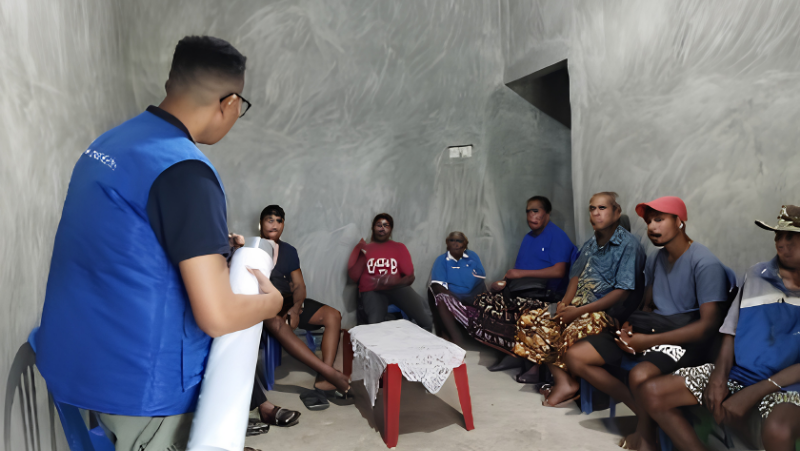
Today, he has become one of the young facilitators who teaches the same techniques to residents and other young people in urban villages. “As young people in the CERAH Program, we don’t just learn—we also take direct action,” he said proudly.
The active involvement of young people like Derven has gradually, but steadily, brought about tangible change. The people of Kupang City are now beginning to recognize the importance of biopores in creating a better quality of life.
“At first I thought this was just an ordinary activity. But after learning that these small holes can save water and make the soil more fertile, it feels completely different,” said Mrs. Dorti, a resident of Batu Kadera Urban Village.
Previously, the term biopore was still unfamiliar to many residents of Kupang City, East Nusa Tenggara (NTT). However, over the past few months, thanks to the CERAH Program initiated by Plan Indonesia, installing biopores has become almost a civic responsibility for every resident.
Kupang City itself faces a serious challenge in accessing clean water. During the rainy season, rainwater flows directly into the sea. Then, when the dry season arrives, household wells run dry. Clean water becomes scarce and expensive.
Data from the Kupang City Environmental Agency show that green land cover continues to shrink as urban development accelerates. Land that once functioned as a water catchment area has been transformed into dense residential areas and asphalt roads. As a result, rainwater has no opportunity to infiltrate the soil; instead, it pools briefly before flowing directly into the sea.
Biopores offer one simple yet effective solution. These small holes, measuring 10–30 centimetres (cm) in diameter and 50–100 cm in depth, are filled with organic waste, which is then decomposed by soil microorganisms. This process creates natural pores that help water infiltrate the soil while also improving soil fertility.
Young People Become an Important Part
In the CERAH Program’s biopore education activities, young people are not only participants. They are also encouraged to take an active role in creating biopore infiltration holes as one of the solutions to this long-standing problem facing the capital of East Nusa Tenggara. Juliani Talan, Plan Indonesia’s Program Lead for Kupang City, explained that the involvement of young people is not without reason. They were chosen because of the strategic role of youth as the next generation and agents of social change. “Through the CERAH Program, we promote the fulfilment of children’s rights and gender equality, while at the same time strengthening their capacity so that they are able to carry out sustainable water and land conservation actions for the future,” she said.
Since the programme began, at least a dozen urban villages in Kupang City have received education on biopores. Thousands of infiltration holes have been installed in school grounds, residents’ yards, and public spaces. Biopore education serves as a reminder that solutions to the environmental crisis do not always have to come in the form of sophisticated technology or massive projects. Sometimes, they come in the form of a small hole in the ground, young hands willing to get dirty, and a community that believes simple actions can produce real results. According to Juliani Talan, Provincial Coordinator of the CERAH Program, biopores are only the first step. She hopes that all stakeholders, including young people, will dare to go further by taking concrete action to conserve water. The government is also expected to demonstrate a strong commitment through policies that support consistent implementation. Meanwhile, the Integrated Water Resources Management Forum can serve as a collaborative platform where stakeholders support one another to ensure that the community’s water needs are met fairly and sustainably.


