

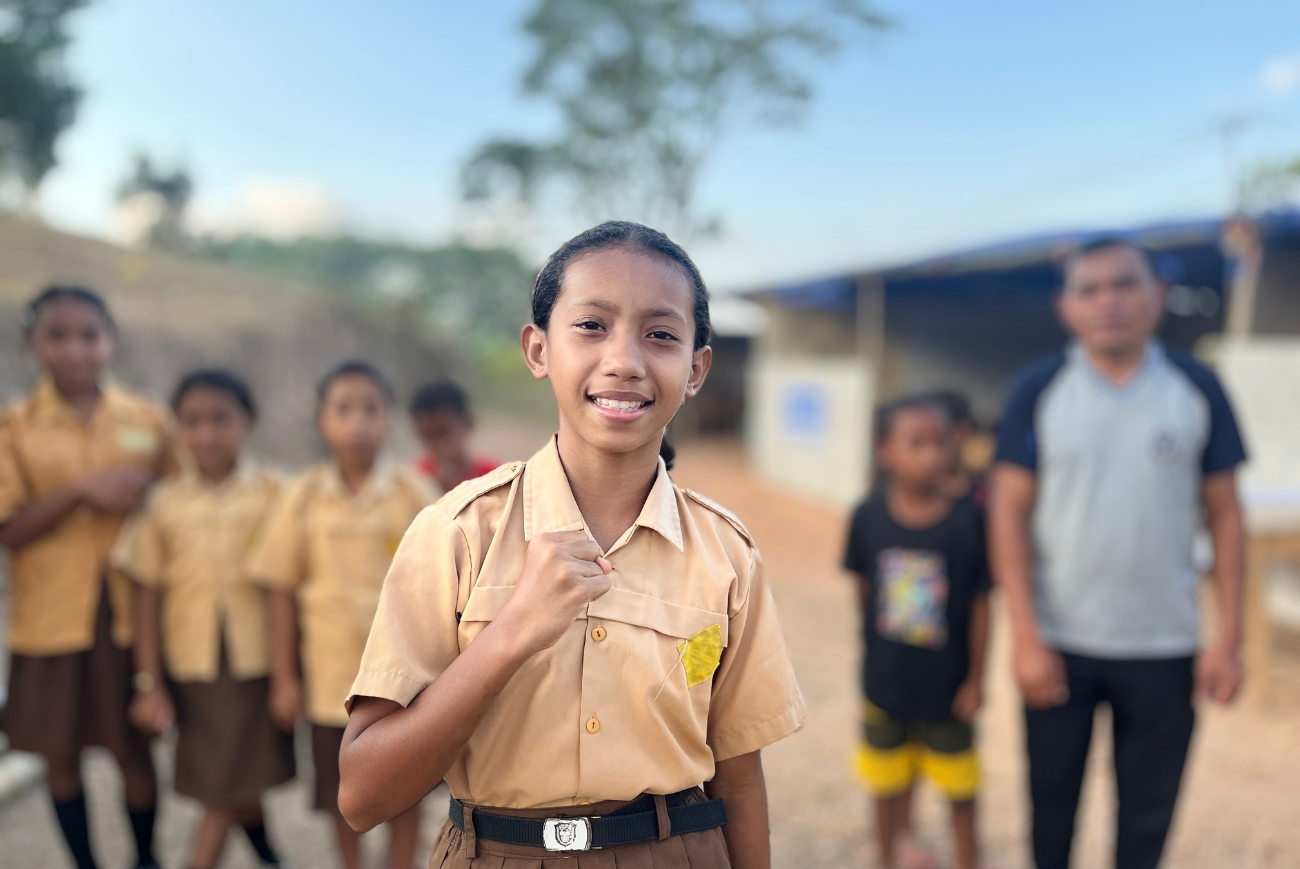
Under a Tarpaulin Roof, Novela Chases Her Dreams Once Again After the Flores Earthquake
11 September 2026
That morning, August 15, was supposed to be just another ordinary day for 11-year-old Novela and her friends. She is a primary school student in a small village in Manggarai Regency, Flores. Like many children her age, she started her morning by helping her parents fetch water before getting ready for school.
However, in a matter of seconds, that routine turned into an experience she will never forget.
“At that time, I was scooping water and getting ready for school. Suddenly, the earthquake happened. I immediately ran away from the water tank because I was scared,” she recalled.
The powerful magnitude 7.7 earthquake that struck the Flores region and several parts of East Nusa Tenggara sent residents panicking into the streets. Numerous buildings suffered heavy damage, including public facilities and schools that served as daily spaces for children to learn and play.
For Novela, the earthquake did not just shake buildings; it halted her favorite activity: learning alongside her classmates.
For nearly two weeks following the disaster, teaching and learning activities were suspended because the school was no longer safe to use. Classrooms were damaged and required thorough safety inspections before anyone could enter.
“We couldn’t go to school for almost two weeks. I missed learning at school, playing with my friends, and seeing my teachers so much,” Novela said, her face reflecting her sadness.
For many adults, a school might simply be seen as a place of instruction. But for children like Novela, it is a crucial space to grow, dream, and experience community. Missing school for days left a heavy toll that was just as impactful as the visible physical destruction.
Yet, their determination to return to learning never faded.
Recognizing the urgent need to restore children’s right to education, teachers, parents, and community members joined forces to find a solution. By early September, they agreed to construct a temporary emergency school using materials available around the village.
Starting September 2, the school grounds echoed with activity once again. Bamboo was cut, support poles were raised, and tarpaulins were stretched out to form a temporary roof. Parents worked side by side with teachers to recreate a learning space for their children.
“The teachers and all the parents started working together to build an emergency school made of bamboo with a tarpaulin roof,” Novela shared.
Amid these limited resources, assistance began arriving from various groups dedicated to supporting affected children. Among the support received were tarpaulins used to build the temporary classrooms.
“So far, we have received tarpaulins from Plan Indonesia. Thank you so much to everyone who cares about us,” she added.
Now, even though it consists of simple bamboo structures topped with tarpaulins, the emergency school stands as a symbol of renewed hope. Under tarpaulin roofs that occasionally sway in the wind, children open their textbooks once more, listen to their teachers’ lessons, and write down their dreams.
The School Principal, Ardianus Suhardi Temot, expressed his appreciation for the support that allowed the school to resume lessons.
“We extend our deepest thanks to Plan Indonesia for their quick response and empathy toward our situation. The donation of six tarpaulins was extremely helpful in constructing the emergency school, enabling us to restart teaching and learning activities quickly,” he stated.
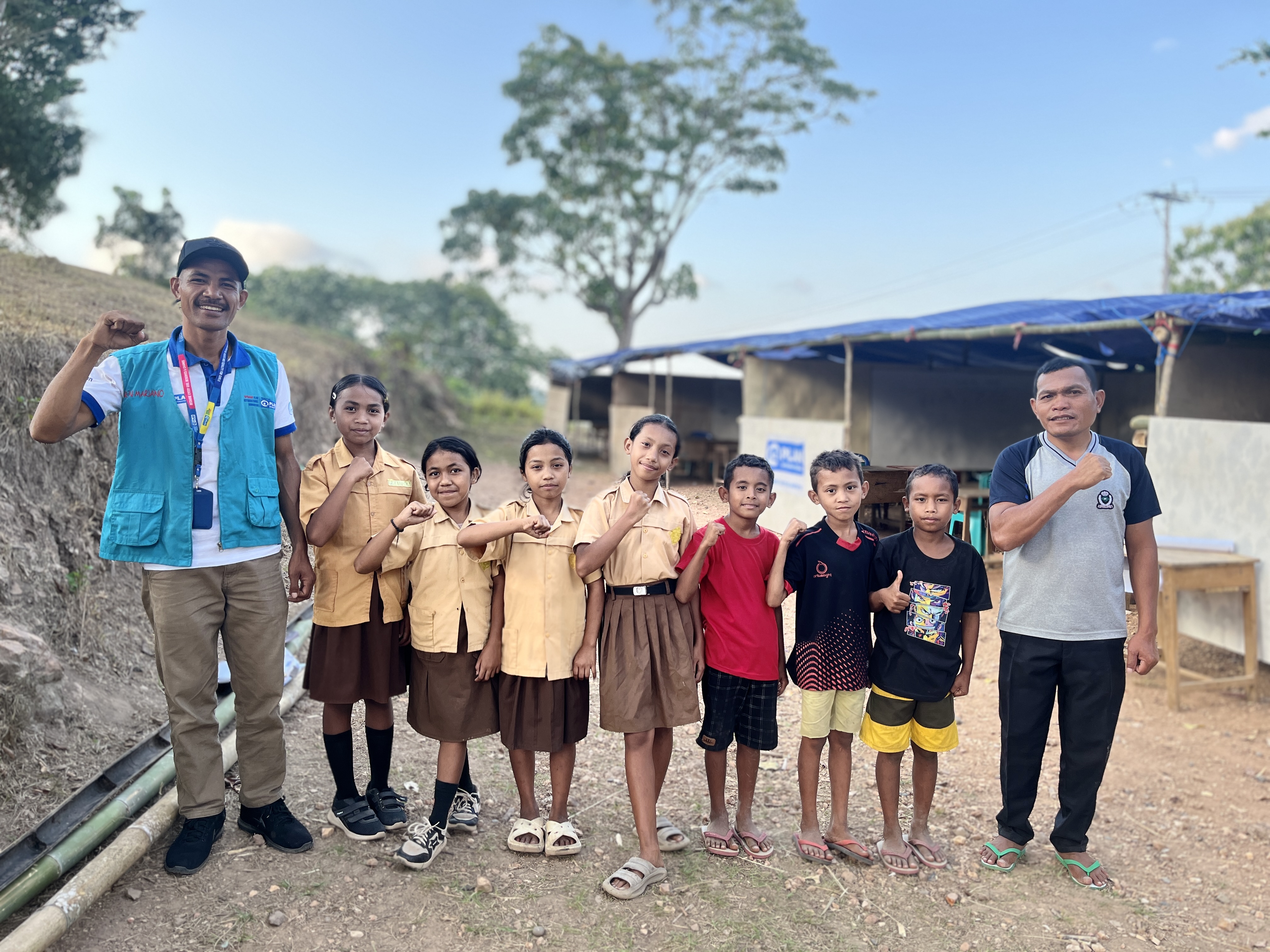
Despite this progress, challenges remain. Due to space constraints, the temporary facility cannot accommodate all students at the same time. To ensure every child still receives an education, the school implemented a shift system.
“For now, we only have three emergency classrooms, so learning activities must be rotated. Grades 1, 3, and 5 attend on Mondays, Wednesdays, and Fridays, while Grades 2, 4, and 6 attend on Tuesdays, Thursdays, and Saturdays,” Ardianus explained.
For the teaching staff, this arrangement is far from ideal. However, compared to leaving children without education for even longer, the emergency school is the best immediate solution.
Amid the post-disaster recovery, the children’s resilience has become a vital source of strength for the entire community. They continue to arrive at school with smiles, carrying salvaged textbooks, and sitting side by side in the simple classrooms built through collective effort.
Novela is among them. For her, being back at school—even under a tarpaulin—is a joy that is hard to put into words.
“I’m just really happy to be learning again,” she said simply, with a smile.
Novela’s story illustrates that post-disaster recovery is not merely about rebuilding physical structures; it is about restoring hope and a sense of security for children. When schools reopen, children regain their daily routines, re-engage with their peers, and receive the crucial emotional support needed after experiencing trauma.
In Flores, the road to full recovery remains long. Many schools and public services still require major repairs. However, the spirit of mutual cooperation among residents, the dedication of local teachers, and the ongoing support from humanitarian partners show that hope can always flourish, even in the most challenging times.
Under a simple tarpaulin roof, Novela and her classmates are back to spelling words, solving math problems, and nurturing their future ambitions. The earthquake may have damaged their school building, but it could not crush the determination of Flores’ children to keep learning and striving for a better tomorrow.


