

SUMBAWA HIJAU LESTARI: SPARKING HOPE FOR FOREST RESTORATION IN TANA SAMAWA
05 August 2026
Sumbawa Regency is one of the regions in West Nusa Tenggara (NTB) with an extensive forest area. Of its total area of 665,591.70 hectares (ha), approximately 59.08 percent, or 393,115.60 ha, is forest.
Geospatial data show that Sumbawa Regency’s Forest area consists of Protected Forest (45.50%), Limited Production Forest (34.74%), Permanent Production Forest (12.81%), and Conservation Areas (6.96%). This means that Sumbawa Regency is highly dependent on the condition of its forests.
Unfortunately, this green stronghold is in a critical condition due to illegal logging and the massive conversion of forest land. The latest data show that land classified as very critical covers 45,054 hectares (6.77%), critical land covers 113,564 hectares (17.06%), and potentially critical land reaches 148,947 hectares (22.38%).
The impacts of this degradation have been profoundly felt by local communities. Every year, the people of Sumbawa are now confronted with floods, landslides, and extreme drought. These conditions pose a major challenge to the sustainability of development in West Nusa Tenggara (NTB), particularly in Sumbawa Regency. Various efforts are now being undertaken to restore the degraded environment. One such initiative is the Sumbawa Hijau Lestari (Sustainable Green Sumbawa) programme, introduced by Regent Ir. H. Syarafuddin Jarot, M.P.
Sumbawa Hijau Lestari is a strategic programme and a cross-sector collective movement aimed at addressing land degradation, combating environmental destruction, and restoring forest areas across Tana Samawa.
Included in the 2025–2029 Regional Medium-Term Development Plan (RPJMD) of Sumbawa Regency, the programme integrates robust ecological protection with efforts to improve community livelihoods through sustainable forest and land management practices.
Sumbawa Hijau Lestari is aligned with the National Medium-Term Development Plan (RPJMN), the Regional Medium-Term Development Plan (RPJMD) of West Nusa Tenggara (NTB) Province, and the global Sustainable Development Goals (SDGs). Sustainability lies at the heart of this development approach, which seeks to balance the social, economic, and environmental dimensions.
Five Pillars of Environmental Restoration
In implementing this programme, the Sumbawa Regency Government has adopted a five-pillar intervention framework to restore environmental conditions.
The first step focuses on forest protection and security through the establishment of a joint task force. Intensive patrols are conducted regularly in vulnerable areas such as Beringin Sila, Alas, Lenangguar, and Batulanteh.
Second, the programme implements restoration based on economically valuable crops. The Government no longer limits its efforts to planting conventional trees for greening purposes, but instead focuses on commodities with high market value, such as sengon, candlenut, porang, durian, mango, jackfruit, coffee, banana, and cashew. The potential area for cultivating these commodities reaches 186,809.64 hectares. These planting activities are carried out primarily in Areas for Other Uses (APL), which are located outside forest areas.
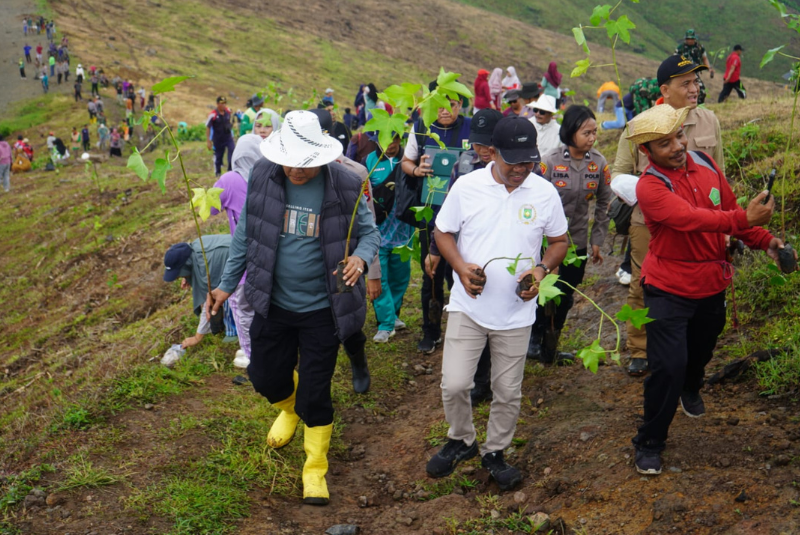
Third, the programme requires concrete action through the Safari Tree Planting Movement (Gerakan Safari Menanam Pohon). This movement brings together various segments of society through several mandatory sub-programmes, namely: One Civil Servant, One Tree; One Student, One Tree; One Employee, One Tree; and One Engaged Couple, One Tree, with the overarching target of planting one million trees across Sumbawa Regency. Fourth, the programme provides conservation incentives and rewards. Farmers who actively participate are granted full harvesting rights, free seedlings, and support for planting and maintenance costs. Community groups that successfully keep their trees alive will receive direct rewards in the form of livestock (cattle or chickens), as well as business capital.
Fifth, this pillar strengthens the scheme through cross-sector collaboration involving the active participation of non-government stakeholders.
Tangible Achievements of the Sumbawa Hijau Lestari Programme
From the perspective of law enforcement and field supervision, the Forest Protection and Security Task Force has thwarted various illegal logging activities in vulnerable areas such as the Batulanteh region. In addition, law enforcement has been strengthened through the issuance of Sumbawa Regent Circular Letter No. 500.4/263/Ekon-SDA/III/2026 concerning the Prohibition of Corn Cultivation in Forest Areas. This policy prohibits the cultivation of corn in protected forests, production forests, conservation forests, and Social Forestry areas.
The implementation of this regulation carries criminal sanctions, as it refers to Law No. 41 of 1999 on Forestry, as amended by Law No. 6 of 2023 on Job Creation.
As of April 2026, eleven rounds of tree-planting activities had been carried out through the Safari Sumbawa Tree Planting Movement and the One Student, One Tree Movement. Through these mass movements, more than 35,000 trees had been planted, while 264,645 timber and productive seedlings had been distributed evenly across all 24 districts.
Nevertheless, the evaluation report recorded an average post-planting survival rate of 42 percent, due to challenges posed by herbicide residue, pests, and conflicts arising from free-ranging livestock.
This environmental restoration initiative has also succeeded in building strong funding collaboration with the private sector and philanthropic organisations through the Corporate Social Responsibility (CSR) scheme. The mining sector led the contribution through PT AMNT, providing IDR 200 million for the construction of a Nursery Farm facility in Lunyuk District. This was followed by PT Bank NTB Syariah, which contributed IDR 150 million for a similar facility in Labuhan Badas. Additional support came from PT Sumbawa Jutaraya, which provided IDR 150 million for the Candlenut Festival and the procurement of avocado seedlings, while the philanthropic initiative Green Zakat Baznas contributed IDR 30 million to support the operational costs of the Safari Tree Planting Movement.
A New Synergy Through Plan Indonesia’s CERAH Programme
In view of the challenges in water governance and the continuing threat of drought, the multi-sector approach has been strengthened through a partnership with Plan Indonesia. This collaboration is being implemented through Plan Indonesia’s CERAH Programme, which runs from July 2025 to June 2028.
During the Kick-off Meeting of the CERAH Programme for Sumbawa Regency on 15 December 2025, Sumbawa Regent Syarafuddin Jarot stated that the programme represents a collective effort to protect river basins, restore the environment, and ensure the sustainability of water resources for the people of Sumbawa.
“This cross-sector collaboration is expected to become a concrete step towards building environmental resilience, supporting community economic and agricultural activities, and preventing disaster risks in the future,” he stressed.
The CERAH Programme specifically assumes a strategic role in the climate change adaptation pillar, focusing on integrated and sustainable watershed management through water and land governance.
For Plan Indonesia, forest restoration and sustainable water resources management are long-term investments for future generations. Healthy forests help maintain water availability, reduce disaster risks, and support a safe and healthy environment in which children and adolescents can grow and thrive.
Plan Indonesia’s presence enriches the Sumbawa Hijau Lestari programme ecosystem by strengthening the capacity of farmers in upstream, midstream, and downstream areas, while also promoting the inclusive participation of communities in planning environmental conservation programmes.
This synergy is reflected in the preparation of regional planning instruments, including support for the development of Village Action Plan documents for watershed management and the implementation of Thematic Development Planning Consultations (Musrenbang) on Integrated Water and Land Management.
A long-term blueprint has also been prepared through the “One Village, One Land” policy. Each village is encouraged to manage a designated area for cultivating high-value economic crops. The regional government is also planning downstream industrial development through the establishment of a sengon wood processing plant and the utilisation of candlenut shell waste as an environmentally friendly alternative energy source.
This cross-sector collaboration strengthens the Sumbawa Regency Government’s confidence that ecological restoration and economic growth can be achieved simultaneously.
Written by: Abdul Rohman | Editor: Annisa Hanifa


