

Stories from Mambalan Village: Empowering Cadres to Combat Stunting
05 October 2024
Improving parenting practices has become one of the key solutions in addressing children’s growth issues, particularly stunting. The role of the Posyandu (Pos Layanan Terpadu, village health services) cadres is crucial in encouraging changes in parenting behavior.
==
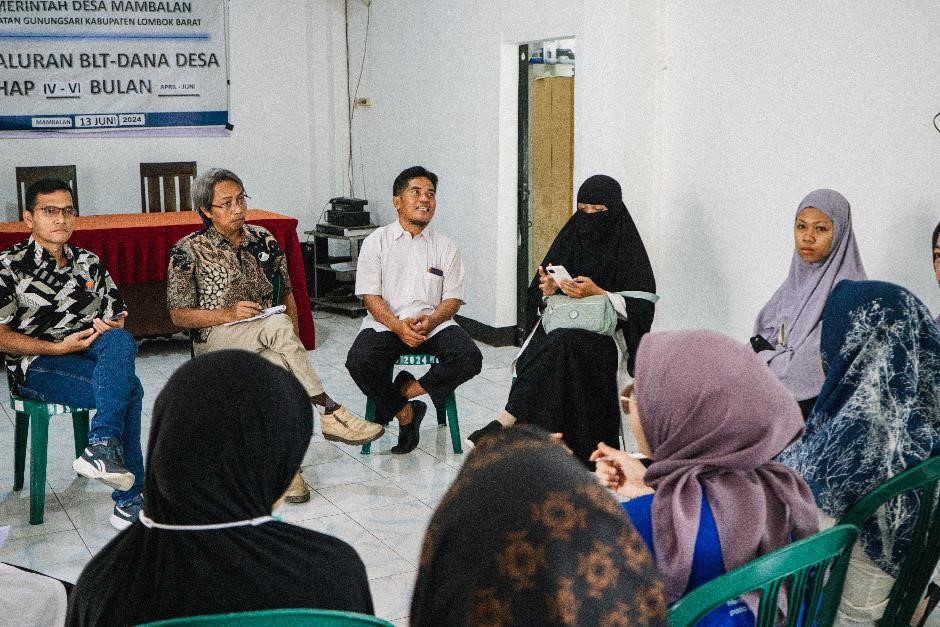
On the morning of June 26, Lalu Ahyar Supriadi, the Secretary of Mambalan Village, was deeply involved in a discussion regarding the implementation of parenting classes in his village. Several cadres, family planning educators (PKB)/family planning field officers (PLKB), representatives from Yayasan Plan International Indonesia (Plan Indonesia), young people, and Puskesmas (Pusat Kesehatan Masyarakat, community health center) staff participated in a meeting held at the village office hall. Various stakeholders gathered to coordinate and monitor the implementation of Plan Indonesia’s program, which focuses on improving the capacity of family planning cadres to prevent stunting (PARENTS).
In recent years, the Mambalan Village Government has been quite active in tackling stunting. Improving health services, particularly in addressing stunting, has become one of the village government’s priorities.
Lalu Ahyar Supriadi explained that the village government always remains open and transparent in health budget planning.
He is very grateful that Mambalan Village already has a Family Posyandu, which provides broader services, ranging from toddlers to teenagers and even the elderly. The Posyandu cadres and family planning educators in the village are also very active.
This condition motivates the village government to continue providing budget support. “In principle, any health-related needs in our village are always a priority for us,” said Lalu Ahyar Supriadi
He recognized that addressing stunting requires cross-sector collaboration. Therefore, the village government always coordinates with relevant stakeholders, including Plan Indonesia. Thus, all agencies understand their respective roles and responsibilities in dealing with stunting
“Today, the activities of the Posyandu Permata Hati Mambalan had already been communicated well in advance, so that everyone knows what needs to be done, whether it’s Plan Indonesia, the government, or the puskesmas,” he said.
“The key is integration so that the goals we want to achieve can be reached quickly, especially in tackling stunting,” he added.
For the parenting classes, the village government receives feedback and suggestions from the cadres and the community regarding their needs. The village government always strives to meet these needs.
This year, the parenting classes have been divided into four groups—two classes specifically for nutrition and two for pregnant women. “Whatever the health needs of our community, in principle, we always allocate the budget professionally and proportionally,” he said.
Professionally here means that the planning is done through proper stages, starting from village meetings, while proportionally means the budget is allocated according to the needs.
Regarding budget support from the village, he admitted that before 2017, the health budget was quite concerning.
Learning from that mistake, they have consistently increased the health budget every year. This year alone, they have allocated up to IDR 120 million for health matters, including activities such as bina keluarga (family development program), cadre meetings, and other operational needs.
Lalu Ahyar Supriadi acknowledged that the role of all parties is crucial, including the interventions carried out by Plan Indonesia in the village. The health policies have been highly beneficial, and now the enthusiasm of the villagers is very high.
“Our villagers’ enthusiasm is extraordinary in truly paying attention to the health of their babies and toddlers,” he said.
This is evident from the active participation of residents in Posyandu activities, especially now all Posyandu have become Family Posyandu, covering everyone from babies to the elderly. “This is due to the efforts of everyone involved, including Plan Indonesia. Our collaboration and coordination in the village always run smoothly,” he said.
Mandatory Training for Posyandu Cadres
Hilmiah, the Head of Welfare Section of Mambalan Village, said that every month, they regularly hold Family Posyandu sessions, which involve health checks for babies, toddlers, teenagers, and even the elderly.
Regarding collaboration with Plan Indonesia, she said it usually involves increasing the knowledge of the cadres and synchronizing the database to ensure assistance is accurately targeted.
Monthly training for the cadres is mandatory, especially for new cadres. They are given training to enhance their skills and capacities in the field. Besides mandatory training from the village, they also receive guidance from other stakeholders.
“From the village side, we provide mandatory training because they are new joiners. From uniforms, tools, and other necessities, we provide them from the beginning,” she said.
The impact of this training has been significant, especially in tackling stunting in Mambalan Village. One of the most notable improvements is in the quality of the database and the community’s enthusiasm for participating in Posyandu activities.
According to Hilmiah, the cadres are now more organized and very active within the community. Previously, the village government had difficulty recruiting cadres.
“Now, if we lack cadres, we can easily find those who fit the need. Before, it was hard to find people willing to work as cadres, but now we have many young cadres,” she said with a smile.
There are currently 42 cadres in Mambalan Village, actively involved in stunting prevention. Their interventions go beyond just toddlers, as they provide assistance to couples before marriage.
“They (the soon-to-be husbands and wives) are provided with assistance until they have children and as their children grow. Before they give birth, we hold pregnancy classes,” she concluded.
Why the PARENTS Program?
Sabaruddin, a representative of Yayasan Plan International Indonesia (Plan Indonesia) in West Nusa Tenggara (NTB), explained that the PARENTS program was initiated due to the high rate of stunting in Indonesia, including in NTB. Additionally, family participation in parenting classes remains low.
“In NTB, the numbers are still low, although there have been improvements from the NTB Provincial BKKBN (National Population and Family Planning Board) and the OPD-KB (Regional Family Planning Office). The interventions have shown significant progress, but there is still much work to be done. Specifically, we need to ensure that the interventions are beneficial in the long term, with sustainable behavior changes, so that no more stunted babies are born,” he said.
Nationally, the stunting rate in 2021 was recorded at 7.31%, while NTB’s rate in 2022 was 6.2%, showing improvement from previous years. This is why Plan Indonesia introduced the PARENTS project, which primarily aims to enhance the capacity of family planning educators in preventing stunting.
“The PARENTS program is a collaboration between Plan Indonesia and the government, contributing to complement the existing government interventions, particularly in the aspect of parenting and increasing the capacity of cadres for long-term stunting prevention. Plan Indonesia focuses more on preventive actions, one of which is encouraging families to adopt better parenting practices, so that parents have the capacity to prevent their children from becoming stunted,” he explained.
In Mambalan Village, Plan Indonesia has already conducted several activities. First, they carried out a baseline assessment of the village conditions. Then, they held capacity-building activities for cadres and young people, particularly on stunting awareness and its causes, including knowledge about the impact of child marriage on stunting, reproductive health, and sanitation and hygiene. “Next, we worked with the NTB BKKBN Representative to distribute parenting calendars. There are three types of parenting calendars: one for pregnant women, one for families with children aged 0-12 months, and another for families with children aged 13-24 months,” he explained.
After distributing the parenting calendars, Plan Indonesia collaborated with the NTB BKKBN Representative to hold training sessions for cadres on how to use the calendars.
Currently, Plan Indonesia is preparing two important documents in collaboration with BKKBN. First, they are developing the Parenting Advocacy Module for the First 1,000 Days of Life (HPK).
“This module has been trialed in Sumedang Regency, facilitated by the central BKKBN (Ditbalnak and Pusdiklat). It is now being finalized, with the next steps being master training, TOT (Training of Trainers) at the district level, and cadres training at the village level. We are targeting 50 cadres to be trained in each village, including Posyandu, BKB (Family Development Program), PKK (Family Welfare Empowerment Program), PAUD (Early Childhood Education Program) cadres, and young people, as well as involving male cadres or prospective male cadres” he explained.
The second document that Plan Indonesia and BKKBN are preparing is a prototype or approach to encourage parents to attend parenting classes in the village, whether integrated with or separate from the Posyandu. This prototype is part of the social behavior change communication effort to attract and encourage attendance at the parenting classes.
With this, it is hoped that the parenting classes will be effective and encourage the participation of fathers or male caregivers.


