

REVIVING THE HEARTBEAT OF BRANG REA FOREST THROUGH AGROFORESTRY
06 August 2026
Brang Rea Village, in Moyo Hulu District, Sumbawa Regency, holds a collective memory of fertile land nourished by abundant rivers. For centuries, its people lived in harmony with nature. The rivers flowed strongly and their waters were crystal clear.
Sadly, that beautiful picture is now only a memory. The river’s discharge has declined dramatically. Sapri, a local resident who now serves as Chairperson of the Brang Rea Village Consultative Body, remembers the changes vividly.
“If I compare the river today with what it was like when I was a child, the difference is enormous. Back then the river was full of water, with plenty of shrimp and fish. Now the water is shallow, and all that remains are water and rocks. The fish are gone,” Sapri recalled.
The drastic changes began to be felt around 2015. Since then, the river’s flow has continued to diminish. Irrigated rice fields have also been affected. As a result, farmers have been forced to rely on water pumps just to survive the second planting season.
The declining river discharge has been caused by forest degradation in the upstream area. Since 2020, large areas of forest have been convertedinto cornfields became massive. As a consequence, large trees were felled and the forest became barren. It did not take long for the ecological impacts to become evident. Once-fertile soil gradually eroded away, leaving behind little more than layers of exposed rock.
The situation reached its peak in 2023, when the environment could no longer absorb heavy rainfall because the watershed had lost much of its infiltration capacity. A devastating flash flood swept through the village within a matter of hours, leaving widespread destruction in its wake.
Dozens of homes were washed away, infrastructure was severely damaged, and residents suffered losses amounting to billions of rupiah after livestock, tractors, and agricultural machinery were carried downstream as far as the Batu Bulan Dam.
For residents like Sapri, the tragedy was deeply painful. They were unable to prevent it because much of the forest destruction had been carried out by local people who were tempted by the economic profits of corn cultivation, supported by local government policies at the time.
Today, everyone in the village is bearing the consequences. Agricultural production has declined, while natural disasters now occur almost every year. Brang Rea Village Head Iwan Darsono explained that the devastating flash flood in 2023 was triggered by illegal mining activities and illegal logging in the upstream forest.
“Although the flood lasted for only about two hours, the destruction it caused was extraordinary. At least twelve houses were swept away, dozens of livestock were lost, agricultural machinery disappeared, and Batu Bulan Dam became filled with carcasses and debris carried downstream from various villages.”
— Iwan Darsono, Village Head of Brang Rea, Building Awareness Among the Trees
Iwan Darsono expressed his gratitude when Plan Indonesia returned to the village in 2025 with a new program.
He has been involved with Plan Indonesia since 2018 through a sanitation and environmental hygiene program. That initiative helped Brang Rea become one of the first villages to declare itself Open Defecation Free (ODF).
“Alhamdulillah, we also received support from the Public Works and Spatial Planning Office for the construction of clean water facilities. Today, almost every household has its own household water connection managed by the Community-Based Drinking Water Supply System (KP-SPAM),” said Iwan.
To ensure that clean water remains available in the future, efforts must be made to restore the damaged forests. This is why Plan Indonesia’s CERAH Program is so important for Brang Rea Village.
The sustainable availability of clean water is fundamental to the health and well-being of communities, especially children and adolescents. When water catchment areas are degraded, the consequences are felt not only by today’s farming families but also by future generations. The program is fully committed to restoring the ecological integrity of the upper and middle watershed while raising public awareness about the importance of protecting forests.
Through the CERAH Program, Plan Indonesia promotes land management practices that not only protect the environment but also strengthen community resilience to climate change. These efforts are essential to ensuring that children and young people have access to a healthy environment, protected water sources, and a more resilient future.
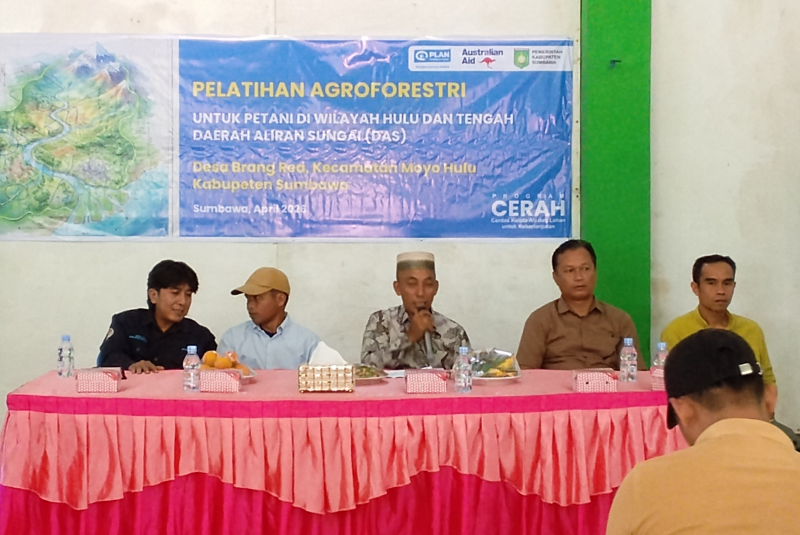
One of the program’s first activities was the Agroforestry Training for Farmers, held on 23 April 2026 in Brang Rea Village. Conducted in collaboration with facilitators from the Forest Management Unit (BKPH) Region IV of West Nusa Tenggara Province and the Village Government, the training brought together a wide range of community representatives, including the Village Consultative Body (BPD), the Youth Organization (Karang Taruna), the Family Welfare Movement (PKK), the Indonesian National Armed Forces (Babinsa), the National Police Community Officers (Bhabinkamtibmas), and local farmer groups.
Written by: Mulyadi AR (Sumbawa Regency Agroforestry Training Facilitator) | Editor: Annisa Hanifa


