

PRESERVING NATURE, REVIVING THE INDIGENOUS VALUES OF TALAS OF THE HELONG TRIBE
06 August 2026
The harmonious relationship between people and nature is reflected in various Helong traditions, such as in kabing (marriage), tam nod and Safbalu (customary rituals), and ini mate (funeral rites). These values have been passed down from one generation to the next as a commitment to sustaining life.
Ecological wisdom is also embedded in customary practices, such as the Talas tradition, a customary ritual that prohibits people from harvesting natural resources for a certain period so that nature has time to recover. The prohibition is lifted by the sound of a gong struck by the guardian of the Palokan (mamar), serving as a collective signal to the community. Unfortunately, as the system of governance has evolved, the role of customary law has weakened. This local wisdom has gradually been abandoned. Individualistic lifestyles and the limited involvement of younger generations have further accelerated the decline in environmental awareness.
This concern led to the establishment of the Helong Cultural Guardians Community in February 2022. The group was initiated by young people together with customary leaders, women, and residents of Kolhua. It has become a space for reviving cultural traditions while at the same time protecting nature.
Finding immediate resonance, this idea was warmly embraced by Plan Indonesia through the CERAH Program, which partnered with the community to revive local wisdom.
For Plan Indonesia, protecting water and land resources is not only about environmental conservation, but also about fulfilling children’s rights and promoting gender equality for girls. Access to clean water, proper sanitation, and a healthy environment is an essential foundation for the growth and development of children and adolescents, especially amid the increasingly evident challenges posed by climate change.
This collaboration is built upon a shared vision: protecting the environment through local wisdom. One concrete initiative is reforestation along the banks of the Kolhua River to protect water sources and prevent erosion.
The Helong Cultural Guardians Community currently has 30 members spread across Kolhua Village and its surrounding areas. Today, the condition of the customary forest is no longer well preserved due to the transition from the village governance system to the urban village (kelurahan) system, which has overlooked the legal status of customary law.
Kolhua Village is home to dozens of springs that have remained preserved to this day. However, the rapid development of residential areas has caused water discharge to continue declining. One example is the Uibaha Spring, located within the area of the Helong Cultural Guardians Community in Kolhua Village.
Residents of Kolhua Village now live under the constant threat of disasters whenever the rainy season arrives. Several locations in the area are highly susceptible to landslides and erosion. In response to these threats, the indigenous community has taken concrete action through reforestation along the riverbanks.
Alexsius Trianus Bistolen, a local customary leader, stressed that replanting trees in these critical areas is no longer negotiable if the safety of local residents is to be ensured.
“During the rainy season, several areas in Kolhua are prone to landslides and erosion. Reforestation along the riverbanks is essential to maintain ecological balance and prevent even greater disasters,” said Alexsius.
This environmental initiative is far more than a ceremonial activity. Local residents are fully committed to conducting regular monitoring after tree planting to ensure that the seedlings grow well.
The Ecological Roots of the ‘Talas’ Tradition
The strong environmental awareness found in Kolhua did not emerge overnight. The movement is deeply rooted in Talas, a traditional customary value that governs the relationship between people and nature.
The Talas customary ritual explicitly contains a number of prohibitions intended to safeguard the community’s shared living space, including prohibitions against entering the forest indiscriminately, cutting down trees around spring areas, and polluting the surrounding environment.
Although Talas is a traditional ancestral heritage, its values have proven to remain highly relevant and effective in safeguarding environmental sustainability in the modern era.
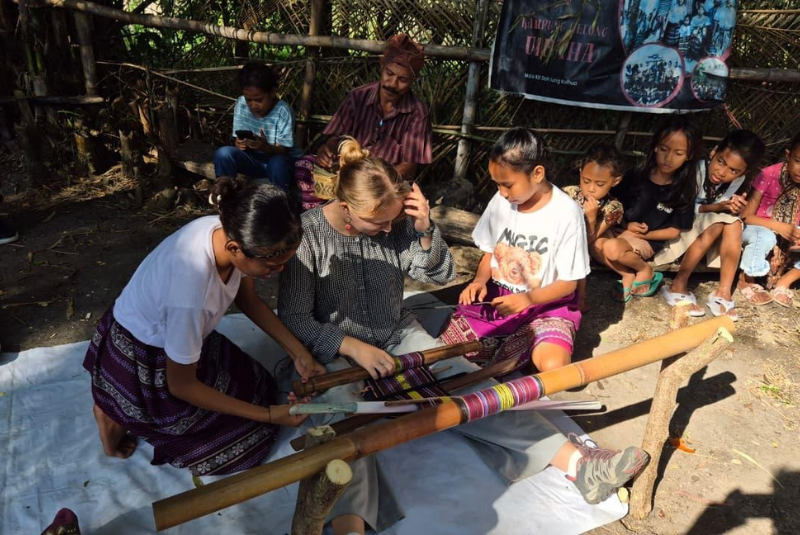
These efforts to preserve both nature and culture have been further strengthened through the Helong Cultural Festival, which is held annually on 1 June at the Um Kleo Traditional House in Kolhua. The festival serves as a public space to reintroduce ancestral heritage to younger generations and the wider community, ranging from traditional woven cloth (seman), local food, to traditional medicines.
This local movement has gained renewed momentum with the arrival of Plan Indonesia’s CERAH Program in Kupang City. The program brings a fresh approach that differs from environmental programmes in general.
In Kolhua, the CERAH Program does not position the indigenous community merely as passive participants or recipients of awareness activities. Instead, indigenous people are actively engaged as agents of change who hold primary responsibility for safeguarding the sustainability of their ancestral homeland.
Through the CERAH Program, Plan Indonesia also promotes the participation of women, young people, and vulnerable groups as part of the solution. When communities have better access to protected water sources and a healthy environment, children and adolescents have greater opportunities to grow, learn, and thrive.
Through the combination of the Talas local wisdom and modern facilitation, the people of Kolhua are optimistic that they can restore ecological balance while protecting their area from the threat of hydrometeorological disasters.
Written by: Rally Mukti Bistolen | Editor: Annisa Hanifa


