

Planting Hope on Dry Land in Lembata
19 January 2026
With steady steps, Eka (26) walks through the narrow paths of her village in Lembata. That afternoon, she is visibly excited—eager to show the results of a permaculture farming initiative she has been developing together with local families.
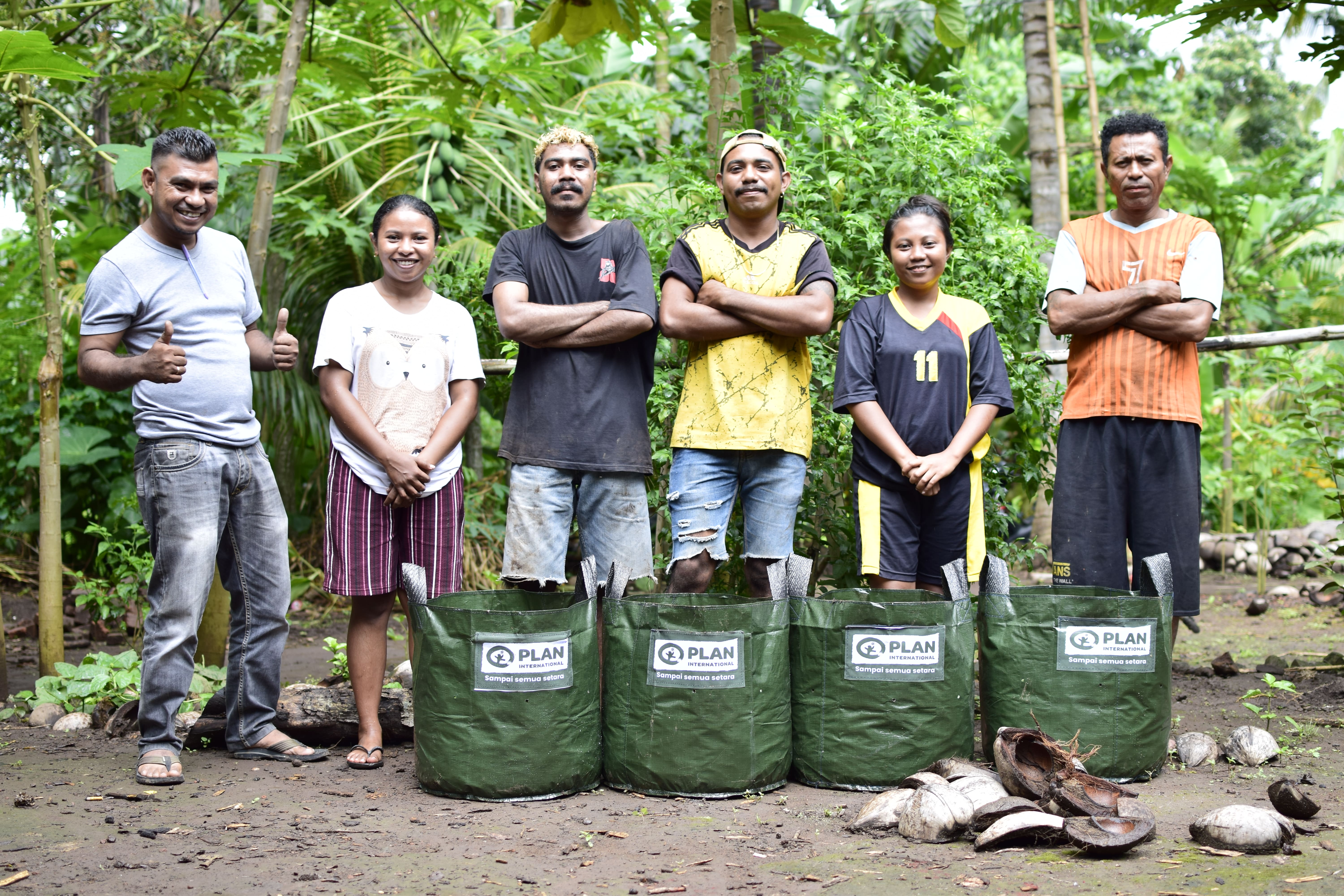
At one beneficiary’s home, four planter bags are neatly placed against the wall of the house. Inside them, eggplant plants grow behind a knee-high net fence stretching about three meters long.
“This is to protect the plants from goats and chickens,” Eka explains. “Without the net, the chickens would peck at them, or the goats would eat them.”
Two of the four eggplant plants are already bearing fruit, though they are still small and not ready for harvest. The other two are struggling—their stems shriveled and fruitless.
“These ones will be replaced with new seedlings,” Eka says, pointing at the nearly dead plants. The homeowner happens to be away at the time.
As a young facilitator in the Disaster Risk Reduction and Climate Change Adaptation (DRR–CCA) program supported by Plan Indonesia, Eka explains that this permaculture approach has been practiced in her village since January 2025.
The initiative began after she and other youth facilitators participated in climate-smart agriculture training in Lewoleba, followed by hands-on permaculture practice in Lerahinga. There, Eka, along with Azi and Rian, learned how to prepare planting media, organic fertilizer, and natural pesticides.
“I never imagined farming could be this simple,” Eka admits. “I used to think agriculture was complicated, but permaculture uses methods that are very practical and easy to apply.”
After completing the training, Eka and her two peers agreed to introduce permaculture practices to 43 sponsor children (SC) families in their village.
“We agreed that families could prepare the materials themselves, or we would help them directly,” Eka recalls. “During socialization, we also agreed that the first eggplants would be grown at our own houses first, so families could see the process and then replicate it.”
Gradually, all 43 households began growing crops at home. Eggplant was the first crop introduced, followed later by tomatoes and chilies.
The enthusiasm of the families has motivated Eka to spend her afternoons sowing new seeds in her own yard—both for initial planting and as replacements for damaged plants. Outside her routine as a PAUD (early childhood education) teacher, Eka now spends her free time doing something that benefits not only herself, but her wider community.
This climate-smart farming practice has helped her and the villagers adapt to water scarcity and the arid soil conditions that characterize much of Lembata. Eka continues to encourage families to take small, achievable steps toward bigger change.
Not far from the first house, Eka points to another SC household that she considers a success story. Peni (36), the homeowner, has managed to harvest eggplants from the four planter bags provided through the program.
The backyard of Peni’s house is mostly covered in coral rock, with soil too barren for conventional farming. The planter bags, however, have enabled her to grow eggplants and tomatoes—something she believes she can continue for years.
A few days earlier, Peni harvested eggplants from two of the planter bags. Since January 2025, she has harvested eggplants and tomatoes several times. The small garden has helped reduce her household expenses.
“I’ve picked eggplants for our meals many times,” she says. “We eat them often. Maybe in two more days, I’ll harvest from the other plant for our next meal.”
Although the eggplants are smaller than those sold at the market, Peni believes they taste better. She is confident that permaculture-grown vegetables are healthier, free from chemical pesticide residue.
“If we wake up in the morning and don’t have side dishes,” she adds, “we just pick eggplants, fry them, and eat them with rice.”
Beyond distributing planter bags, Eka emphasizes that families were trained to prepare organic planting media using locally available materials.
“We taught them to mix soil with banana stems, sawdust, and dried leaves,” Eka explains. “Now they realize that even on dry land with limited water, growing food is possible.”
For Eka, every household that successfully practices permaculture becomes a source of renewed motivation to support others.
“Each household received four eggplant seedlings—so with 43 families, that’s 172 plants,” she says. “If they grow well, imagine how much money families can save on vegetables, or even earn from selling the harvest.”
Water scarcity remains the biggest challenge. The village’s clean water system is only sufficient for basic household needs.
“For watering plants, families rely on rainwater collected during the wet season, or reused water like rice-washing water that hasn’t been contaminated with chemicals,” Eka explains.
Although each planter bag requires a considerable amount of water, permaculture techniques help reduce overall water usage.
As a young woman growing into her role as a facilitator, Eka believes there is always a way to keep families motivated—even when crops fail.
“We always create space to share,” she says. “We discuss the problems together, identify the causes, and look for solutions.”
She is grateful for the opportunity to serve as a facilitator with Plan Indonesia. With the knowledge and confidence gained through multiple trainings, Eka continues encouraging families not to give up in the face of water scarcity and economic hardship.
“For families whose seedlings died, we are still preparing replacements,” she says.
Another challenge lies in the daily realities of village life. Parents’ work responsibilities often mean plants are unintentionally neglected.
“Sometimes the vegetables are forgotten,” Eka explains. “In some families, the father migrates for work, and children forget to water the plants after school. Eventually, the plants die.”
Through this experience, Eka has begun mapping the social and economic factors that influence the success of permaculture in her village.
Despite the challenges, Eka hopes the initiative will grow into something bigger: long-term food self-reliance for the community. For that dream to materialize, she believes collaboration—especially with village authorities—is essential.
“If all parties can work together with the same vision, I believe this can happen,” she says. “Support from village leaders, strong encouragement from parents, and proper education for children are the keys.”
Slowly but surely, Eka remains optimistic. Armed with knowledge, patience, and the trust of her community, she continues planting hope—one planter bag at a time.


