

Youth and AI: Changing Digital Narratives to End Child Marriage
31 August 2026
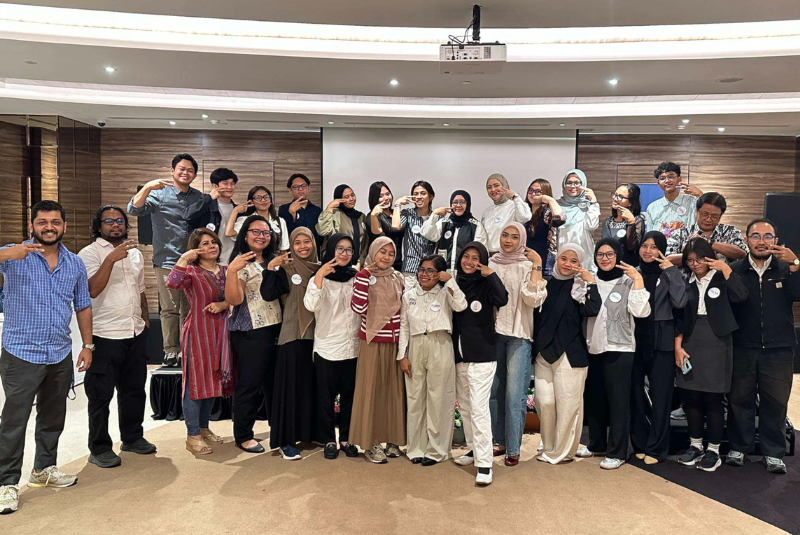
Jakarta, August 30, 2026 – Amid the rapid flow of digital information, narratives surrounding young girls, gender, and child marriage do not only exist through formal spaces. Social media has become one of the arenas where various views, values, and even misleading information thrive and influence how society perceives these issues. Seeing both the opportunities and challenges, the Youth Action Lab: AI for Influencing Counter-Narratives to End Child Marriage and Advance Gender Equality in Asia brought together 20 young people in Jakarta on August 29–30, 2026. This activity is part of the Project Time to Act! Core Support to Implementing the Regional Strategic Framework batch #3. Over the course of two days, participants were not only guided to understand the context of child, early and forced marriage (CEFM) in Indonesia and Asia, but also learned how to become changemakers in the digital space.
Ida Ngurah, Program Director of Plan Indonesia, opened the event and provided context regarding the importance of youth involvement in driving change through the digital space. During the event agenda, Ida Ngurah delivered welcome remarks while officially opening the training.
“Youth are not only receivers of information, but also hold the power to shape narratives and drive change. When equipped with knowledge, room to speak up, and the ability to utilize technology responsibly, they can become a crucial part of efforts to create a more equal environment and protect young girls from child marriage.”
From understanding the issue to dismantling harmful narratives
The first day began with discussions on the context of CEFM in Indonesia, the roles of various stakeholders, and the context of CEFM in Asia alongside the role of ASEAN ACWC (ASEAN Commission on the Promotion and Protection of the Rights of Women and Children). The session then continued with a discussion on influencing in restrictive contexts, including how to identify and map emerging public narratives.
For Amina Khatun, Regional Advocacy & Youth Civic Engagement Advisor at Plan International Asia Pacific, who co-facilitated sessions on the context of CEFM, narrative mapping, advocacy tactics, and an introduction to Artificial Intelligence (AI) for influencing, shifting narratives is a vital part of advocacy work.
“Ending child marriage also means challenging the narratives that allow it to continue. Young people have an important role in identifying harmful narratives, creating positive counter-narratives, and using digital spaces to advocate for the rights of girls and advance gender equality.”
This approach was then translated into practice. Participants were introduced to using AI for influencing, ranging from understanding the opportunities and risks of AI, ethical issues, to utilizing various basic tools. However, technology was not positioned as the end goal. Rather, participants were encouraged to think critically about how AI can be used responsibly to strengthen campaign messages.
In the AI-Powered Campaign Message Creation session, participants not only learned to leverage AI for developing campaign ideas, slogans, visuals, and social media content, but also understood how the technology could help them build stronger, evidence-based messages—an experience felt directly by Adinda, one of the Youth Action Lab participants.
“Using AI is becoming crucial, especially for youth who want to speak up about gender equality issues on social media. AI can help us conduct research, filter information, and find relevant sources so that the narratives we convey in the digital space become stronger and well-informed.”
From narratives to action
Moving into the second day, the learning shifted from message production toward campaign strategy. Participants studied campaign frameworks, audience targeting, advocacy tactics, as well as methods for measuring the outcomes and impact of digital campaigns. Then, during the AI-Driven Content Creation session, participants worked in groups to develop their own communication products. These ranged from posters and social media posts to video scripts and AI-supported video development. They also practiced turning harmful statements into more constructive messages. This process demonstrated that the ability to use technology must go hand in hand with the capacity to understand context, read audiences, and determine the right message.
For the participants, a learning environment like this opened up opportunities to view AI not merely as a tool to create content faster, but as an instrument capable of supporting advocacy work and social movements.
Ultimately, the goal of the Youth Action Lab was not just to produce digital content. Furthermore, the initiative empowered young people to develop evidence-based counter-narratives, design digital campaigns, and learn from the experiences of youth across Asia. In a rapidly changing digital world, the voice of youth is becoming increasingly essential. When harmful narratives can spread within seconds, building strong, evidence-based counter-narratives that stand for equality is also part of the effort to drive change.
Because change begins not only with what we say, but also with the narratives we choose to continuously share.


