

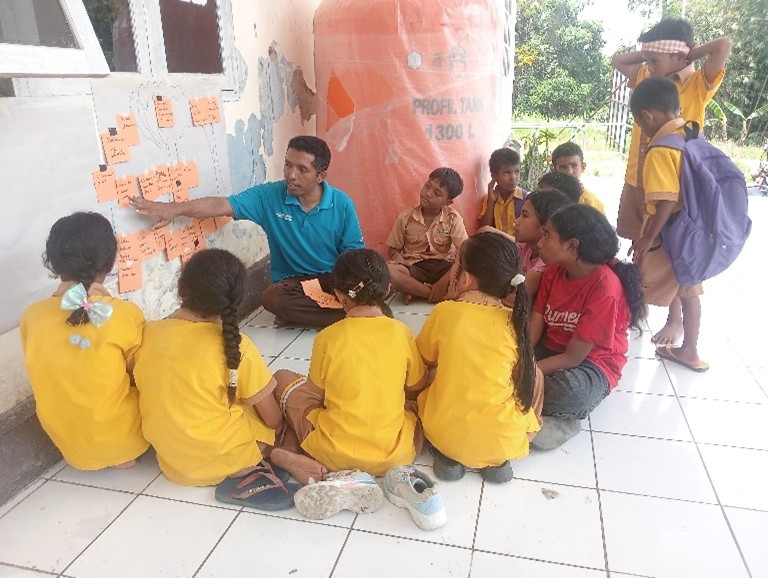
Introducing Village Program Issues to Children Through the Problem Tree Method
18 November 2025
In one of the assisted villages of Plan Indonesia in Nagekeo, a cool and calm atmosphere surrounded the village as a Participatory Rural Appraisal (PRA) activity took place. The session involved around eight children and thirty adults, focusing on introducing village-level issues through the Problem Tree approach.
Although the Problem Tree method is commonly used with adults, facilitators adapted it for children by using simpler language and a more engaging, playful approach. Using local language and familiar expressions, facilitators invited children to talk about issues they experience in their daily lives.
Topics such as access to clean water, stunting, diarrhea, and natural disasters were openly discussed. To create a relaxed and inclusive environment, children were encouraged to participate through interactive games like “tepuk hebat” and “tepuk salut”, used as expressions of appreciation for their courage and participation.
One of the children, Kiran, raised the issue of clean water.
“Sir, we have to buy water because the source is far away. There are nine families who bathe and collect water from a spring that is quite far,” he said.
He added, “The water we drink smells like tree roots.”
Other children shared that most parts of the village already have access to clean water through a piped system. This discussion highlighted disparities in access to clean water within the same village.
I, Yustinus Weke Wea, one of the Field Development Officers (FDO) of Plan Indonesia, then raised the issue of education. I asked, “Are there friends who have dropped out of school?”
Tores replied, “Yes, Uncle—three of them.”
When asked about the reasons, he explained, “They started smoking and dyeing their hair, then felt ashamed to go to school and eventually stopped attending.”
This response opened space for deeper discussion on the social and psychological factors affecting children’s school attendance and educational continuity.
The children were once again appreciated with “tepuk hebat” for their honesty and bravery in sharing their experiences.
Next, Jores raised a concern related to disaster risk.
“Uncle, there are still landslides in our village. Recently, a landslide blocked the main road,” he said.
The facilitator responded with a reflective question: “What do you think we can do to stay safe from landslides?”
The children answered together, “We stay away from the landslide area, Uncle.”
Throughout the session, facilitators used metaplan cards to record each issue raised by the children. These notes were then placed on a flipchart illustrated with a banyan tree, symbolizing the Problem Tree. The roots represented the causes of problems, the trunk symbolized the core issues, and the leaves illustrated the impacts felt by the community.
This activity was not only a tool for identifying village issues, but also a way to build children’s awareness of their surrounding environment. Through an inclusive and enjoyable approach, children were able to actively express their experiences and perspectives. They were not treated merely as objects of development, but as subjects with a meaningful role in the planning process.
By using the Problem Tree method, facilitators successfully captured key village issues from children’s perspectives. The activity demonstrated that children are capable of understanding and analyzing their environment—when they are given appropriate space, trust, and methods.
This short story from Nagekeo reflects how meaningful child participation can be nurtured through simple yet thoughtful approaches. A small step, but an important one, toward building more inclusive and sustainable village development through children’s voices.


