

Every Drop of Water for a Dream
01 October 2026
That afternoon, the sun began to sink behind the hills. Children Cheril’s age usually spend their time playing together with friends or doing homework from school. But for Cheril, a 14-year-old girl living in one of Plan Indonesia’s assisted villages, time after school holds a completely different meaning.
While her friends might already be relaxing at home, Cheril must prepare to begin a long, exhausting journey. In her hands, she holds two empty jerrycans. She knows that before darkness falls, she has to walk more than two kilometers to reach a water source located deep within the forest and hills.
It is no ordinary journey. The path she must take consists of a narrow, steep, and rocky trail. At certain points, the ground turns slippery when it rains. On her left and right are only trees and thick bushes that make the atmosphere feel silent and lonely. There are no houses nearby to seek shelter in if something were to happen.
Despite being only 14 years old, Cheril is already very familiar with the terrain. She has been doing this almost every single day since she was in elementary school.
“When I get home from school, I immediately pick up the jerrycans and walk to the water source. Sometimes it feels so tiring, but I have to do it because my family needs water,” she recalls.
If she sets off around three in the afternoon, Cheril usually only arrives back home close to five o’clock. Two hours of her time are gone just to fetch water. Resting on her shoulders is a responsibility that no child her age should have to bear.
Upon arriving at the water source, her work is far from over. She still has to wait her turn, scoop the water, and fill two jerrycans, each with a capacity of five liters. After that, an equally heavy journey home awaits her.
The jerrycans that were once light now weigh heavily on her steps. Every meter of the journey feels longer. Sweat drenches her school uniform. She gasps for breath as she climbs incline after incline.
Yet behind that exhaustion, Cheril keeps walking forward. Not just for herself, but to fulfill her family’s need for clean water.
For many people, turning on a tap and getting clean water might be a ordinary, taken-for-granted thing. But for Cheril and her family, water is something immensely precious.
The water they fetch is used for almost all daily needs: cooking, washing dishes, bathing, doing laundry, and drinking. Because the amount of water brought home is very limited, Cheril’s family must manage its usage with extreme care.
They are used to living with various limitations: taking minimal baths, washing only what is necessary, and taking turns using water so that supplies do not run out quickly.
The family’s economic hardship leaves them with few options. In her village, water can actually be bought from pick-up trucks selling water to residents. However, the cost is far beyond what many families, including Cheril’s, can afford.
As a result, the only option available is to fetch the water themselves from a distant source. For adults, this activity might not be as exhausting. But for a young girl still in junior high school, that burden feels much heavier.
This reality is not experienced by Cheril alone. In a village inhabited by around 300 people across 60 households, the difficulty of obtaining clean water has been a part of daily life for years. Among them are 123 sponsored children and former sponsored children (SC) who also feel the impact of limited access to clean water.
Even so, Cheril never complains. She understands that her family needs help. She realizes that water is an unavoidable necessity. That is why every day she continues this routine, even if she has to sacrifice many things vital to her future.
Cheril has a simple yet noble dream. She wants to become a teacher. To her, a teacher is someone who can help children learn and achieve a better future. She envisions herself standing in front of a classroom one day, teaching her students with passion.
However, the journey toward that dream is not always easy. After walking long distances to fetch water every afternoon, her body is often too exhausted to study. By the time she reaches home, the remaining energy is only enough for dinner and rest.
Textbooks that should be read often end up lying unopened on the table. Not because she is lazy, not because she doesn’t want to learn, but because her body is simply too tired to think.
There are days when her eyes feel heavy even before opening a textbook. There are nights when she wants to review her school lessons, but exhaustion forces her to fall asleep first. Time that should have been spent studying is lost on the journey to fetch water.
“Sometimes I don’t have time to study because I’m already too tired after getting water,” she says.
For Cheril, losing study time isn’t just about losing a few hours in a day. It means losing opportunities to move closer to the dream she has held deep in her heart.
Uniforms That Are No Longer White
The lack of water also leaves a clear mark on her daily life as a student.
Every morning, Cheril leaves for school with the same enthusiasm as other children. But there is one thing that often makes her feel self-conscious: her school uniform.
Because available water is so limited, her family cannot wash clothes as frequently as needed. Consequently, the white uniform that should be clean slowly turns brownish. Stains and dullness become difficult to avoid.
At times, even just washing her face before leaving for school is a luxury. While other children might be able to bathe and change into clean clothes every day, Cheril has to learn to accept her conditions. But what is even more saddening is that this experience is shared by many other children in her village.
Besides being exhausting, the journey to the water source carries various risks. Children like Cheril have to walk through areas far from residential settlements. They trek through forests, pass quiet footpaths, and navigate steep hills going up and down.
For a 14-year-old girl, these conditions are far from ideal. When bad weather hits, the path becomes even more dangerous. Slippery ground increases the risk of slipping and falling. Large rocks and protruding tree roots pose a threat to anyone passing by.
Yet fear never takes away their responsibility. Every day they keep walking—not because they are brave, but because they have no other choice.
In many places, a water crisis is not just about a shortage of water. A water crisis also means lost study time, increased risks to children’s safety, and diminished opportunities to enjoy a childhood that should be full of joy. Cheril is one of the true faces of that reality.
Hope began to arrive in early 2026. For years, villagers had dreamed of closer, safer access to clean water. That dream slowly began to come true when Plan Indonesia, together with the community, built a piping network from the water source directly to the settlement.
The work was no simple task. To ensure water could reach residents living far from the source, a transmission pipe network spanning over 2,000 meters was constructed, stretching across various challenging terrains.
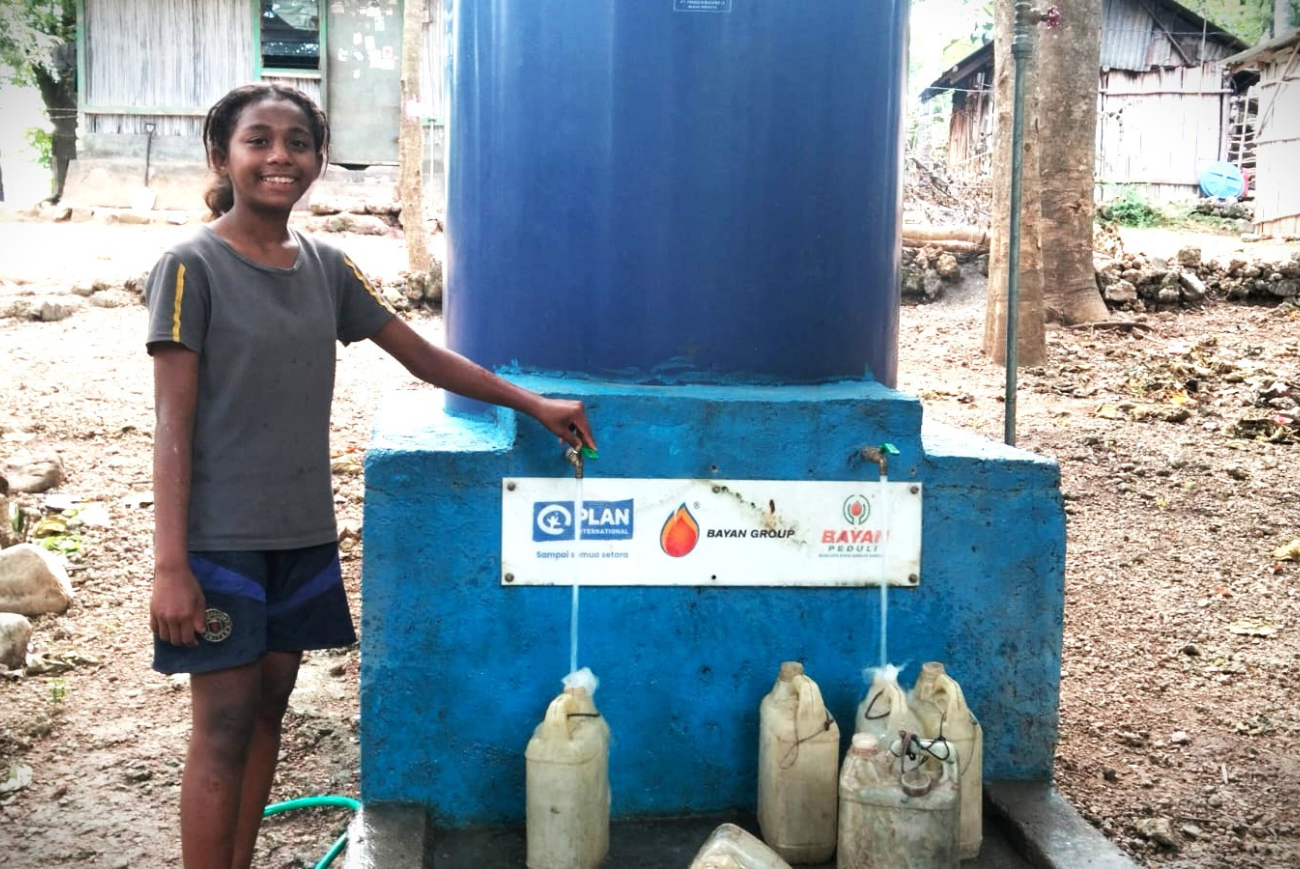
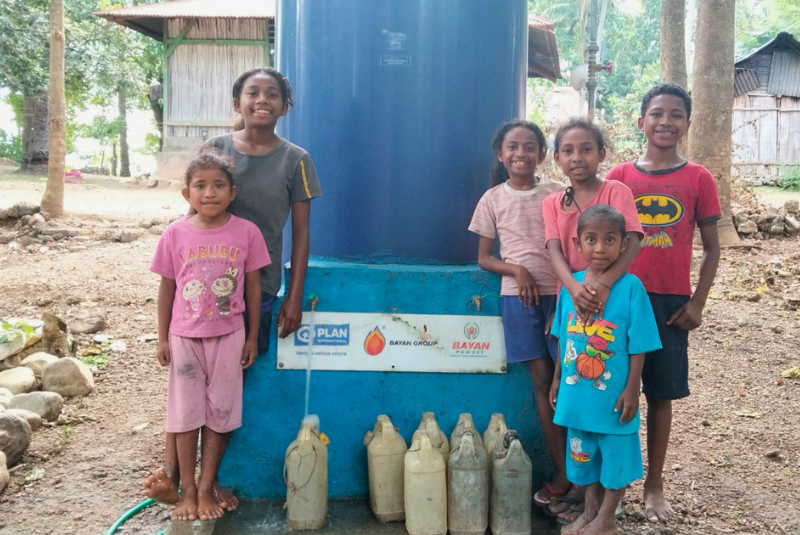
In addition to the pipe network, a spring intake box (broncaptering) was built to capture the spring, along with a reservoir tank for water storage and three public hydrants that allow community members to obtain clean water closer to their homes.
However, this change was not built through infrastructure alone. Plan Indonesia also strengthened the community’s capacity to ensure long-term sustainability of the clean water services. A total of 7 members of the Drinking Water Supply System Management Body (BP-SPAM) received technical training on system operation and maintenance, as well as financial management training so that the facilities built could be managed sustainably and transparently by the community.
This spirit of change was further supported by the village government. Seeing the tangible benefits felt by the community, the village government continued developing the water system by constructing 2 additional public hydrants, one of which is already completed and actively used by residents.
The collaboration between the community, village government, and Plan Indonesia paved the way for a transformation that was once only a hope.
Then in February 2026, the long-awaited change finally arrived. Clean water began to flow closer to residents’ homes, including Cheril’s. That day became a moment she would never forget.
For the first time, she no longer had to carry heavy jerrycans and walk for hours to the water source.
For the first time, she could get clean water without having to trek through forests and hills.
For the first time, the simple dream of having clean water access near her house became a reality.
That change might seem simple to some, but for Cheril, it meant everything. Now, the two hours previously lost to fetching water can be used for far more meaningful activities. She has more time to study, more time to complete school assignments, more time to rest, and most importantly, more time to enjoy her youth.
No more exhausting long walks every afternoon, no more fear of walking quiet trails to the water source, no more worries about whether there will be enough water at home for tomorrow. The water flowing near her house does not only ease daily life; it brings back opportunities that had long been lost in Cheril’s life—the opportunity to dream, the opportunity to learn, and the opportunity to just be a child.
Dreams That Now Flow with Clean Water
Today, standing near the clean water network that transformed her life, Cheril’s smile shines brighter than ever before.
She still holds the same dream—she still wants to become a teacher—but now the road to that dream feels a little lighter.
Not because life’s challenges have completely disappeared, but because one massive burden that drained her time and energy for years has been lifted.
With closer access to clean water, she can devote more attention to school and her future.
“I used to have to walk far into the forest every day just to fetch water. It was so exhausting; sometimes I couldn’t even study because I was too tired. My school uniform was rarely washed because water was so limited, until its color was no longer white,” Cheril says.
Her face lights up as she talks about the changes she experiences now.
“Now that there is a clean water network from Plan, I can fetch water right near my house. I’m so happy and grateful because my friends and I don’t have to be tired every single day just to draw water. I can focus more on studying and pursuing my dream of becoming a teacher.”
This transformation is now felt by the entire village community. Around 300 people from 60 households, including 123 sponsored and former sponsored children, now have access to clean water that is closer, safer, and proper. For children like Cheril, this change means far more than just easy access to water. It restores time, opportunity, and hope that were once slowly slipping away due to hardship.
Cheril’s story demonstrates that access to clean water is never just about infrastructure.
Clean water is about opportunity. About health. About education. About children’s safety. And most importantly, about the future.
For Cheril, a piping network of over 2,000 meters is not merely a water conduit connecting a source to a settlement.
That network is a bridge connecting a young girl to her dreams.
Every drop of water that now flows near her home carries renewed hope that one day, Cheril will stand in front of a classroom as a teacher, inspiring the next generation to keep dreaming—no matter how tough the journey may be.
Written by: Yosinta Marturia │ Editor: Agus Haru │ Photo: Plan Indonesia/Yosinta Marturia


