

CLIMATE-SMART FARMERS COMBATING SALINE SOIL THREATS
03 August 2026
The pungent smell of dry soil filled the air beneath the scorching sun in Penyaring Village, North Moyo District, Sumbawa Regency. Across the rice fields stretched a heartbreaking sight: patches of rice had turned yellow and begun to dry out.
Standing at the edge of his field, Mr. Anto, a member of the Orong Desa Farmers Group, stared blankly across his land. With his hands resting on his hips, he watched the rice stalks slowly dying. “The rice in my field is gradually drying up and disappearing. Of the four plots I planted, one is slowly drying out,” he said resignedly. For the local farming community, the phenomenon they describe as “disappearing rice” is nothing new. It has become increasingly common over the past several years. For Mr. Anto, however, it is nothing short of a disaster. His rice field is not merely farmland—it is the primary source of his family’s livelihood. As weather patterns become increasingly unpredictable, most farmers in Penyaring Village are now able to cultivate rice only once each year. They rely entirely on rainfall duringthe December planting season. Even then, the harvest is rarely sold; instead, it is reserved to meet the household’s own food needs. Yet harvest yields continue to decline. The harvested rice is not sold but reserved to meet the family’s daily food needs. However, harvest yields in this village continue to decline. Rice production averages only around 4 tonnes per hectare, significantly lower than in neighbouring villages, where yields can reach 7 tonnes per hectare.
The low agricultural productivity in Penyaring Village is caused by the increasing salt content in agricultural land, commonly known as saline soil.
Saline soil makes it difficult for plant roots to absorb water and nutrients effectively. The effects are immediately visible in crop growth. Leaf tips begin to dry out and turn yellow, plant growth slows, and gradually the crops die. As a result, farmers suffer crop failure.
Saline soil also disrupts photosynthesis, root development, and the uptake of essential nutrients such as potassium, calcium, and magnesium, causing crops to become weak.
These conditions leave farmers increasingly vulnerable to crop failure. Yet agricultural production remains the primary source of food for their families, including for preparing for major religious celebrations such as Eid al-Fitr.
Besides reducing crop yields, limited water availability further worsens land conditions. Farmers deliberately retain water in their rice plots because the water supply is extremely limited. After the planting season ends, the fields are usually left fallow and used as grazing land for livestock, providing an additional source of household income.
If left unaddressed, these conditions have the potential to threaten the future food security of farming families.
The CERAH Program: Standing Alongside Farmers
In response to these challenges, Plan Indonesia’s CERAH Program has partnered with the North Moyo Agricultural Extension Centre (BPP) to seek practical solutions.
The availability of clean water has a direct impact on the health, education, and well-being of children. When access to water is limited, children—particularly girls—often face greater health risks and may lose educational opportunities because they are required to help meet their household’s water needs. Through the CERAH Program, Plan Indonesia supports farmers in addressing climate change and declining land productivity, challenges that also affect the long-term well-being of their families.
The assistance is delivered through a participatory approach, directly involving farmers in identifying problems and developing solutions in the field.
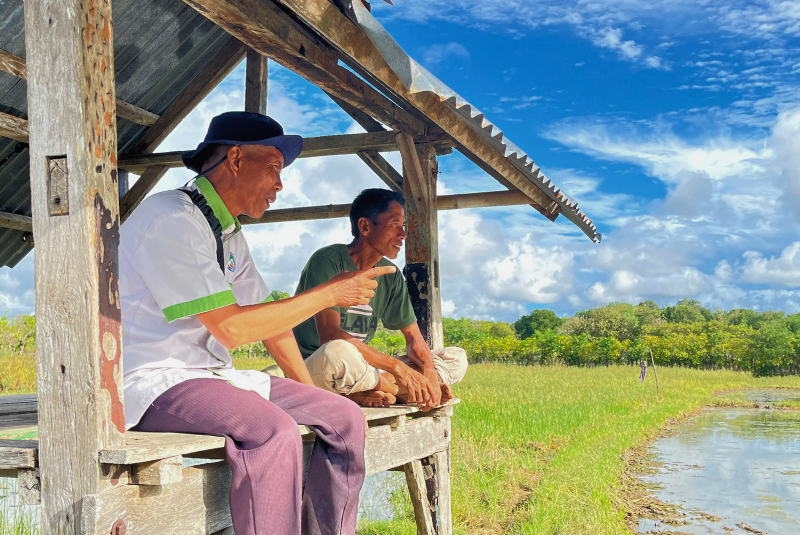
During the Climate-Smart Agriculture Training, farmers gathered in the rice fields under a simple tarpaulin shelter. They engaged in open and lively discussions. Male and female farmers, together with agricultural extension officers, discussed the many challenges they face in their farming activities.
One farmer shared his concerns as the harvest season approached.
“Our harvests keep getting smaller, yet Eid al-Fitr is just around the corner. The rice from these fields is what we normally use to feed our family, pay our zakat al-fitr, and make charitable donations,” he said.
The Coordinator of the North Moyo Agricultural Extension Centre explained that the low rice productivity in Penyaring Village has become a major concern for agricultural extension officers. Field assessments have identified saline soil as one of the dominant factors contributing to declining agricultural production.
Adaptation Strategies for Saline Soils
The CERAH Program, together with the North Moyo Agricultural Extension Centre, continues to strengthen practical efforts to help farmers address the challenges posed by saline soil.
This collaboration goes beyond discussion and planning. It is being translated into concrete mentoring activities and the application of adaptation technologies known as Climate-Smart Agriculture (CSA).
One of the approaches to be introduced is the use of crop varieties that are tolerant of saline soil conditions. In addition, water and land management will be improved through mechanical methods, including the construction of raised planting beds. This technique is intended to reduce standing water containing high salt concentrations. As a result, soil conditions can gradually improve and better support healthy crop growth.
Farmers are also encouraged to improve soil quality through the use of organic fertilisers and botanical pesticides. These practices are expected to enhance the soil’s chemical and biological properties, increase soil fertility, and help reduce the negative impacts of excessive salt levels on agricultural land.
Providing intensive assistance to farmers is another key focus of the programme. Through the planned Farmer Field School activities, farmers are expected to gain a better understanding of, and be able to apply, cultivation techniques that are appropriate for saline soil conditions.
The involvement of young people is also considered an important component in expanding the dissemination of agricultural information. The use of communication media and digital information-sharing platforms is expected to accelerate the delivery of knowledge to local communities, allowing agricultural innovations and technical knowledge to reach more farmers and farming families throughout North Moyo District.
Environmental change has undoubtedly become a major challenge for farmers in Penyaring Village. Nevertheless, through collaboration, continuous mentoring, and a shared commitment to learning, new hope is beginning to emerge.
With support from various stakeholders, Mr. Anto and other farmers remain confident that the agricultural land in Penyaring Village can once again become productive and continue to sustain their families’ food security.
Written by: Abdul Rohman Editor: Annisa Hanifa


