

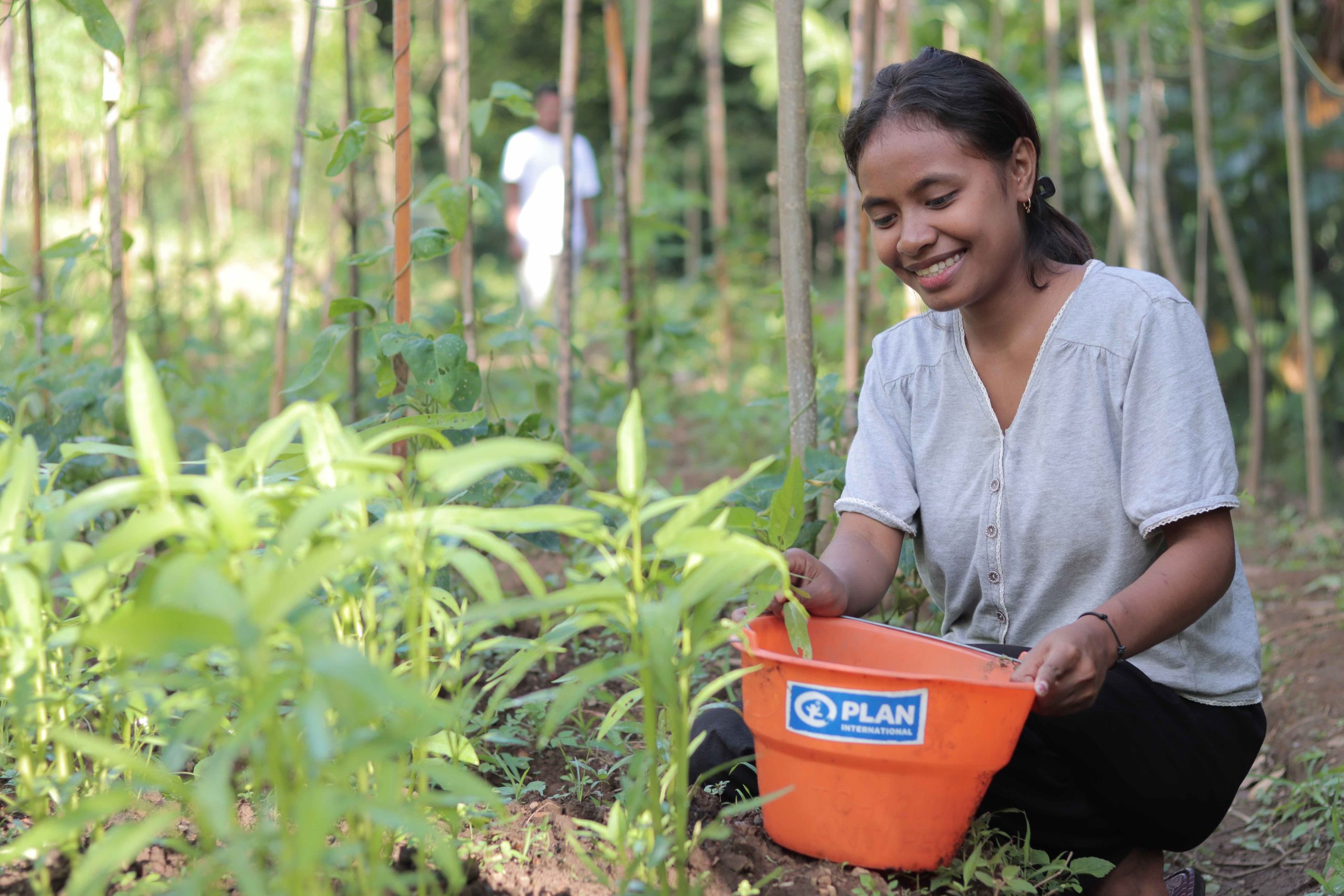
Climate Change in Lithdiana’s Backyard
03 October 2024
“It’s been very cold lately. It’s been two weeks since the rain stopped. We also have a lot of vegetables that are damaged by caterpillars,” said Lithdiana (22), a Plan Indonesia sponsored child alumni from one of the villages in Nagekeo.
***
Nagekeo, East Nusa Tenggara – In a small village in one of the green valleys of Nagekeo Regency, a story of resilience and local innovation emerges from a group of young villagers dealing directly with climate change’s impacts. The village, one of the fertile areas with abundant agricultural products, is now facing major challenges due to erratic weather.
Lithdiana, met sometime after returning from Kupang, shared the content of a conversation with her father. From that conversation, she learned that from year to year, crop yields have been declining. Prolonged rains and unpredictable weather are destroying the crops. “According to my father and grandmother, from year to year, there are fewer and fewer cloves to sell. Sometimes the crop fails because the flowers fall due to the rain,” said Lithdiana.
Where they live, the seasonal calendar shifts without certainty. Weather conditions change rapidly. It’s not extreme heat that hits the village, but prolonged moderate rain. In addition, pest attacks are getting worse. Bananas turned black and died, and many other key commodities failed to grow. For people who depend on agricultural produce, this situation is a direct threat to their livelihoods.
Climate change, which has been considered a global issue far removed from everyday life, is now a reality that farmers here must face. They are not only dealing with the uncertainty of the weather but also the economic impact of declining crop yields.
Seeing this situation, Sensi (30), the head of the local youth organization, felt the need to take action. After attending a Y-Adapt training organized by Plan Indonesia, he and his friends developed an action plan to help their village adapt to climate change. “We were asked to propose an action plan that, if passed, would receive full support to implement,” Sensi said.
With support from Plan Indonesia through the Youth-Led Climate Resilience program, Sensi worked with village youths, including Lithdiana, to start making fermented animal feed and organic fertilizer. They worked together with Os, a 54-year-old Field Agricultural Extension Worker (PPL) who has served in the village for 15 years. Os mentored the youth enthusiastically, teaching them how to produce biofertilizers and plant-based pesticides.
“We see this as an opportunity to preserve the habit of organic farming, as people here have never used chemicals in gardening,” Os said.
Climate Change Challenges in Organic Farming
Despite high spirits, the action did not go smoothly. In the first planting, vegetables such as mustard greens, kale and cucumber were attacked by pests and some failed to grow due to heavy rain. However, this failure did not discourage them. They started over from scratch, improved their methods and strategies, and finally succeeded in harvesting thriving cucumbers, mustard greens and kale. This shows that young people can utilize organic farming to improve the youth economy even amidst the challenges of the climate crisis.
Os also taught the youth about the importance of understanding weather changes and the seasonal calendar. With this understanding, they can adjust planting times to avoid unexpected rainy seasons.
Not only that, Os is also working to get the youth farmer group registered with the local Agricultural Extension Office so that they can get access to seeds and take advantage of various empowerment programs from the government.
The initiative started by Sensi and her friends is a clear example of how local communities can face the impacts of climate change with innovation and a spirit of togetherness. “Our hope is simple, that organic vegetables without chemicals are always available to the villagers. And one day, we can penetrate the Nagekeo market, thus providing an economic impact for this group,” says Sensi.
This activity also has a special meaning for Lithdiana. Armed with community action in the YLCR program, in 2024, Lithdiana and Sensi were invited to be speakers at the environmental commemoration day in Kupang City. A new experience that was full of learning for her. This momentum also motivated her to deepen and strengthen youth action in her village for climate change adaptation work.
For a village that has been dependent on agriculture, these small steps can be a long-term solution to maintain food and economic security. However, the challenges of climate change continue to haunt us, and continued support from various parties, including the government and community organizations, is urgently needed.
Written by: Alfred Ike Wurin | Editor: Moudy Alfiana | Photo: Alfred Ike Wurin/Plan Indonesia


