

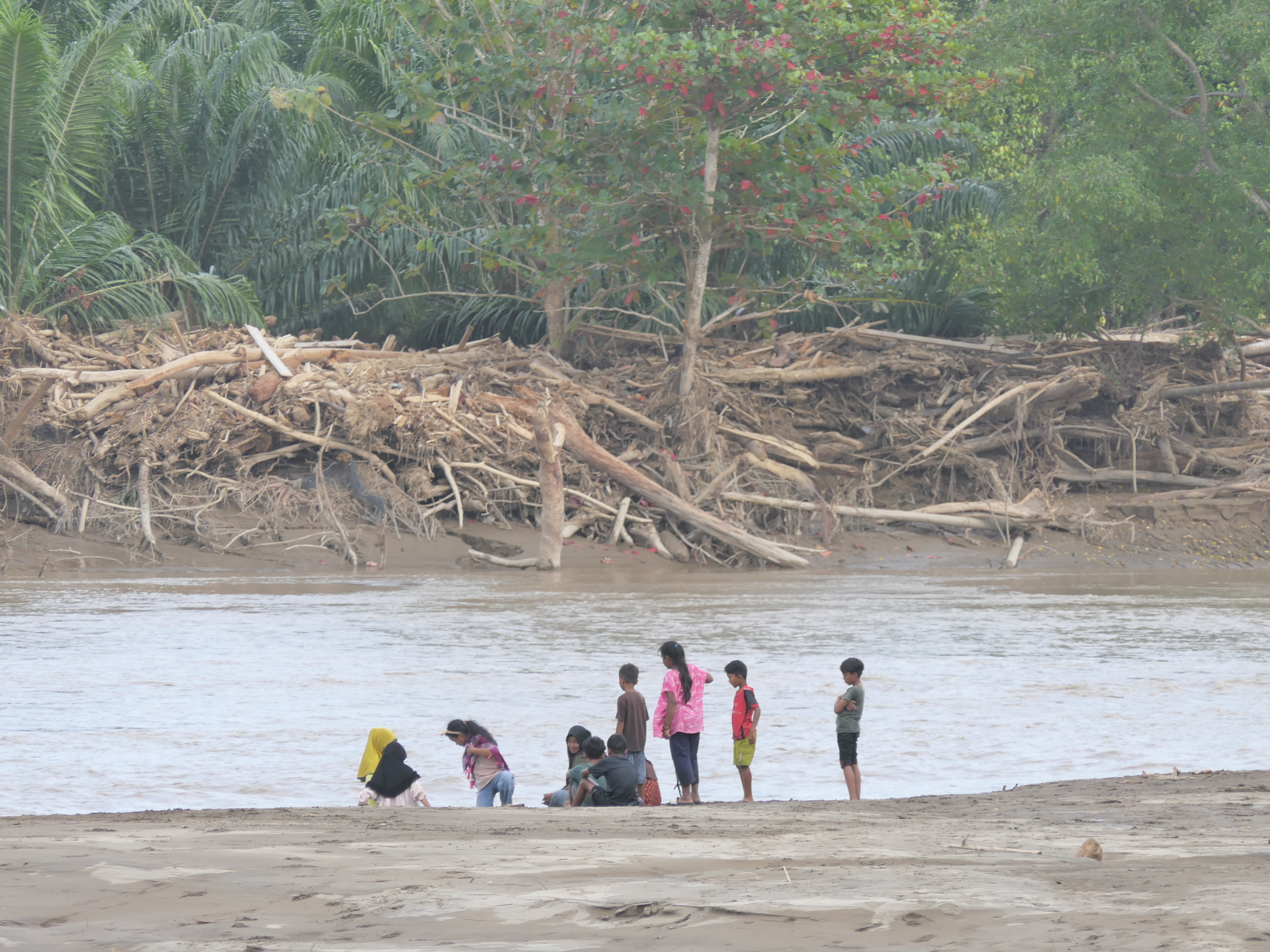
Children at Highest Risk, Humanitarian Access Remain Severed as Floods and Landslides Devastate Communities Across Sumatra
09 December 2025
Aceh, 9 December 2025 — The humanitarian crisis in Sumatra continues to deepen as communities face the aftermath of one of the deadliest flood-landslide disasters in recent years. According to the latest update from National Disaster Management Agency issued Monday afternoon (8/12), the death toll has risen to 921 people, with 392 individuals still missing and more than 975,079 people displaced. The scale of destruction spans 51 districts and cities, where over 121,000 homes, 1,009 schools, 270 health facilities, and 405 bridges have been damaged or destroyed.
In Aceh, where Plan Indonesia’s Emergency Response Team arrived since November 29th, entire villages remain engulfed in mud and debris. Many of the communities they visited are still cut off due to collapsed bridges and landslides, slowing rescue efforts and limiting the delivery of life-saving assistance. Families have been forced to seek refuge in makeshift shelters and crowded spaces where privacy is nearly nonexistent and basic needs remain unmet.
“We are witnessing communities who have lost everything. Families are sleeping on cold floors without mats or blankets. Children are living in shelters with no proper sanitation or safe water. The conditions are extremely difficult, and the risks for women and girls are especially concerning.” said Dini Widiastuti, Executive Director Plan Indonesia, from Pidie Jaya, Aceh, where approximately 67,000 people are displaced.
In several displacement sites in West Sumatra, access to clean water has become a critical emergency. Plan Indonesia Emergency Response team on the ground found only one functioning water source for entire communities, an open area used simultaneously for bathing, washing, and toilets by both men and women, adults and children. The lack of privacy and adequate facilities has already resulted in children experiencing skin rashes, infected wounds from the evacuation, and early signs of respiratory infections. These unsafe conditions are further heightened by limited lighting at night, increasing protection risks for women and girls.
Livelihoods have also been destroyed. Many of the families affected in Aceh rely on farming, and their fields have been swept away or buried under landslides. Without land to farm, households face the prospect of prolonged economic hardship that will hinder recovery long after the waters recede.
Humanitarian access remains one of the most urgent challenges. In Bireuen, Aceh, the collapse of multiple bridges has left entire areas cut off from assistance. Our emergency teams witnessed firsthand how at least 48 villages, remain isolated, with communities fully dependent on dangerous, improvised methods to cross fast-flowing rivers. With no functioning bridges, people are forced to use small wooden boats or a makeshift iron cart attached to a manual pulley system, hauled by residents themselves, just to transport basic goods, seek medical help, or reach evacuation points. These extreme access barriers significantly delay the delivery of humanitarian aid, especially for children, adolescent girls, pregnant women, and elderly people who cannot safely make the crossing. As long as these routes remain severed, the most vulnerable face heightened risks, from health complications to protection concerns, and will continue to struggle to receive even the most basic lifesaving support.
Education has also come to a standstill. Children have not attended school for more than a week, and in many areas classroom buildings are buried under thick mud or severely damaged. With no emergency learning spaces yet available, many children remain without access to learning or psychosocial support during a time of deep distress.
“This disaster has pushed children’s education into a state of emergency. Hundreds of thousands of children are suddenly cut off from education, protection, and the stability they desperately need. Without emergency learning spaces and psychosocial support, children risk not only falling behind academically but also suffering long-term emotional and psychological impacts. We urge all stakeholders to accelerate the restoration of education services, including the immediate establishment of safe, child-friendly learning spaces, so that every child can regain a sense of normalcy and hope,” Dini adds.
Emergency Response in Sumatra
Plan Indonesia has deployed emergency teams across in Aceh and West Sumatra, to deliver 23 tons immediate assistance, including 150 shelter kits (tarpaulins and ropes), 150 hygiene kits, 200 menstrual hygiene management kits, 404 blankets, 787 mats, and other essential supplies.
Our team is coordinating at national, provincial, and district levels. Nationally, Plan Indonesia actively participates in the Indonesian Humanitarian Country Team (IHCT) and engages in activated clusters such as Education, Protection, WASH, and Logistics. At the provincial and district levels, Emergency Response Team members also join daily coordination meetings with disaster authorities and work closely with local NGOs, CSOs, and community leaders to ensure interventions respond directly to community needs. Plan Indonesia is also assessing and engaging potential local partners to anticipate emerging needs as the situation evolves.
Plan Indonesia is also collaborating with donors and supporters such as UNIQLO, Lion Parcel, crowdfunding platform Kitabisa.com and Indonesian public figures and activists including Ferry Irwandi, content creator Jerhemy Owen, and actor Joe Taslim to expand the reach of life-saving assistance.
However, with infrastructure heavily damaged and needs rising daily, available resources remain far below what is required.
“The needs here are immense. Behind every statistic is a child, a parent, a family trying to survive. We must continue working together to ensure that support reaches those who need it most, especially children and women who face the highest risks in crises like this,” said Dini.
Plan Indonesia calls on national and international partners, donors, and the public to continue supporting emergency efforts in Sumatra, one of them is via bit.ly/bantusumatra. Sustained assistance is urgently needed to restore access to clean water, hygiene, health services, safety, and education while helping families rebuild their lives and livelihoods in the months ahead.


