

Birth Certificate: A Small Step for a Child’s Bright Future
10 November 2025
Every child born into this world carries hope. From their very first breath, they are entitled to fundamental rights—one of which is the right to identity.
Identity is more than just a name. It represents recognition—that a child exists and is acknowledged by the state. And it all begins with one vital document: the birth certificate.
Legally, the state guarantees every child’s right to identity. Law No. 35 of 2014 on Child Protection, Article 27 (1) and (2), states that every child must have an identity from birth, proven through a birth certificate. Furthermore, Article 28B (2) of the 1945 Constitution affirms that every child has the right to survival, growth, and development, as well as protection from violence and discrimination.
For some, a birth certificate may seem like just a piece of paper. But for many children in remote areas—such as those in South Central Timor (TTS) District, East Nusa Tenggara (NTT)—it is a ticket to a better future. Unfortunately, many children still do not have one.
According to data from Yayasan Plan International Indonesia (Plan Indonesia) in 2025, among 11,975 sponsored children across 46 villages in TTS, 1,635 children still do not have birth certificates. In addition, 218 children have no access to basic education, 5,294 children walk more than 30 minutes to fetch clean water, and 6 children have yet to receive measles vaccination. These are not just numbers—they are real stories reflecting challenges that we must address together.
A birth certificate is not just an administrative formality. Without it, a child may be considered “non-existent” in the eyes of the law. This can have profound consequences on their lives:
- Limited access to education – many schools require a birth certificate during enrollment.
- Restricted access to health and social services – a birth certificate is often needed to receive healthcare, vaccinations, or government social assistance.
- Lack of legal protection – a birth certificate serves as proof of age, which determines appropriate legal treatment for children in conflict with the law.
- Policy planning challenges – accurate birth registration data helps the government design better-targeted education and health policies.
Stories from the Village: Hope Made Real
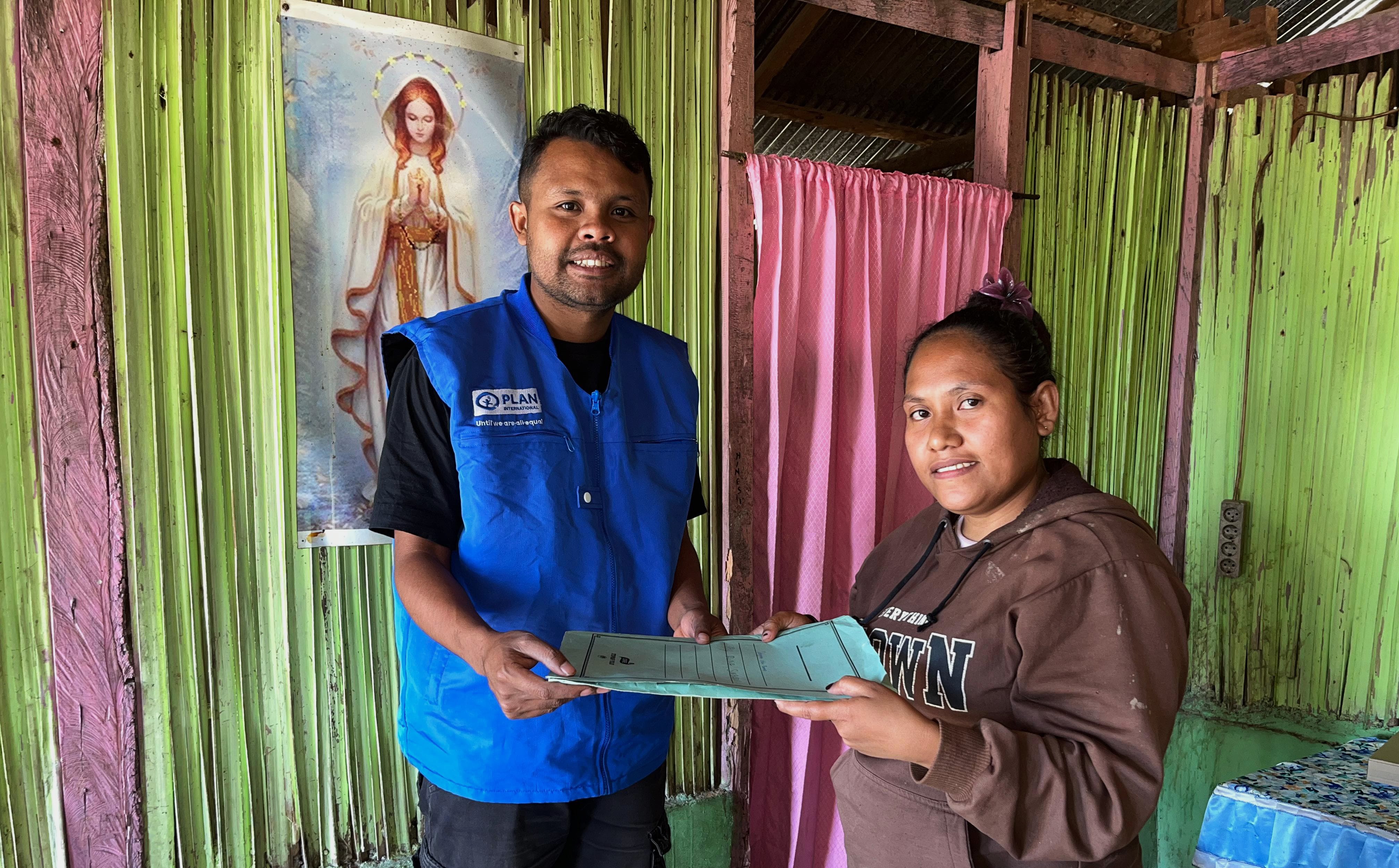
One inspiring story comes from Mama Desi Banamtuan (27), a young mother from TTS District. After a long and challenging process, her child finally received a birth certificate with the support of Plan Indonesia. The document was personally handed over by Henry Lapenangga, a Field Development Officer (FDO) of Plan Indonesia working in their village.
“Thank you so much for helping us,” said Mama Desi, her eyes sparkling as she held her son Fandi’s birth certificate tightly. Fandi is 8 years old. “Now my child finally has a birth certificate. It means so much to us—especially since he’s about to move up to second grade, and the school has been asking us to submit a copy.”
She recalled how difficult it was to manage administrative paperwork due to the long distance to the nearest civil registration office. “Sometimes we have to wait for a ride, or even walk very far. But now I feel so relieved—my child finally has an official identity,” she added with a grateful smile.
Plan Indonesia does not work alone. Together with the community, village government, and the Civil Registry Office of TTS District, the field team continues to move forward—collecting data, helping residents prepare documents, and ensuring a smooth registration process.
These small steps, when taken together, can create meaningful change. Because when a child receives a birth certificate, it is not just about a document—it is about recognition, hope, and a future.
Every child deserves to be seen, valued, and protected. And it all begins with one simple yet powerful step: having a birth certificate.


