

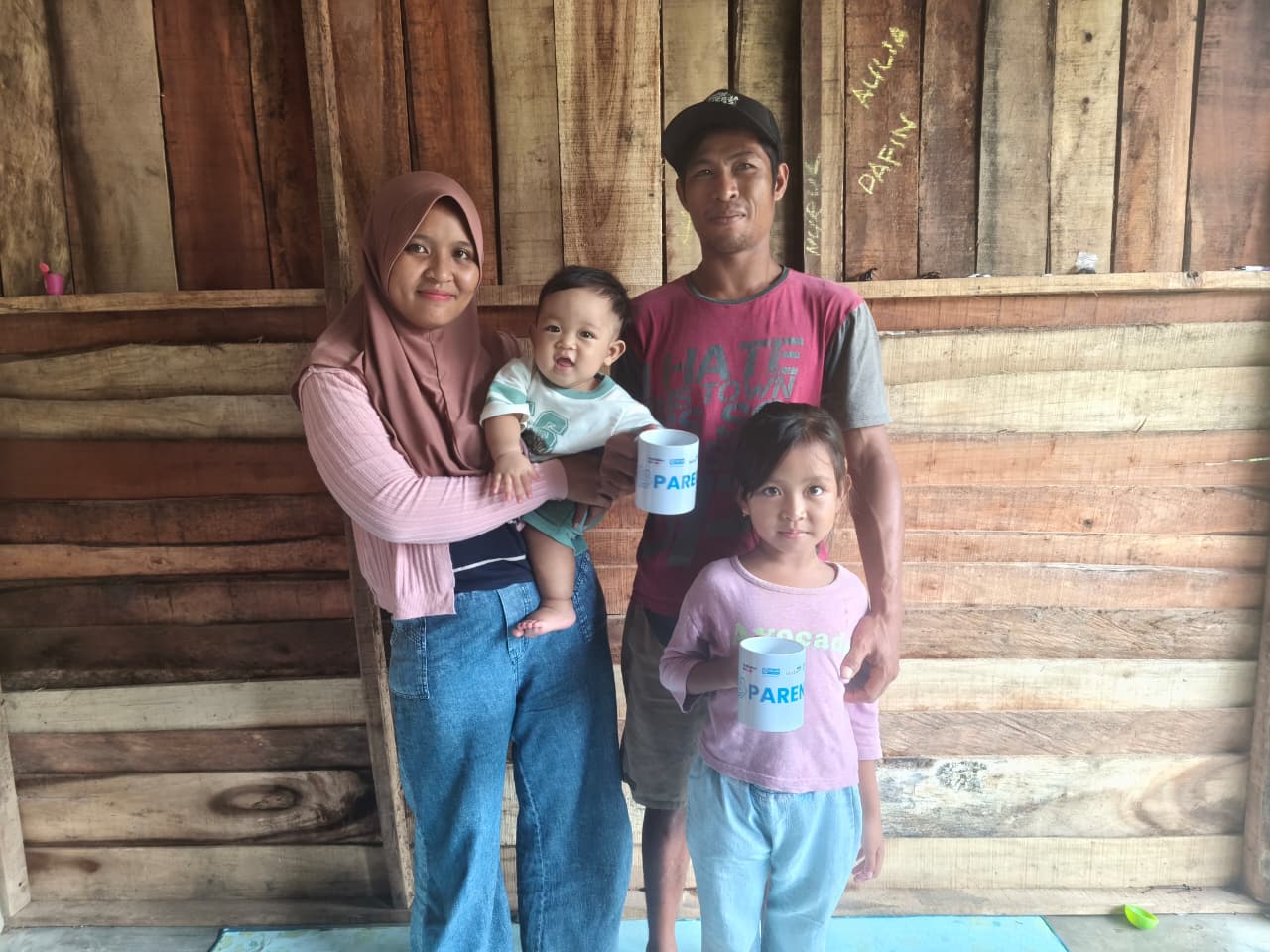
A Shared Journey of Learning: How Amat and Fitri Transformed Their Parenting in Gelangsar Village
20 April 2026
Pak Ahmad Fikri (34), known locally as Amaq Amat, and Ibu Nurul Safitri (26), or Inaq Fitri, are a couple living in Gelangsar Village, West Lombok. Their journey as parents began early; they married when Fitri was just 17 and had not yet finished high school, while Amat was 23. Due to their young age, they started their family with very limited knowledge or experience in child-rearing. With their first child, they relied entirely on trial and error. Nutrition was not a priority, and communication was often ineffective. They frequently relied on instant complementary foods (MPASI), which led to their first child having an ideal weight issue at the time and a lasting habit of refusing vegetables till today. Their only sources of information back then were the local Posyandu (local health centres) and advice from extended family.
The turning point came in mid-2025 when Fitri began actively participating in the Bina Keluarga Balita (BKB) classes held in her village. Driven by a desire to be a better parent, especially for her second child, she attended the sessions regularly. She found the materials on parenting styles and Clean and Healthy Living Behaviors (PHBS) to be incredibly practical. The interactive delivery by the facilitators made the lessons easy to understand and implement immediately. Even small incentives, like receiving laundry soap as a reward, added to her motivation to maintain cleanliness for her children and home.
The changes Fitri experienced were profound, especially when comparing the upbringing of her two children. While her first child grew up on instant food and struggled with eating vegetables, she now prepares homemade “real-food” MPASI for her second child. Amat noted a significant difference: their second child is much healthier, their diet is carefully controlled, and they experience fewer tantrums. Fitri also shared how the classes helped her manage her emotions, allowing her to be more patient and better at balancing her role as a mother. By applying the “four-star” balanced nutritional menu she learned in BKB class, she has seen her second child grow more optimally than the first child did at the same age.
This transformation was further strengthened by Amat’s own involvement through the other BKB that exclusive for fathers, namely “Father Class.” The division of roles within the household has become much more balanced. Previously, Amat was rarely involved in childcare due to his work schedule, but now, he is willing to managed his time and finds it easier to care for his children and is less prone to frustration. He has learned to be a more mindful father, choosing to consult with midwives or village volunteers whenever a health issue arises rather than relying on myths. He recalled a time when their second child had diarrhea; instead of visiting a belian (a traditional village healer) as he might have done in the past, he consulted health workers and followed their advice to avoid instant foods. He also made the crucial decision to stop smoking near his children.
For Fitri and Amat, the most important lesson from these parenting classes is the realization that raising a child is a continuous, shared learning process between a husband and wife. They hope that these classes will continue in their village so that more parents can grow in confidence. As they reflect on their journey, they hold onto a simple but powerful principle: “It is better to learn late than never at all. Let us be good parents who are willing to learn and grow, for great parents are those who are willing to share the journey together.”
Author: Zamroni Rangga Putrawan│Editor: Annisa Hanifa│Photo: Plan Indonesia/Zamroni Rangga Putrawan


