

A Pair of Shoes for Melvi
31 July 2026
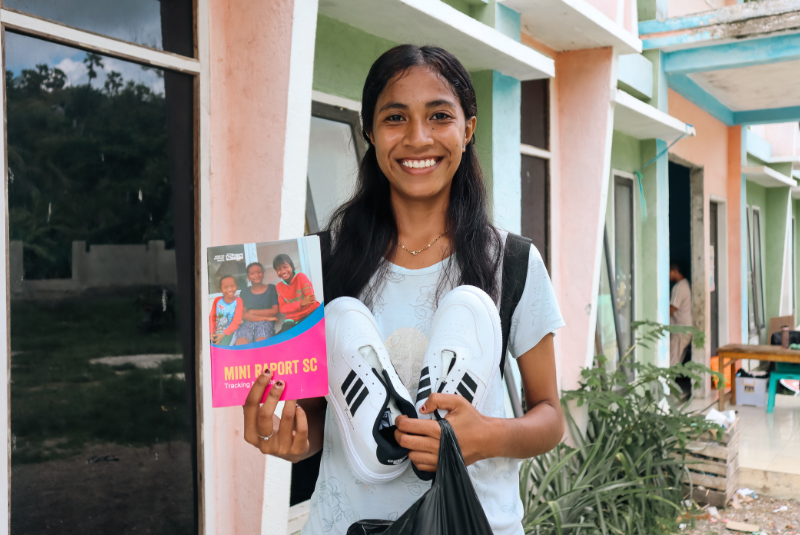
For Melvi, a third-year senior high school student in Lembata, East Nusa Tenggara, education is not something she can access without significant physical effort. Every morning, she walks 6.5 kilometers from her home to school. That means the 18-year-old covers a total distance of 13 kilometers each day just to be able to sit in a classroom.
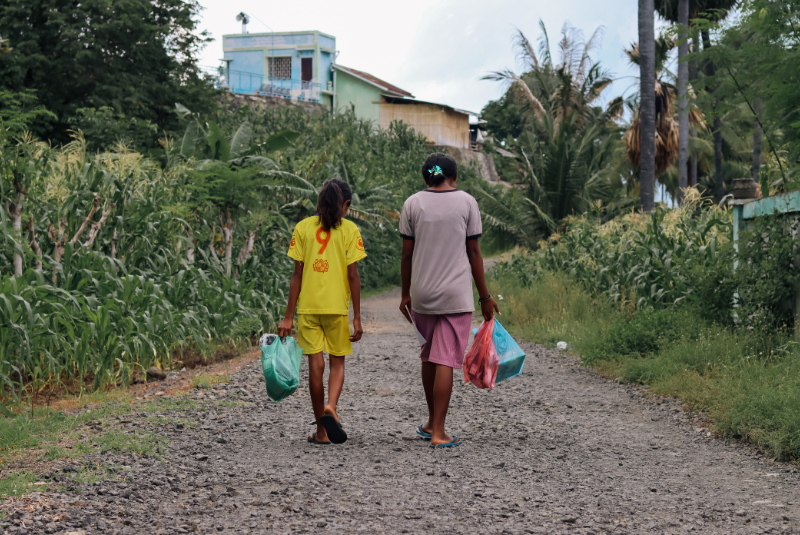
In the area where she lives, public transportation is unavailable. Private vehicles are also rare; when they do exist, motorbikes are typically used by parents to earn a living. Walking is the only way for Melvi to continue attending school while still living at home. She has chosen not to stay in a dormitory or rented room, as at her age, direct parental supervision remains a priority.
However, Melvi’s greatest challenge is not the distance, but the road itself. What was once asphalt has long since deteriorated, leaving behind a stretch of coarse aggregate that has become the main enemy of her shoe soles. The remaining crushed stones from the road’s base layer—exposed after the asphalt eroded—quickly wear down her footwear until it becomes dangerously thin.
“Every day we walk on roads like this, so our shoes wear out very quickly. Usually after six months, they can’t be used anymore,” Melvi said when met recently. “Once they’re damaged, we have no choice but to buy new ones, because wearing shoes is mandatory at school.”
Buying new shoes every semester is an additional burden that is not easy for households in the area to bear. Melvi and her friends are well aware of this reality. They often suppress the desire to ask for new shoes. Their motivation to learn must contend with obstacles that may seem trivial to others: thinning soles or torn leather.
Since 2024, a new approach has been introduced by Plan Indonesia through the Lembata Area Implementation Program. To support the education of sponsored children, Plan Indonesia has moved away from the old model of distributing static support packages. In the past, mass distribution of uniform items often failed to address children’s specific needs. Support frequently missed the mark—such as when a child received a new backpack, while their most urgent need was a pair of shoes to navigate rocky roads.
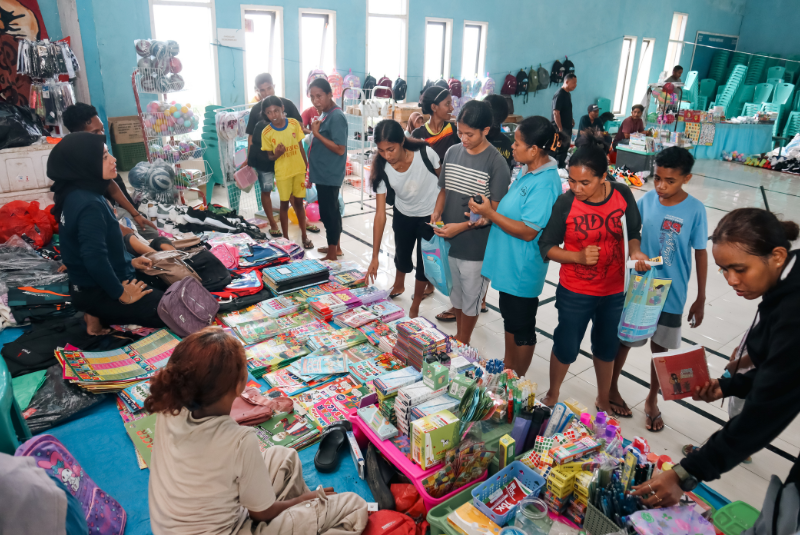
Instead, a Voucher Cash Assistance (VCA) scheme was introduced through school supplies bazaars. Under this system, decision-making power shifts into the hands of children themselves. Accompanied by their parents, they come directly to the bazaar locations, which partner with local vendors. There, they are no longer passive recipients, but active decision-makers.
Children are given the freedom to choose the items they need most, ranging from shoes and books to stationery. This scheme does more than distribute material support—it recognizes and respects children’s autonomy in setting priorities for their education.
“Last year I used it to buy shoes, and this year I bought shoes again. The rest I used to buy books and pens,” Melvi said. Because the shoes she bought the previous year are still in good condition, she now has two pairs that she can alternate to make them last longer.
For Melvi, a new pair of shoes obtained through this support scheme is more than just school equipment. It is an essential tool that ensures her journey is not halted simply because a sole has worn through. This support serves as a bridge to access—allowing Melvi to continue growing within the warmth of her family home, without having to live away from her parents just to pursue her education.
For many people, a pair of shoes may not be seen as a key indicator of educational quality. Yet they are a basic requirement explicitly stated in school regulations. Without proper shoes, a child can lose the confidence to attend school and may even face sanctions for being deemed non-compliant with uniform rules.
Now, as Melvi looks ahead to her final year of senior high school, she does so with greater peace of mind. “If we use the vouchers wisely, they really help with school needs,” she concluded.
Written by: Alfred Ike Wurin | Editor: Hesti | Photo: Alfred Ike Wurin/Plan Indonesia


