

A Mentor’s Story: How a Little Support for Young People Can Amplify Change
06 October 2026
This is the story of Komunitas Batik Aeramo, and how a group of young people their village once looked down on turned a little support into 2,000 mangroves protecting their coast, as told by their mentor, Ervin Dahamu.
From a hangout to a movement
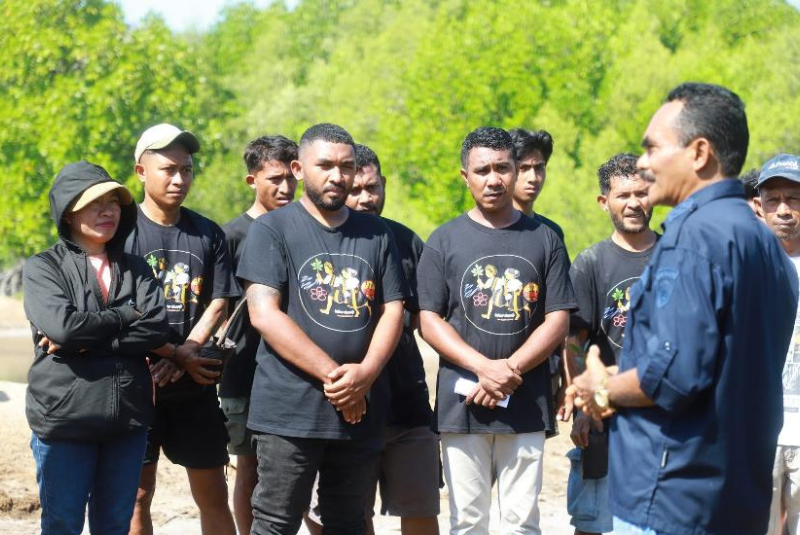
When people ask me about Komunitas Batik Aeramo, I always start with how they began. On 12 December 2012, they were just a group of young men in Aeramo village who liked to hang out together, chatting and joking after the day’s work, with no clear direction. Many residents did not think well of them.
But the more they met, the more they realised their meetings could become something useful for the village. Today the community has 87 members consists of school and university students, daily workers, farmers and small business owners. That diversity is one of their strengths. Their journey shows that a big movement can start from something simple, when people are willing to gather, share ideas and move together.
A coast losing its shield
Aeramo sits on a coast that’s constantly under pressure. At the socialization the community held in May, the Regional Disaster Management Agency (BPBD Nagekeo) and the Environment Office (DLH Nagekeo) spelled out how high was the pressure. BPBD shared that Nagekeo had 278 coastal disasters between 2020 and 2025, and Aeramo has the most people vulnerable to the disaster of all village in the district which is 6,508 residents. DLH showed that Nagekeo’s mangroves shrank from about 948 ha in 2020 to about 653 ha in 2023, where most of the area were cleared for fish ponds. Where mangroves were cut in Aeramo, BPBD estimates the shore erodes about 5 metres a year.
Bill (29), the Batik Aeramo chairman, described the condition in a talk show on Radio Republik Indonesia (RRI) Kupang this July. “Climate change used to feel far away,” he said. “Now its impact hits the coast directly.” During the El Niño drought, coastal wells dried up or turned salty, and fishermen’s catches fell as the fish moved away.
Mangroves were not new to this community. In 2019 they planted around 3,000 seedlings with other partners. But they kept seeing mangroves on the Aeramo coast cut for firewood and cleared for ponds, and they wanted that protection to continue. So, they sent a proposal titled “Green the Coast, Protect Mangroves for the Climate”, to the IKI Small Grants through Plan Indonesia. Bill was clear about what it meant to them: “Planting mangroves isn’t just planting trees. It’s climate action that protects the coast, locks in carbon and makes the people of Aeramo stronger.”
Doing it the right way
What I admire most is that they did not rush to plant. From 28 April to 1 May, they walked the coast with the head of the Nataia clan, who holds customary rights over the land, and the Aeramo village head. The walk brought a hard truth: there was no empty 2-hectare stretch left, only thin strips along the estuary between old mangroves and residents’ ponds. One site had a boundary dispute that could spark conflict, so they let it go. Instead of forcing the original plan, they chose to fill the gaps along the estuary.
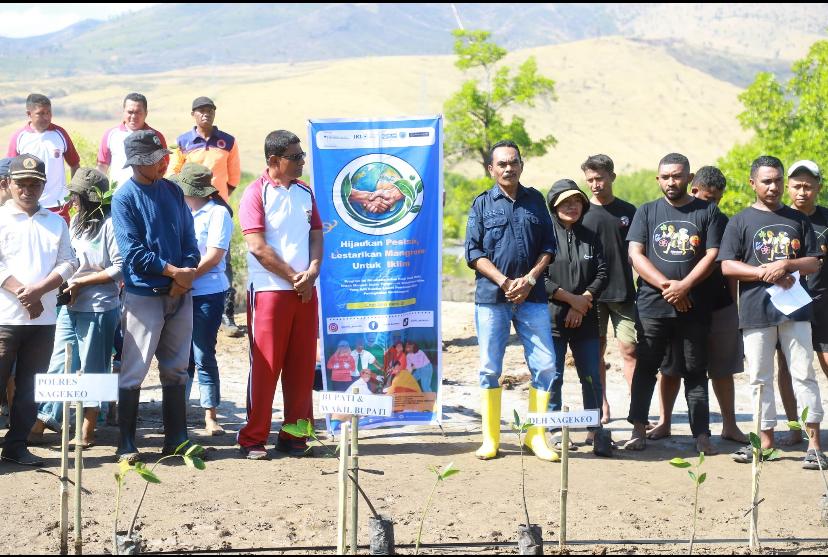
On 4 May, they gathered 57 villagers at the village office. BPBD and DLH laid out the risks, the forest management unit (UPTD KPH Nagekeo) taught how to plant and care for seedlings, and the pastoral council of Yesus Kerahiman Ilahi Parish in Aeramo spoke to their faith. BPBD closed with this line: “BPBD comes when disaster strikes; mangroves stop disaster from coming.” The church reminded everyone that “faith without action is dead.” Science reached people’s minds, and faith reached their hearts.
They were just as careful with the seedlings. They asked three nurseries for quotes. The cheaper offers could only start growing after an order, too late for the season. So, they chose a nursery in Nggolonio with 2,000 four-month-old Rhizophora seedlings ready, and a promise to replace any that died within three months. Before paying, they went to count the seedlings and check them one by one.
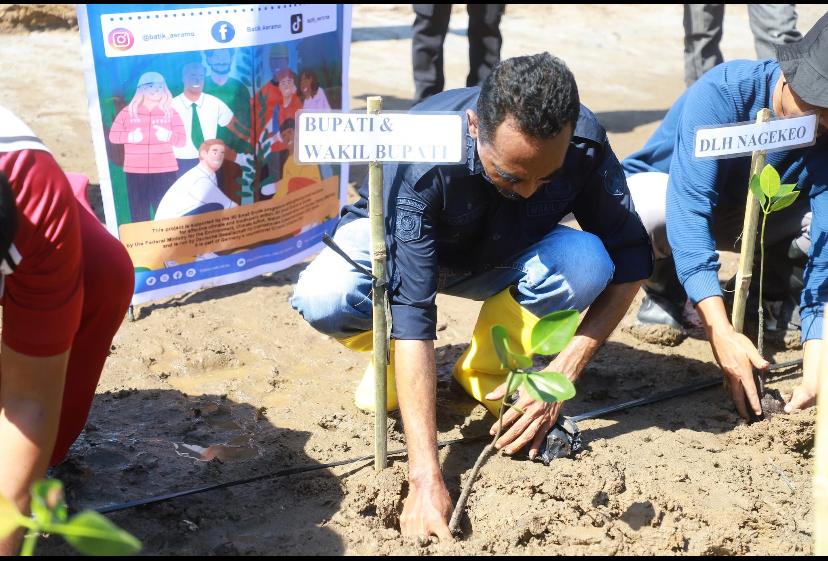
Planting began on 4 August. The Vice Regent of Nagekeo, Gonzalo Gratianus Muga Sada, opened it, alongside DLH, BPBD, UPTD KPH, the police and 95 villagers, each carrying two seedlings to the shore. Standing with the young people, he called on everyone to join them: “We must move together, before it is too late.” He described the mangroves as a gift to future generations and asked residents to keep tending the seedlings. Over the following days, volunteers and residents kept planting in the mud, and on the last day soldiers from the Aesesa Military Sub-district Command and the infantry brigade joined in. By 11 August, all 2,000 seedlings were in the ground. Young people ran everything, from planning to the decisions on the ground. As Bill puts it, “A resilient coast is born when women and men lead together.”
What the grant made possible
“The grant helped us a lot with buying seedlings and running the planting in the field,” the members told me. “With these funds, our climate action could be more planned and more regular.” The money covered the seedlings, transport and the technical needs of planting. Just as important, the young people received the funds and ran every activity themselves.
I have seen the members change. They know far more about why mangroves matter, and they now have real experience in running a project. “We gained new experience in carrying out a project, from planning and fieldwork to reporting,” they said. The work has brought them closer together. The community is better known in the village, and members are more eager to take part in positive activities. The village government has backed them throughout, and residents understand better why mangroves must be protected. A clan leader, the village, four district agencies, the parish, the police and the army all stood behind a plan led by young people, the same young people many residents once wrote off.
The road ahead
The hardest part is yet to come, and Bill is honest about it. “For many people on the coast, the principle is to live for today,” he said. Mangroves pay off only after three to five years, while cutting wood or opening a fishpond brings money straight away. He hopes the Aeramo mangroves can one day become an ecotourism site that earns income for nearby families. For that, he says, the community needs “a living economy, knowledge that levels up, and clear laws,” because many residents are afraid to guard mangroves on land that could suddenly be converted.
The seedlings also need care. KPH counts a planting as successful only if more than 70% survive, and young mangroves can be pulled out by waves, smothered by mud or choked by rubbish. The community’s volunteers will keep checking growth, clearing rubbish and replacing seedlings that die.
My hope is that what they learned through this project becomes their foundation: to plan and manage their own activities more independently, bring in more members and partners, and keep the movement going long after the funding ends. Their dream is to remain a driver of positive change in Aeramo, especially among the young.
Bill’s message to other young people says it best. “The coast is our home,” he said. “Don’t wait for the government. You have energy, a phone, ideas. Start with ten seedlings and three friends.”
In memoriam: Gonzalo Gratianus Muga Sada (1968–2026), Vice Regent of Nagekeo, who stood on the Nagelewa shore with these young people to to launch the mangrove planting. We remember his support for Aeramo’s coast and IKI Small Grants’ youth with gratitude.
This project is supported by the IKI Small Grants programme strengthening local solutions for effective climate and Billdiversity action. IKI Small Grants is funded by the Federal Ministry for the Environment, Climate Action, Nature Conservation and Nuclear Safety (BMUKN) and is run by Deutsche Gesellschaft für Internationale Zusammenarbeit (GIZ) GmbH. It is part of Germany’s International Climate Initiative (IKI).


