

BUILDING RESILIENT CLEAN WATER SERVICES AMID THE PRESSURES OF CLIMATE CHANGE
03 August 2026
That afternoon, the evaluation meeting on clean water services in Kupang City had just concluded. However, the meeting room had not yet completely emptied. Several participants were still chatting over cups of coffee. Music from the 1990s added to the tranquil atmosphere, while outside the building, the sky gradually dimmed as dusk approached.
Amid that atmosphere, the conversation about water was no longer merely about pipes, water discharge, or infrastructure. Rather, it was about how a city strives to withstand increasingly prolonged drought.
“Climate change has had a real impact on water availability in Kupang City. When the dry season reaches its peak in October, water discharge continues to decline while community demand remains high,” said Elsy E. Bengu, who joined the informal discussion after the event.
Elsy is the Head of the Regional Drinking Water Company (PerumDAM) of Kupang City, and therefore has a thorough understanding of the conditions in the field. Unsurprisingly, Elsy also participated in the Evaluation of Kupang City’s Drinking Water Safety Plan (RPAM) in mid-May 2026.
Amid various limitations, Elsy explained that PerumDAM Kupang City continues to strive to ensure that clean water services remain accessible to the community. She acknowledged that the challenge of providing water in a dry region such as Kupang has become increasingly complex.
PerumDAM Kupang City currently provides clean water services to only 18 percent of the population, with 18,000 household connections. Water is sourced from three surface water sources (including the Kali Dendeng Water Supply System/SPAM) and 37 deep groundwater wells.
Under these conditions, expanding access to clean water remains a major task. Areas that have not yet been fully reached by the piped water network face even greater challenges.
Challenges Faced by PerumDAM
Many factors pose challenges to the provision of clean water services, ranging from water availability and infrastructure to limited funding.
Under these circumstances, access to clean water is no longer merely a matter of basic service provision. It has also become an important component of community resilience in the face of climate change. When access to water is disrupted, the impacts are felt not only in public health, but also in household economies, children’s education, and women’s workload.
“There are still several areas of Kupang City that are not yet adequately served, such as Lasiana, Oesapa, Fatukoa, Naioni, Alak, and Namosain. This remains a major homework assignment for us,” said the middle-aged woman who has devoted herself to PerumDAM for the past 15 years.
In this context, the role of PerumDAM has become increasingly strategic. PerumDAM serves not only as a water service provider, but also as part of the social protection system and community resilience.
The challenge lies in ensuring that water services continue to operate amid the pressures of climate change, limited water resources, and growing community demand.
Meanwhile, water service infrastructure in several areas continues to face limitations. Around 50 percent of PerumDAM Kupang City’s pipeline network has already been replaced or repaired because it has exceeded 10 years of service.
This condition increases the risk of leakage and Non-Revenue Water (NRW), which currently stands at approximately 30 percent.
In addition to affecting distribution efficiency, Kupang City’s geographical conditions also make the provision of clean water services more challenging, particularly in reaching areas with difficult topography.
As a result, some residents who are not yet connected to the piped water network are forced to purchase water delivered by tanker trucks to meet their daily needs. For one tanker with a capacity of 5,000 litres, residents must pay approximately IDR 70,000 to IDR 85,000, depending on the delivery distance.
Strategies and Innovations to Support Communities
Through the Drinking Water Safety Plan (RPAM), developed jointly with Plan Indonesia, PerumDAM Kupang City has begun strengthening various strategies to address the challenges of providing clean water services amid the pressures of climate change.
One of the measures taken is to optimise water production and distribution so that supplies can continue to reach customers despite declining water discharge from source areas.
Whereas previously water could be supplied up to three times a week, during certain periods distribution must be reduced to one or two times a week. This is done to maintain service continuity across all customer areas.
Efforts to protect water sources have also been strengthened. Together with various stakeholders, PerumDAM Kupang City has carried out tree planting in the Kali Dendeng Water Supply System (SPAM) area, implemented the “PerumDAM Bergetar” (Water Planting Movement) programme, and promoted the construction of infiltration wells and biopore holes as part of water source conservation efforts. Novika Noerdiyanti, CERAH Project Manager at Plan Indonesia, explained that public education is also an important component of the water resilience strategy. Together with Plan Indonesia’s CERAH Programme, education on water conservation and access to clean water services has been conducted in sixsub-districts in Kupang City, namely Liliba, Penkase, Lasiana, Manutapen, Fontein, and Alak. Similar information has also been disseminated through radio podcasts and social media platforms such as Instagram, TikTok, Facebook, and websites to reach a wider audience.
The CERAH Programme supports PerumDAM Kupang City in strengthening water services to become more resilient to climate change, ranging from water source protection, reducing water loss, expanding network coverage for vulnerable communities, to providing alternative clean water supplies during the dry season.
Inclusive Water Services
One important aspect of this programme is promoting inclusive clean water services.
Women are among those most affected because they bear the primary responsibility for managing household water needs. When water supplies decline, women must spend more time collecting water or managing daily household water use.
The same applies to persons with disabilities. Limited physical access to water sources and service facilities can increase their vulnerability. Water distribution routes, service point locations, and complaint mechanisms have not yet fully taken into account the needs of persons with disabilities.
Low-income communities also face their own challenges. When piped water services are unavailable, they are often forced to purchase water from alternative sources at higher prices. This situation demonstrates that access to water is not only a matter of availability, but also of equitable service.
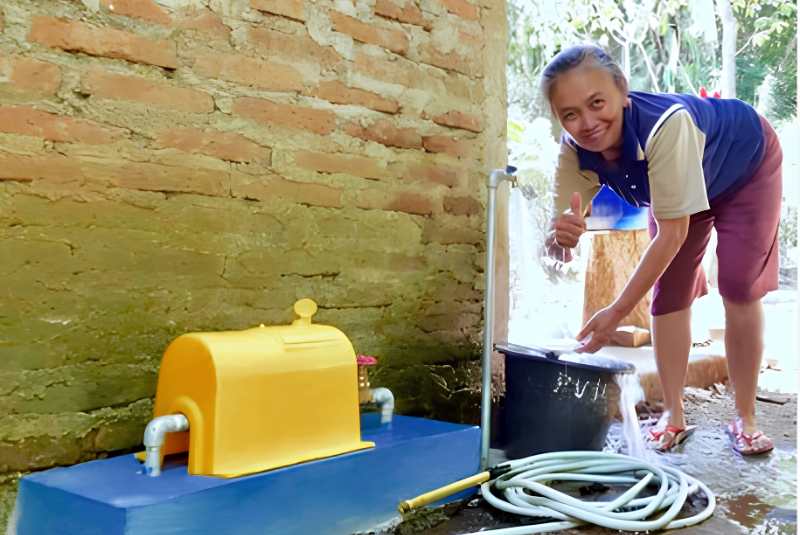
Efforts to strengthen inclusive clean water services therefore continue. During the 17th anniversary celebration of PerumDAM Kupang City in 2026, free household water connections were installed for 17 low-income households.
In addition, a water-sharing programme has been implemented through the distribution of water by tanker trucks to communities in need, particularly during water crises in the dry season.
“As long as there are still people struggling to access clean water, our task is not yet complete. In every drop of water lies the human dignity that we strive to protect,” said Isidorus Lilijawa, Director of PerumDAM Kupang City.
Clean water services are no longer viewed merely as a matter of distribution and infrastructure, but also as part of efforts to safeguard the quality of life of the community, particularly those groups most vulnerable to water crises. For Kupang City, building resilient water services means building the resilience of the community itself. For as long as there are still people who struggle to obtain clean water, those efforts will continue to flow, one drop at a time


