

THE DREAM OF FAIR ACCESS TO WATER FOR PEOPLE WITH DISABILITIES IN KUPANG CITY
05 August 2026
Water in Kupang is like a luxury item. Amid physical and economic constraints, people with disabilities are forced to dig deeper into their pockets for a drop of clean water.
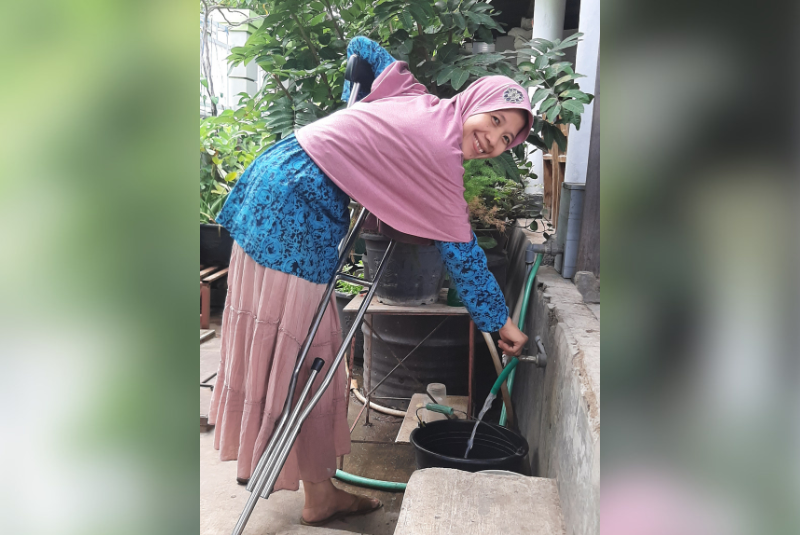
That afternoon, the scorching sun in Kupang City felt intense. Sriyanti, 48, a woman with a physical disability, walked using crutches in the yard of her home in Nefonaek Village. She enthusiastically welcomed me. her face calm with a radiant smile.
Without hesitation, the woman affectionately known as Ibu Sri invited me to sit in front of her small kiosk. Her business is modest, but sufficient to meet her daily needs. She has always been determined to live independently. To her, living with a disability has never been a reason to depend on others.
Ibu Sri realizes that she must continue working, especially as the cost of living keeps rising. Prices of basic necessities continue to increase, including the cost of obtaining clean water. Ironically, this most fundamental necessity remains difficult for her to access.
“In the past, water from the Regional Water Utility (Perumda DAir Minum) flowed twice a week. Now, it usually comes only once,” she complained.
This situation has forced her to be even more frugal in using water at home. Whenever her water supply runs out before the next scheduled distribution, she has no choice but to purchase water delivered by tanker trucks to meet her family’s daily needs.
For the residents of Kupang City, buying water from tanker trucks is nothing new. However, over the past few years, obtaining access to clean water has become increasingly difficult.
Ibu Sri also worries about her fellow persons with disabilities living in other villages, such as Oebufu, Maulafa, and Sikumana. They face the same hardships.
When water from PerumDda Air Minum flows normally, households spend around IDR 70,000–80,000 each month. But when the water supply becomes unreliable, those expenses can triple. Residents are forced to purchase water from tanker trucks, which comes at a considerable cost.
On average, each household requires two to three tanker loads of water every month, with each 6,000-liter tanker costing approximately IDR 70,000–85,000. This means that a family may spend up to IDR 240,000 per month on water alone. For many persons with disabilities whose economic conditions are modest, this financial burden is extremely difficult.
At this point, Ibu Sri feels that the mandate of Article 33, Paragraph (3) of the 1945 Constitution, which states that the land, water, and natural resources contained therein shall be controlled by the State and utilized for the greatest prosperity of the people, feels far removed from reality—particularly for persons with disabilities in Kupang City, East Nusa Tenggara.
Meanwhile, the declining water supply over recent years has become one of the most tangible signs of climate change experienced by local residents. The seasons have become increasingly unpredictable. Rainfall arrives irregularly, while periods of intense heat last much longer than they once did.
Amid these circumstances, persons with disabilities are frequently overlooked in development planning, despite being among the most vulnerable groups affected by these challenges. According to data from the Kupang City Social Affairs Office, the city is home to 1,023 persons with disabilities, comprising 576 men and 447 women. They face not only limited access to basic public services but are also rarely involved in decision-making processes.
Recognizing these challenges, Plan Indonesia’s CERAH Program was established to promote more inclusive water and land management by ensuring the meaningful participation of women, young people, and persons with disabilities in decision-making.
For Plan Indonesia, access to clean water and a healthy environment forms an essential part of fulfilling children’s rights and advancing gender equality for girls. As water resources become increasingly scarce, the consequences extend beyond today’s households, affecting the health, education, and overall quality of life of children and adolescents in the future. For this reason, inclusive water governance must ensure that the needs of vulnerable groups become part of the solution rather than merely treating them as beneficiaries. Beyond improving water access and climate resilience, the program also creates advocacy spaces to ensure that the voices of vulnerable communities are increasingly heard in development planning—from the village level to the city level.
The CERAH Program and the Inclusive Dialogue
At the end of March 2026, the Kupang City Hall hosted an Inclusion Dialogue, bringing together representatives from the local government, organizations of persons with disabilities, environmental communities, and academics to discuss challenges related to water access and climate change in Kupang City.
One of the key reflections and recommendations emerging from the forum was that public facilities remain insufficiently
accessible. Not all public buildings provide adequate access, particularly for persons with disabilities. This serves as a reminder that creating an inclusive city requires not only spaces for dialogue but also public infrastructure that is accessible to everyone.
The situation illustrates that, despite ongoing efforts to build a more inclusive city, many public facilities still fail to accommodate persons with disabilities.
Nevertheless, these accessibility barriers did not diminish the participants’ determination to voice their aspirations. One after another, participants shared stories about the difficulty of accessing clean water and the lack of inclusive public facilities. Erwin, a wheelchair user with a physical disability, explained that his household now depends largely on tanker-delivered water. Every month, his family uses approximately two to three tanker loads simply to meet their daily needs. Under these circumstances, the burden extends beyond persons with disabilities—it also affects the broader community, especially women. “Women are affected even more because we menstruate every month, which means we need greater access to clean water. When water becomes difficult to obtain, it inevitably affects our hygiene and health,” said Fitri, a youth representative, during the meeting. The dialogue broadened perspectives while encouragingthe local government to adopt policies that are more responsive to the needs of persons with disabilities.The Kupang City Government has committed itself to pursuing more inclusive development. This commitment was expressed by Ignasius Lega, Assistant II to the Mayor of Kupang, during the meeting. He emphasized that access to clean water remains one of the local government’s priorities, including ensuring that future water infrastructure development pays greater attention to the needs of persons with disabilities. The government also pledged to encourage the participation of persons with disabilities in development planning processes, including the Development Planning Consultation (Musrenbang).
Taking Action to Love and Care for the Environment
Beyond creating spaces for dialogue, collaboration among multiple stakeholders through the CERAH Program and organizations of persons with disabilities has begun to take shape through a variety of environmental initiatives across Kupang City.
These activities have been adapted by using simple language, visual and audio learning materials, and the active involvement of organizations representing persons with disabilities through various activities.
Biopore education have been conducted in Bakunase II, Oesapa, and Kolhua Villages, involving disability groups and young people. The Kupang Deaf Community (KTK) even produced short educational videos on biopores to make the information more accessible to the deaf community.
Tree-planting activities have also been carried out within the Liliba and Kolhua Watersheds as part of broader efforts to protect water sources and conserve the environment. Gradually, the impact has begun to emerge. Persons with disabilities are becoming increasingly active in environmental conservation activities and more confident in expressing their opinions during public discussions.
Serafina Bete, Chairperson of the Christian Association of Persons with Physical Disabilities (Persani) East Nusa Tenggara, hopes that collaborations like these will continue to expand, enabling more people to recognize the importance of protecting water resources and the environment together. Inclusion is not merely about ensuring that everyone is present in the same space—it is about ensuring that every voice is heard and valued. Efforts to protect water and land can only become truly sustainable when no one is left behind.
Written by: Herning Tyas Ekaristi | Editor: Annisa Hanifa


