

Youth Leadership Summit 2025: Empowering Young Changemakers for Gender-Responsive Climate Action
12 October 2025
Jakarta, 12 October 2025 – Asia-Pacific faces intertwined challenges when it comes to climate change and gender. Women and girls are disproportionately vulnerable to climate impacts, yet they often have less access to decision-making, resources, and support to adapt. According to For Our Futures report from Plan International, more than 12.5 million girls each year are estimated to be prevented from completing their education because of climate change effects.
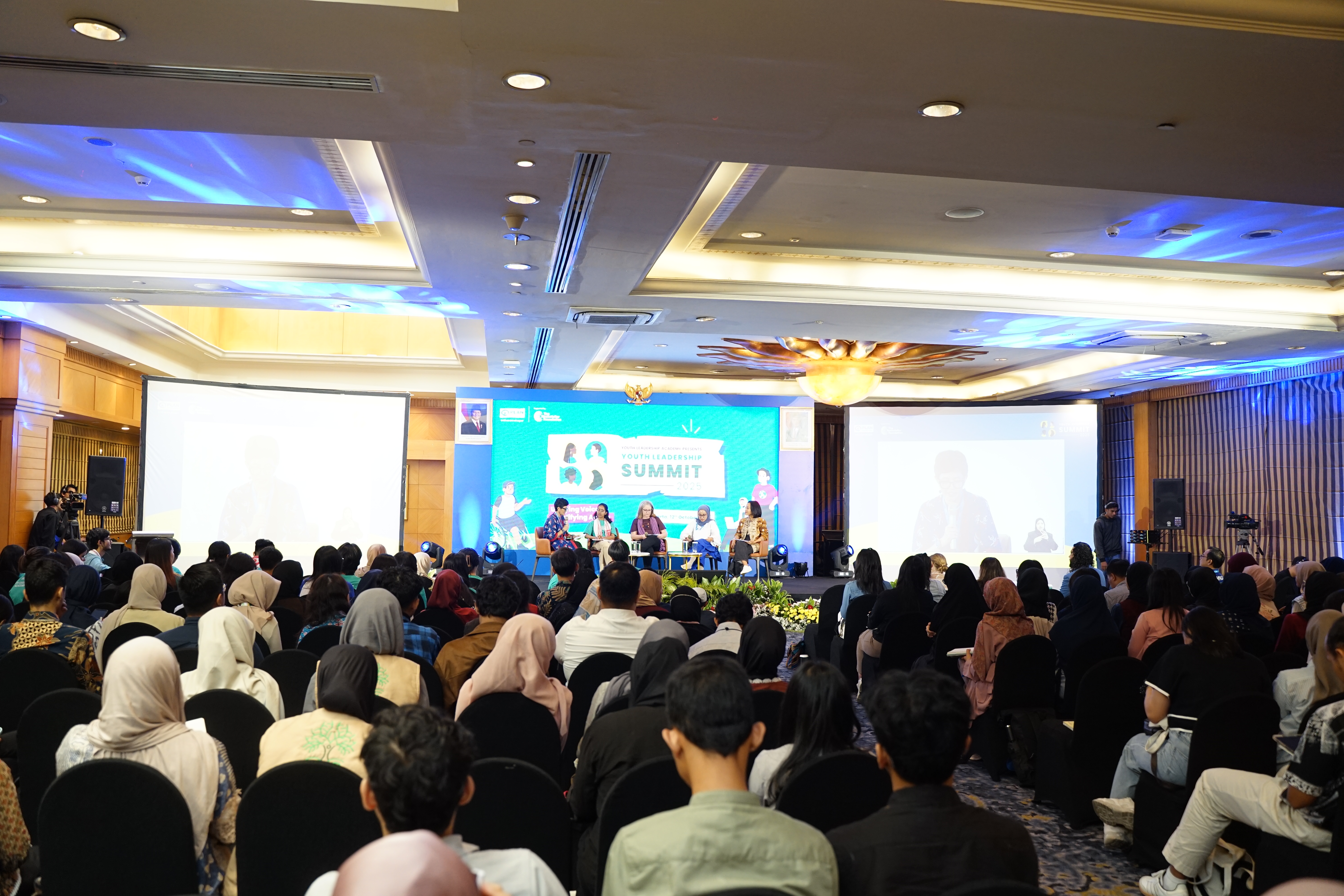
These shared challenges call for collective action, where young people, especially girls and young women, take the lead in driving innovative, inclusive, and gender-responsive climate solutions across the region. Today (12/10) the Youth Leadership Summit (YLS) 2025 embodies this spirit, bringing together young leaders from across Asia-Pacific in Jakarta for a landmark event under the Youth Leadership Academy (YLA) for Gender and Climate Action, an initiative by Plan International with support from The Rockefeller Foundation.
The Youth Leadership Summit serves as the capstone of the year-long YLA programme, that has strengthened young people’s leadership on gender and climate action. Through YLA, 40 Youth Ambassadors from India, Vietnam, Indonesia, Thailand, and the Philippines have developed and implemented innovative, gender-responsive climate solutions in their communities.
Held in a hybrid format, both offline in Aryaduta Hotel, Jakarta and online, with over 1,000 thousand audience attending, the Youth Leadership Summit brings together youth leaders, policymakers, NGOs, and private sector representatives to showcase youth-led climate innovations, foster collaboration, and inspire regional solidarity in advancing inclusive climate solutions.
Amplifying Youth Voices for Regional Impact
The Youth Leadership Summit opened with remarks from Sharon Kane, Director of Sub-Region, Asia-Pacific, Plan International, who emphasized the importance of empowering youth as agents of change in the climate crisis.
“Across the Asia-Pacific region, young people are not just the leaders of tomorrow, they are already leading today. Through the Youth Leadership Academy, we see how innovation, empathy, and courage come together to drive meaningful climate and gender action. This Summit celebrates their leadership and amplifies their collective voice.”
Marjuki M.Si., as the Director of Applied Climate Services, the Indonesian Agency for Meteorology, Climatology, and Geophysics (BMKG), in her keynote speech highlighted the importance of inclusion and science-based innovation in disaster and climate resilience.
“The planet is warming faster than ever, and 2024 ranks among the hottest years on record. This is not a distant issue, it is a crisis happening now. Young people are both the most affected and the most powerful drivers of change. We face three Cs: Change, Crisis, and Choice. The climate is changing, we are in crisis, and together we must choose to act.”
The Youth Leadership Summit 2025 underscores the power of collaboration and youth-led innovation in achieving inclusive climate resilience. Beyond celebrating achievements, the event also opens pathways for sustained partnerships and policy engagement to ensure young people’s contributions are recognized and supported at all levels.
Throughout the day, participants joined two plenary sessions and six breakout discussions, each exploring how inclusive leadership and innovation can accelerate climate justice in the region.
The first plenary, “Feminist Leadership in Times of Climate Crisis,” examined how gender equality and feminist principles can transform the way communities respond to environmental challenges. The second plenary, “Meaningful Youth Participation in Policy & Advocacy,” focused on how young people can influence decision-making spaces and shape climate policies at national and regional levels.
In the breakout sessions, youth participants and experts explored specific themes, including:
- Rethinking Waste and Consumption for Sustainable Lifestyles
- Art, Media, and Storytelling for Social Change
- Women & Girls in Tech-Driven Climate Solutions
- Youth and Persons with Disabilities in Disaster Preparedness
- Building Pathways for Sustainable Business and Green Jobs
- Youth Mental Health in Leading Change
The Summit was attended by an inspiring lineup of speakers, thought leaders, and changemakers from across the region, including Merry Puteri Miss Universe Indonesia Top 6; Amanda Katili Niode, Director of The Climate Reality Project Indonesia; Gita Syahrani, Head of the Executive Board, Earth-Centered Economic Coalition; Meizani Irmadhiany, Senior Vice President and Executive Chair, Konservasi Indonesia; Intan Anggita Pratiwie, Co-founder of Setali Indonesia; Laetania Belai Djandam, Indigenous Dayak Climate Storyteller and Sapek Player; Mustika Wijaya, Founder and Executive Director, Solar Chapter; Ela Nurlaela, Head of the Cianjur Regional Office, Himpunan Wanita Disabilitas Indonesia; Quyen Nguyen, CEO and Founder, Lại Đây Refill Station; and Gabriela Fernando, Assistant Professor in Global Health, Monash University Indonesia, among others.
Showcasing Youth-Led Climate Actions
The Youth Leadership Summit featured presentations of youth-led, gender-responsive climate initiatives developed under the Youth Leadership Academy. In Vietnam, The Safe Steps equips young people in flood-prone regions with disaster preparedness skills. In Thailand, the Green Caviar Project promotes sustainable farming and income generation inspired by the rare plant Wolffia. From Indonesia, SAFE for Climate and Gender mobilizes high school students through art and creativity to raise awareness on climate and gender issues, while EcoVibes engages communities across five regions in tackling waste and climate challenges through workshops and policy dialogues.
In the Philippines, YouLEARN unites youth from multiple provinces to address waste management. Meanwhile, in India, Green Voices for a Sustainable Future nurtures grassroots environmental leadership in underserved communities, and the Girls Climate Parliament empowers girls from marginalized backgrounds to lead local climate solutions and advocate for education, inclusion, and leadership.
“Through the Youth Leadership Academy and this Summit, I’ve learned that climate action is not just about protecting the planet, it’s about protecting people,” said Girish, Youth Leadership Academy Ambassador from India. “When we put gender equality at the heart of our solutions, we make them stronger and more inclusive. Youth leadership means using our voices, creativity, and courage to build a future where everyone, especially girls and marginalized communities, can thrive in the face of the climate crisis.”
***
About the Youth Leadership Academy (YLA)
The Youth Leadership Academy (YLA) for Gender and Climate Action is an initiative of Plan International Asia-Pacific, funded by The Rockefeller Foundation. It aims to strengthen youth leadership, critical thinking, and advocacy skills to address the intersection of gender equality and climate change. The program supports 40 youth ambassadors across five countries, India, Vietnam, Indonesia, Thailand, and the Philippines, in designing and implementing gender-responsive climate actions with real-world impact.
About Yayasan Plan International Indonesia (Plan Indonesia)
Since 1969, Plan International has operated in Indonesia; in 2017, it changed its name to the Yayasan Plan International Indonesia (Plan Indonesia). We seek to advance girls’ equality and realize children’s rights. We also work with young people to enable meaningful engagement in life decisions. Plan Indonesia, a subsidiary of Plan International Inc., runs a major child sponsorship program. In East Nusa Tenggara, Plan Indonesia has fostered 32,000 boys and girls with five pledges to uphold their fundamental rights: the right to birth certificates, essential vaccinations, clean water, sanitation, and cleanliness, as well as education. Plan Indonesia operates in eight provinces through programs with the main goal to build a Healthy, Educated, Empowered, Safe and Resilient Generation. These initiatives seek to strengthen the ability of social movements to engage and focus on 3 million girls to have equal representation, equal power, and equal freedom. For further details: planindonesia.org


