

SPAB’s Implementation Module Now also Discusses Bullying and Gender Equality for Children
20 July 2023
Jakarta, July 20, 2023 – Keeping children safe at school is not enough to mitigate the risk of disaster due to natural threats. It also requires special attention to everyday issues, such as bullying, sexual violence, and gender inequality. The goal is that the school environment can ensure that children are free from all risks and can learn in a Disaster Safe Education Unit.
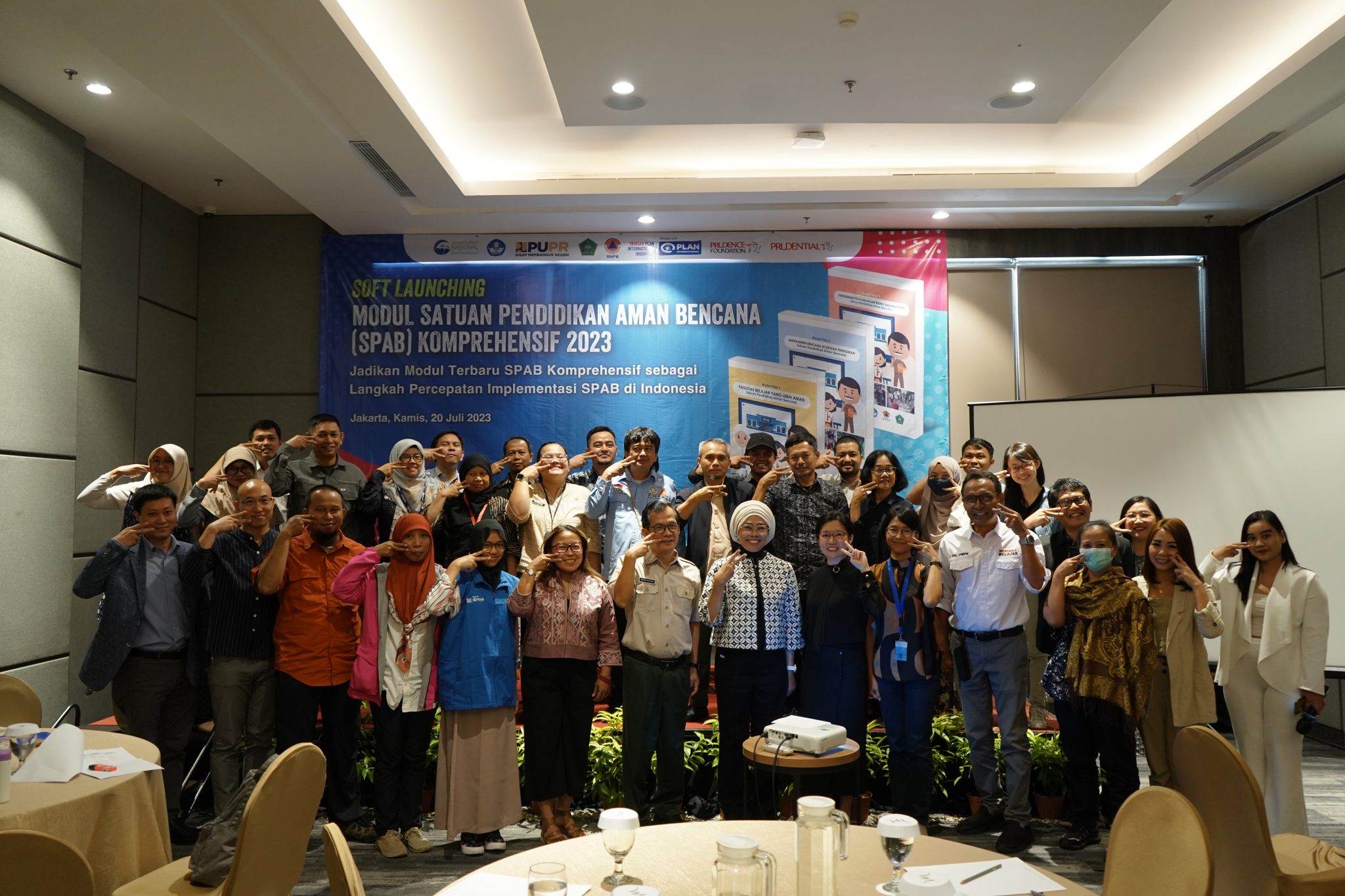
To help realize this goal, Yayasan Plan International Indonesia (Plan Indonesia) together with the SPAB National Secretariat (Seknas) of the Ministry of Education, Culture, Research and Technology (Kemendikbudristek), with the support of the Prudence Foundation and Prudential Indonesia, launched the Comprehensive SPAB Module in Jakarta, Thursday (20/07/2023). This module will be used by teachers and facilitators throughout Indonesia, as a reference or guide in implementing SPAB at the education unit level. 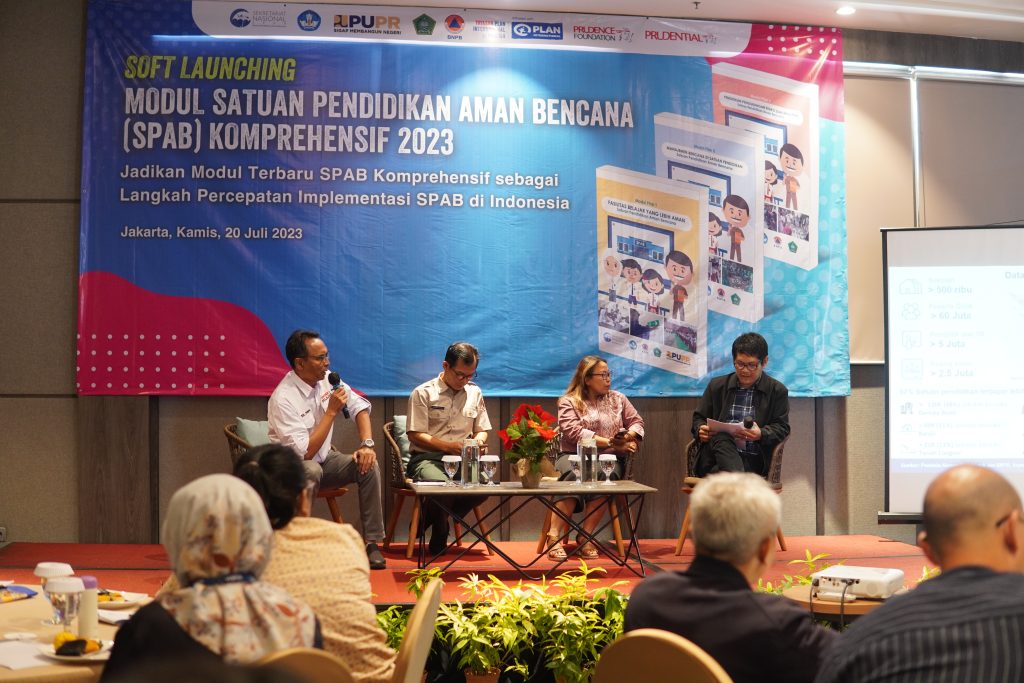
Dini Widiastuti, Executive Director of Plan Indonesia, said that this module was created with the interests and safety of children throughout Indonesia in mind. “We need to ensure that all children, including girls and people with disabilities, can feel safe and comfortable in teaching and learning activities. This is expressed in real terms, starting from the guideline module that discusses facility design to disaster management of education units in the daily context,” Dini said at the launch of the Comprehensive SPAB module in Jakarta, Thursday (07/20/2023).
This comprehensive module developed by Plan Indonesia together with Seknas SPAB Kemendikbudristek will cover the three main pillars of SPAB, namely safer facilities, disaster management and education continuity, to risk reduction and resilience education. Unlike the SPAB implementation module released in 2015, this module also discusses threat management from the protection side. For example, regarding bullying, sexual violence, and gender inequality. The issues in this module also cover the five main disaster threats that children and school environments may face, namely natural disasters and climate change, threats of technological failure, threats of biological and health hazards, threats of conflict and violence, as well as everyday threats.
Prudence Foundation Director, Nicole Ngeow, said that her organization specifically highlighted the importance of comprehensive SPAB development. According to Nicole, disasters can result in many children being left behind, having to miss out on school or even dropping out.
“Disasters disrupt children’s education, preventing them from developing their potential. Our support by strengthening education units through the implementation of SPAB, hopes to help children stay safe, healthy and resilient, even in emergencies,” said Nicole.
Not only does this module contain implementation guidelines, it also contains good practices of SPAB implementation throughout Indonesia. The aim is for schools to be able to compare and learn from implementation experiences in other regions.
“This module will be distributed throughout Indonesia through the Regional Disaster Management Agency and the Provincial and Regency / City Education, Youth and Sports Offices. In addition, to reach all around five million educators, this module will be adapted in the form of learning videos that will be loaded on the Merdeka Mengajar platform developed by the government,” said Jamjam Muzaki, Seknas SPAB Expert.

In 2019, the Ministry noted that 52,902 schools were located in earthquake-prone areas, 54,080 in flood-prone areas, and 15,597 in landslide-prone areas. Thus, education units need to prepare themselves to face disasters, one of which is through the implementation of the Disaster Safe Education Unit (SPAB). Plan Indonesia has also launched the SPAB Model Province program to encourage the implementation of SPAB in Indonesia. This program took place in two provinces namely D.I Yogyakarta and Bali for 36 months. The hope is that through this program, all provinces in Indonesia can implement SPAB by emulating the implementation carried out in the two provinces.
About Yayasan Plan International Indonesia (Plan Indonesia)
Plan International has been working in Indonesia since 1969 and officially became Yayasan Plan International Indonesia (Plan Indonesia) in 2017. We work for the fulfillment of children’s rights and equality for girls. We also work with young people, to ensure meaningful participation in decision-making about their lives. As part of Plan International Inc, Plan Indonesia has a key program related to child sponsorship. Plan Indonesia has supported 36,000 girls and boys in East Nusa Tenggara, with five commitments to fulfill their basic rights: birth certificates, basic vaccines, clean water, sanitation and hygiene, and education. Plan Indonesia works in 8 provinces through seven thematic programs, namely Prevention of Child Growth Failure, Elimination of Violence against Children and Young People, Adolescent Health, Youth Employment and Entrepreneurship, Resilient Schools, Disaster Preparedness and Gender Responsive Humanitarian Response, and Youth-led Climate Resilience. These programs aim to increase the capacity of leadership, agencies, and social movements that engage and target 3 million girls for equal power, equal freedom, and equal representation.
For more informationa: plan-international.or.id
Media Contact:
Muhammad Reysa – Programme Communication Specialist Plan Indonesia
[email protected] – Ph: +62 853-4295-5021


