

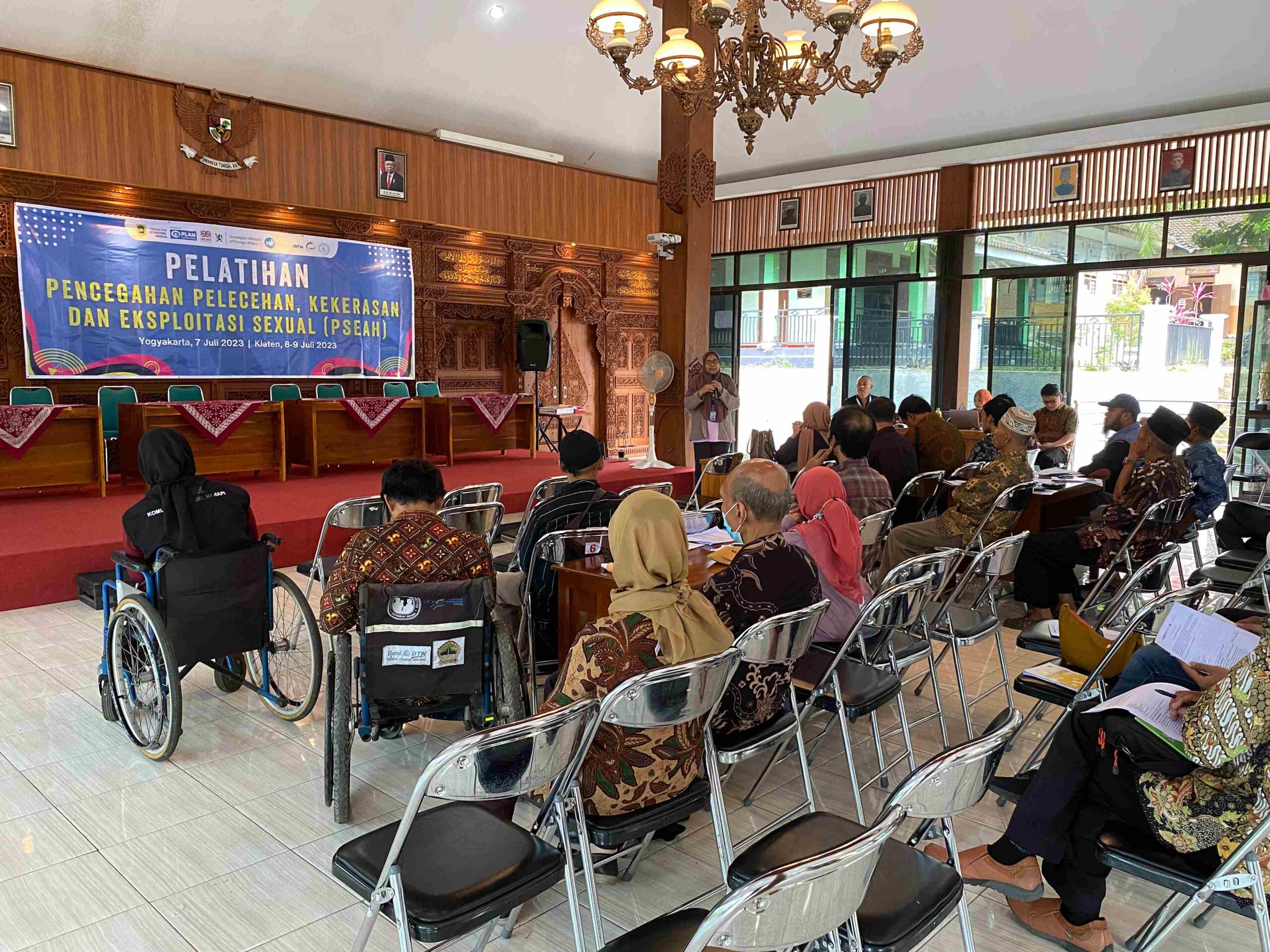
PSEAH Training, Building a Safe Environment for Vulnerable Group
13 November 2023
Yayasan Plan International Indonesia (Plan Indonesia), in collaboration with Yakkum Emergency Unit (YEU) and the Association of Persons with Disabilities (PPDK) in Klaten, organized the Preventing sexual exploitation, abuse and harassment (PSEAH) training with the aim to provide a deep understanding to project stakeholders regarding the Safeguarding Policy and GESI (Gender Equality and Social Inclusion) and its implementation within the scope of each organization involved in the project.
Ida Ngurah, Humanitarian and Resilience Program Manager at Plan Indonesia, highlighted that the training aims to enhance stakeholders’ understanding of of distinctive risks and corresponding mitigation measures when integrating vulnerable groups, including children, youth, persons with disabilities, and the elderly, into its activities, including humanitarian responses. “This activity is more than just a workshop or an awareness session; it includes consultation meetings to enhanc understanding of the principles and policies of PSEAH, which are vital within the humanitarian framework, especially for stakeholders,” Ngurah expressed.
Related stakeholders gathered in face-to-face sessions facilitated by Plan Indonesia. In line with the inclusion principle underlined in this project, this session enables stakeholders to actively participate in developing feedback mechanisms to assist in project implementation.
The program implementers and related stakeholders are expected to have a deeper understanding of the risks faced by vulnerable groups and the mitigation steps required in each stage of the project.
Meilinarti, Inclusion Data Management Project Manager, added that training participants are expected to have better understanding of the policies, principles, and applicable procedures related to PSEAH. “Furthermore, it is expected that program participants engaged in project implementation comprehend the significance of feedback mechanisms to facilitate the successful execution of this project. They are encouraged to reach a consensus on a feedback model that promotes data-driven inclusivity,” Meilin explained.
Several participants expressed that they gained many benefits from this training. “I am happy to participate in this training about protecting women and children. Hopefully, we can protect teenagers and children in the future better,” said Menik, a Member of the Merapi Disability Group (KDM) from Bumiharjo Kemalang Village, Klaten.
Warsito, a member of the Disability Service Unit (ULD) for Disaster Management, BPBD Klaten, revealed that the material presented in this training is exciting, and they will follow up on the results of the activities. “In the future, we want to respond to village governments better, prevent harassment, and create a safe place for displaced people. We hope the support will continue to help shaping better policies for our village,” he stated.
The Preventing Sexual Exploitation, Abuse and Harassment (PSEAH) training is part of the Data-Driven Inclusion program. This program offers innovations in inclusive, participatory data collection and analysis for persons with disabilities, ranging from children to elderly individuals with disabilities, and associations of older men and women. This program is carried out in areas threatened by volcanic eruptions, particularly in Kemalang Subdistrict and Manisrenggo Subdistrict.
The program seeks to develop holistic, innovative solutions to reflect the ideal conditions and needs of the most vulnerable and at-risk individuals, especially during volcanic eruption disasters. This program will involve many humanitarian actors and stakeholders as consultants.
The Data Driven Inclusion Program in Klaten Regency is funded and supported by the Humanitarian Innovation Fund (HIF) from ELRHA. This grant-giving facility enhances outcomes or achievements for those affected by humanitarian crises by identifying, nurturing, and sharing more effective, innovative, and measurable solutions.
The Humanitarian Innovation Fund (HIF) ELRHA is funded by the UK Foreign, Commonwealth & Development Office (FCDO), the Ministry of Foreign Affairs of the Netherlands (MFA), the Swedish International Development Cooperation Agency (Sida), and the Norwegian Ministry of Foreign Affairs.
Author: Muhammad Reysa – Program Communication Specialist Plan Indonesia


