

Promoting Gender Equality, Ayeb Becomes the Example of Male Involvement at Home
22 January 2024
To achieve gender equality, not only women should be involved but men’s engagement is also needed. When men understand equality, they will get used to dividing roles in household affairs without gender discrimination.
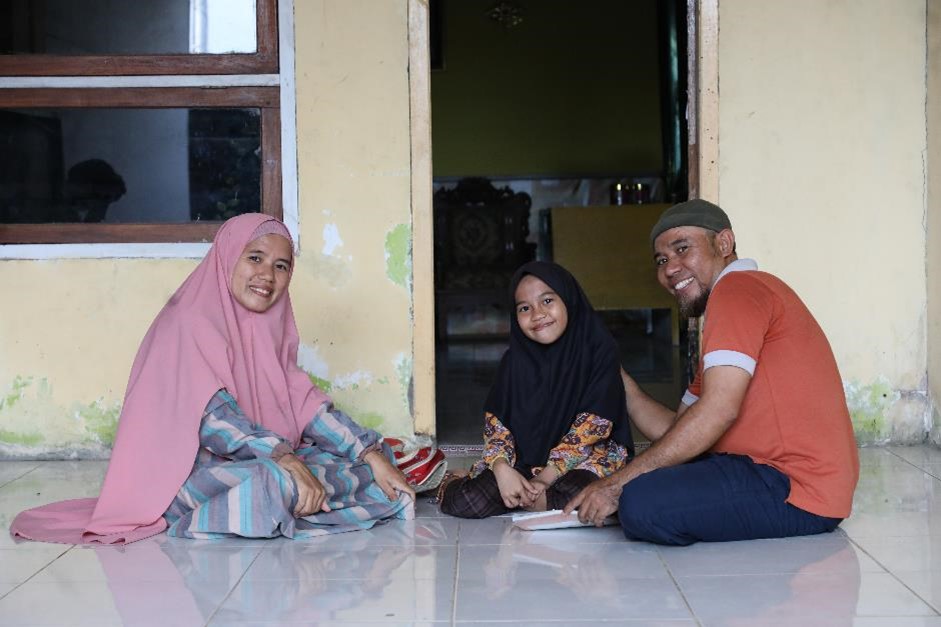
Ayeb Ariansyah, S.KM, a Health Promotion Officer at the Alas Barat Community Health Center, is a role model for the men around him because Ayeb is used to sharing chores role with his wife. “I have learned to divide chores with my partner. My wife cooks, and I wash the dishes. My wife washes clothes, and I dry them. My wife takes care of the children, I sweep the house,” said Ayeb.
According to this 40-year-old man, gender equality must be realized. Of course, the division of household roles needs to be carried out and implemented in society. ” I have implemented it, being a role model first for my family, neighbours and the surrounding community,” said Ayeb.
After becoming a facilitator for Monitoring Gender Equality in Community-Based Total Sanitation (MKGS) in 2020, he has been more aggressive in conducting outreach to the community.
Monitoring Gender Equality in Community-Based Total Sanitation
MKGS is an instrument developed to explore and monitor gender roles and relations for boys and girls and adult men and women in implementing Community Based Total Sanitation (STBM) activities in households and the community.
Ayeb said that there are cultural values that support or hinder gender equality. One of them is the local wisdom value in Sumbawa which supports gender equality, namely tokal barema.
Tokal barema is when men and women sit together to make decisions regarding societal activities such as weddings and other celebrations.
Apart from that, there is still local wisdom that does not support it, namely myths, values, norms or beliefs in the Samawa tribe (a native tribe of Sumbawa) that men are not allowed to do household work because they are responsible for earning a living and will receive bullying from the surrounding environment.
Bullying often happens in rural communities that still adhere to conservative (patriarchal) beliefs. Ayeb said that the challenge so far is that the values attached continue to be passed down from generation to generation. Some local values believe that household work is only women’s business.
As a MKGS facilitator for Yayasan Plan International Indonesia (Plan Indonesia), he realized there were societal changes before and after the program. Ayeb still remembers how at first he provided MKGS assistance in Mapin Kebak Village, Alas Barat District, there were still many who had not yet divided their roles in carrying out domestic household work.
Changes in Society
This society does not yet understand gender equality. From the initial monitoring results, men said that their wives did the housework on average. After more massive outreach and assistance, there are now changes and division of workload in the household environment. Some men cook, wash and sweep. Gender equality in the household is slowly being implemented.
Ayeb wants to carry out more massive advocacy to policymakers, namely sub-district and village governments and religious and community leaders. The aim is to educate the public to abandon myths and values that can hinder gender equality because they are no longer relevant.
“I carry out campaigns and outreach to all elements, including the government, religious leaders, community leaders and the public, because changing this mindset takes time. It’s not as easy as turning the palm of your hand,” explained Ayeb.
Ayeb said that conveying outreach more often through various activities or events in the community could be the key to influencing community and religious leaders. It is hoped that the government can play an active role and start moving towards equality for men and women to have equal opportunities.
“Hopefully, stakeholders can implement gender equality from the bottom to the top, and this diplomatic step must be carried out sustainably,” Ayeb hoped.


