

Promoting Climate Resilient and Inclusive Water and Sanitation in Kupang City in 2 Years
18 November 2024
Kupang, November 18, 2024 – Kupang City still faces various challenges in achieving inclusive sanitation. Therefore, since 2023, Yayasan Plan International Indonesia (Plan Indonesia) has supported waste management and the development of a drinking water safety plan in Kupang City through the Water for Women (WfW) program. For two years, WfW has involved 389 young people, 743 women, and 127 people with disabilities.
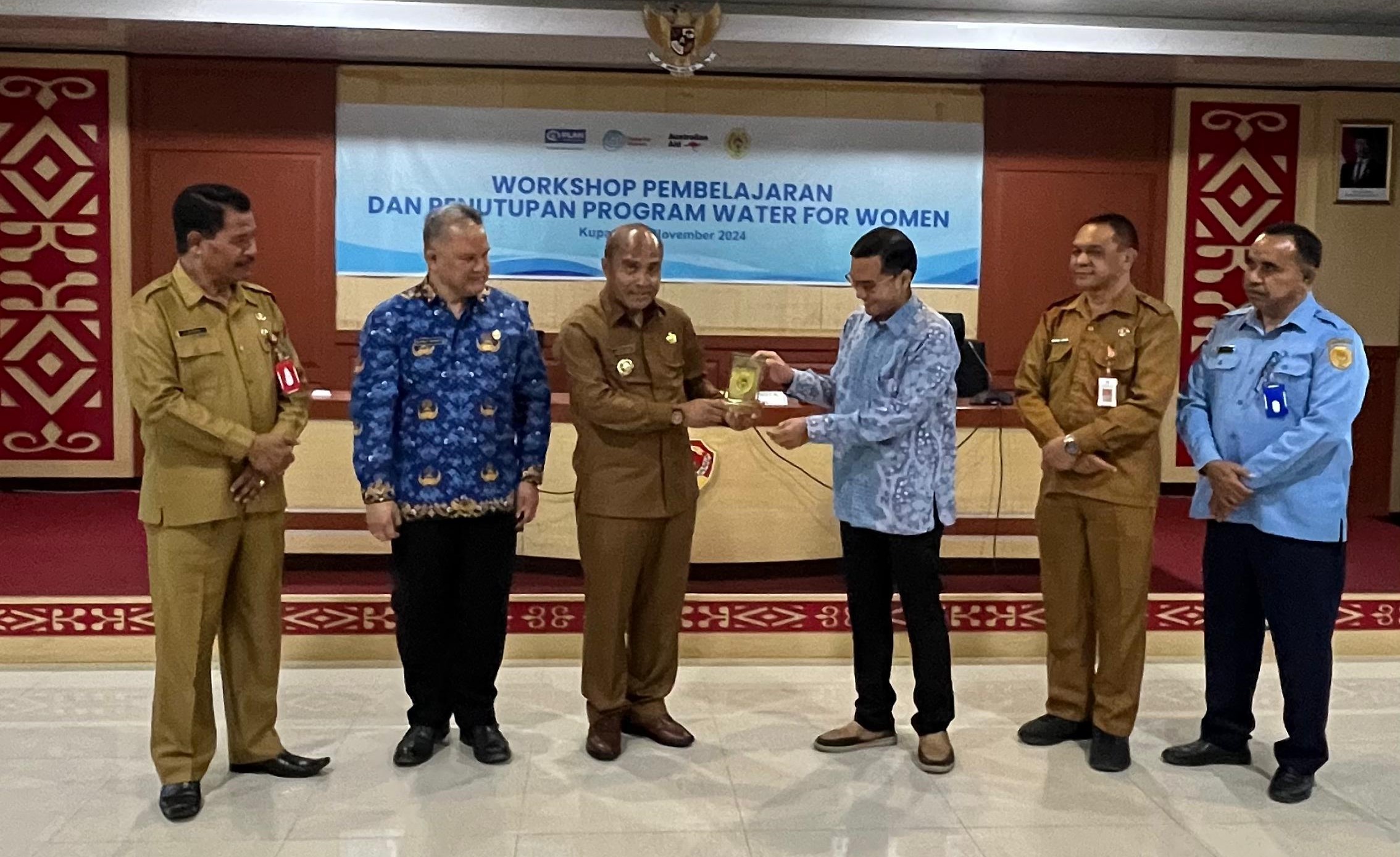
At the program closing handover to the Kupang City Government today (19/11), Pj Mayor of Kupang Linus Lusi, expressed his appreciation to WfW for contributing greatly to realizing clean water and sanitation in Kupang City that is inclusive and climate resilient.
“Kupang City has challenges in providing safe and sustainable drinking water. So it is hoped that with joint efforts, this WfW program can be a solution to achieving the target of safe drinking water for all Kupang residents. Furthermore, with this handover, we hope to continue the good practices in the city,” Linus said.
Herbet Barimbing, Program Manager of Plan Indonesia, explained that so far the WfW program has also contributed to the preparation of the Kupang City Drinking Water Security Plan (RPAM) together with the Kupang City Regional Public Company for Drinking Water (Perumda AM). This plan can be a guide in providing quality, safe, and sustainable drinking water for the residents of Kupang City. The RPAM document for the Dendeng River SPAM serves more than 3,000 active customers in Kupang City.
Waste Management Involving the Community
The WfW program has assisted four unit waste banks in Kupang City, namely the Unit Waste Bank in Maulafa, Naioni, Nefonaek, and Oebufu Villages with a total of 11.5 tons of managed waste. We hope that with the existence of a unit waste bank, other villages can also replicate the good practices of our assistance, so that they can help alleviate the waste problem and build a climate-resilient Kupang City community.
Head of the NTT Provincial Bappelitbangda, Dr. Alfonsius Theodorus, said that in addition to inclusive access to water, in the face of climate change, Kupang City is also solving the waste problem by involving the community.
“The Waste Bank is the first key to waste processing so that it does not accumulate in landfills (landfills). In addition, the proceeds from the waste bank are also a plus in the economy of the residents,” said Alfonsius.
In waste management, WFW’s program also promotes gender equality and the involvement of youth and friends with disabilities with nearly 40 percent of the waste management team being women. Rahmat, 28 years old, is one of the young people/friends with disabilities who plays an active role in the waste bank assisted by the WfW and Participatory Action Research (PAR) programs.
“PAR helps and enables us to explore the problems around us, plan and take action together. Like the actions we have done, namely socialization about disability, socialization of waste management and tree planting,” explained Rahmat.
During the six years of implementation, the WfW Program has had a direct impact on nearly nine thousand people in Kupang City, Manggarai Regency in East Nusa Tenggara and Sumbawa Regency in West Nusa Tenggara including marginalized groups namely women, girls, people with disabilities, and the elderly. Furthermore, since 2018, WFW has been contributing
Notes to Editor:
About Water for Women (WfW)
Water for Women (WfW) is a program funded by the Australian Government and aims to improve the quality of access to water, sanitation and sanitation in climate-resilient communities. The program promotes the active participation of girls, women, and people with disabilities. Since its inception in 2018, WfW has built inclusive toilet facilities, encouraged the implementation of clean and healthy living behaviors, and supported the active participation of women and people with disabilities in economic and social aspects. All activities of the WfW program also consider aspects of climate resilience or the level of resilience of people and objects to the climate crisis that has hit the world.
About Yayasan Plan International Indonesia (Plan Indonesia)
Plan International has been working in Indonesia since 1969 and officially became the Plan International Indonesia Foundation (Plan Indonesia) in 2017. We work to fight for the fulfillment of children’s rights and equality for girls. Together with youth groups and networks, we work to ensure meaningful youth participation in decision-making that impacts the fulfillment of children’s rights and equality for girls. We are also mobilizing resources with partners, such as the private sector, donor agencies, philanthropic foundations, and individual donors, to make a wider impact on Indonesian children.
Plan Indonesia implements its activities through four programs, namely Child Protection and Development, Adolescent Sexual and Reproductive Health, Skills and Opportunities for Youth Economic Empowerment, and Resilience and Humanity. We work in 7 provinces, including in East Nusa Tenggara, West Nusa Tenggara, Central Sulawesi, Uta Sulawesi
Media Contact
Annisa Hanifa, Programme Communication Specialist
Email: [email protected]; WA: 081807805393


