

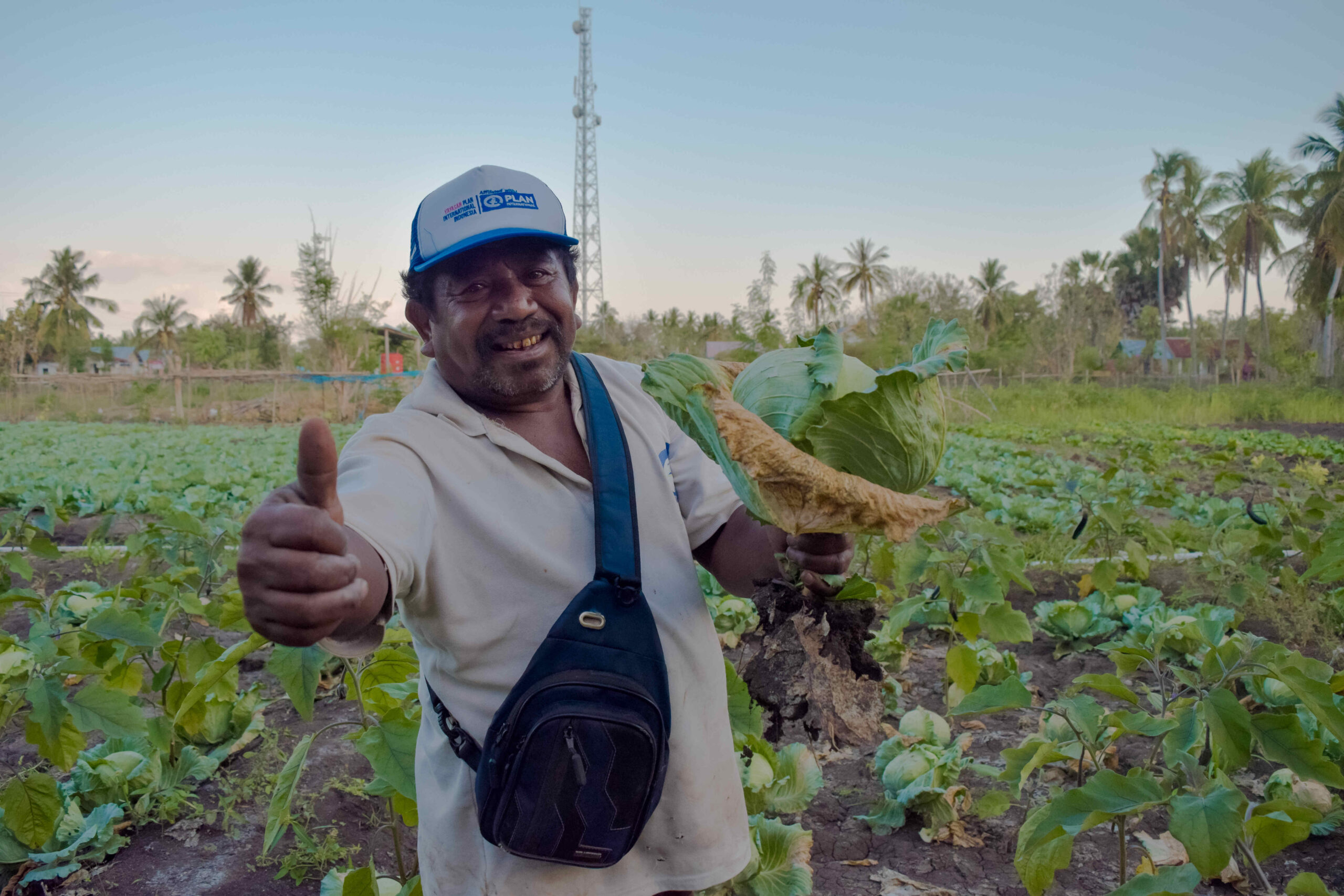
Climate-Smart Agriculture for Economic Recovery after Cyclone Seroja
04 October 2023
In April 2021, flooding caused by Cyclone Seroja hit several villages assisted by Plan Indonesia on Lembata Island. This disaster resulted in the community’s agricultural land being submerged, which in turn led to crop failure and severely impacted the lives of villagers who mostly worked as farmers. One of them is Hasan (52 years old), a vegetable farmer from the village.
To accelerate economic recovery for disaster-affected communities, Yayasan Plan International Indonesia (Plan Indonesia) through its Program Implementation Area (PIA) Lembata intervenes through a climate-smart agriculture approach. The community was taught about the selection of crop varieties, proper irrigation methods, efficient cropping patterns, organic farming, and good marketing management. This approach was well received by farmers in local villages. The farmers then established a productive farming group and elected Hasan to be the group’s leader.
Hasan owns a plot of land located on the edge of the road leading to one of Lembata’s popular marine tourism destinations. As such, they agreed to turn the land into a climate-smart agriculture demonstration plot.
“The location of the demonstration plot has had a significant impact on marketing and learning for our community,” said Hasan. He noted that the demonstration plot often attracts passers-by to stop by, due to the various types of fresh vegetables presented in the demonstration plot.
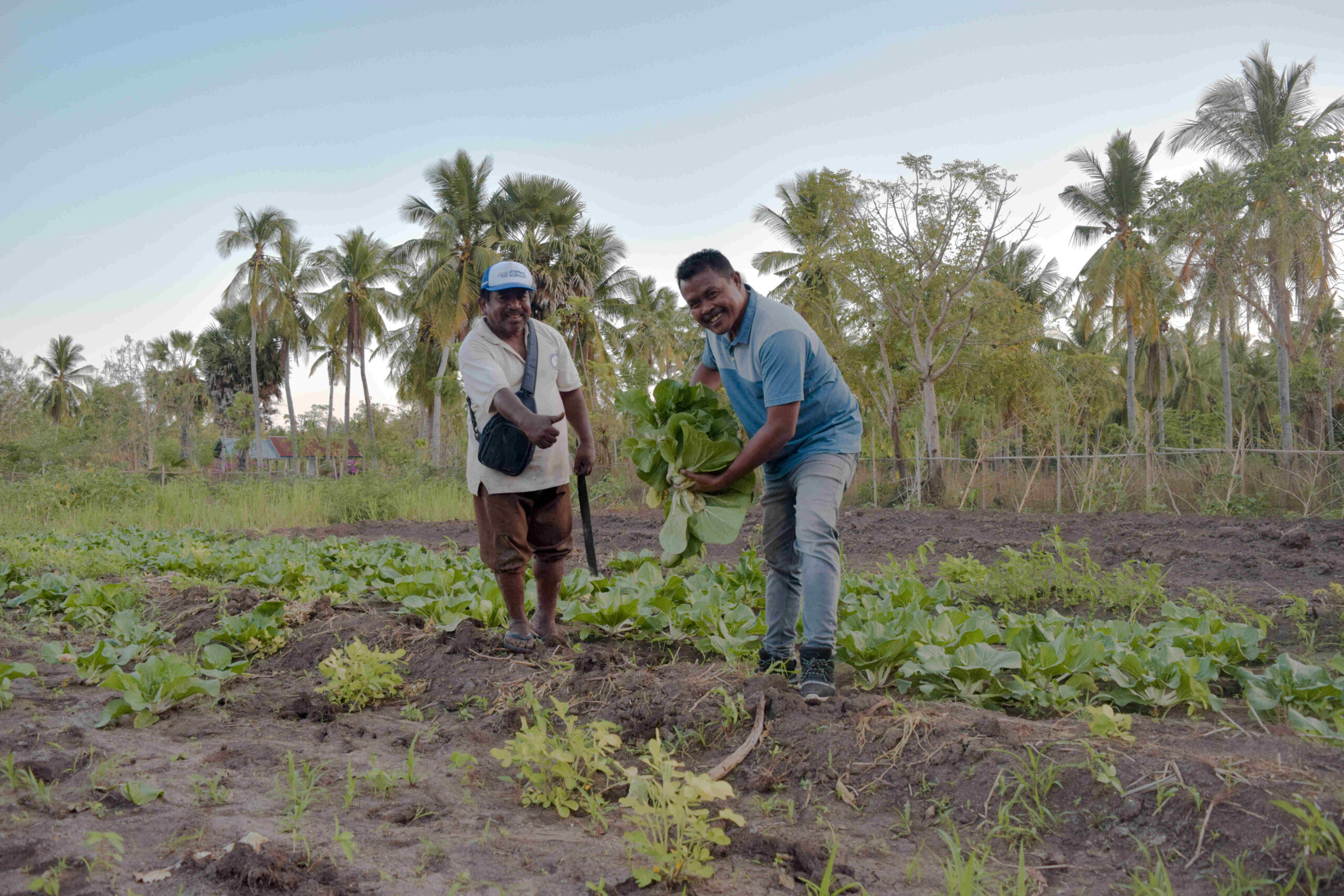
Hasan accompanies buyers to pick mustard greens from the fields at the demonstration plot.
This approach to climate change adaptation also serves as an excellent evaluation and correction for local farmers. Previously, the vegetables they grew, especially cabbage, were often attacked by caterpillars. They used chemical pesticides to control the pests. Not only did this increase production costs, but it also affected the quality and sales of the crops amidst calls for stunting prevention.
“Together with Plan Indonesia, we discovered the main problem lies in the way the plants are planted and watered. Watering from above causes the caterpillar eggs hidden behind the leaves to not be washed away by the water flow,” Hasan explained.
After the evaluation, the group began to improve their technical farming culture, including changing the irrigation method and implementing intercropping in their demonstration plot. These changes yielded very satisfactory results, with cabbages that could be harvested without suffering from caterpillar infestation. Moreover, on the same plot, they were able to grow and harvest a significant amount of eggplant, in line with the size of their land.
Hasan expressed his appreciation to Plan Indonesia for this program. In addition to contributing their insights, Plan Indonesia also helped them with the necessary agricultural materials, such as increased water discharge and the use of warning. “Previously, we struggled to grow vegetables in large quantities due to the limited water supply. However, now we can harvest three times a year, thanks to the access of water and effective watering systems,” said Hasan.
Besides the aforementioned approaches, Plan Indonesia also worked with the local agriculture office to educate the community on the production of compost as an organic fertilizer used in their demonstration plots. This step was taken as a form of contribution to stunting prevention and empowering local communities to process and utilize climate-friendly organic fertilizers.
“In addition to saving production costs by using organic fertilizers, our vegetables also become products that are free from chemical pesticides, fresh and healthy for consumption,” said Hasan. He also stated that they can now grow other vegetables such as mustard greens, carrots, cucumbers, and eggplants.
At present, the climate-smart agriculture demonstration plot led by Hasan continues to grow and is supported by the local village government through the village fund budget allocation. The village government is also replicating the program by establishing several groups and roadside demonstration plots to further attract community interest in climate-smart agriculture methods.
Written By: Alfred Ike Wurin | Editor: Agus Haru | Photo: Plan Indonesia/Alfred Ike Wurin


