

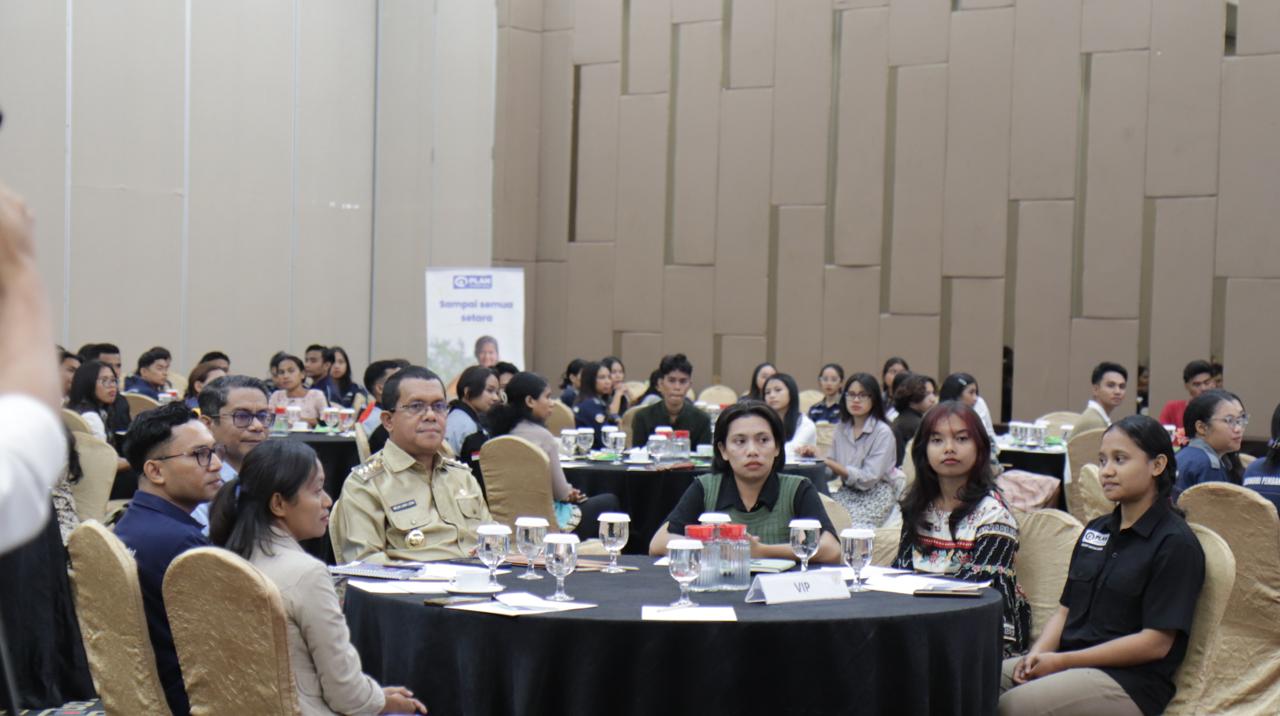
NTT youth meet directly with Governor Melki Laka Lena, push for more inclusive policies
27 May 2025
Kupang, 27 May 2025 — Hundreds of young people from various districts in East Nusa Tenggara (NTT) gathered in a consultative meeting with the Governor of NTT, Melki Laka Lena, to directly voice their aspirations, policy recommendations, and challenges they face in various sectors, ranging from education, infrastructure, health, to the economy.
The meeting was a collaboration between Yayasan Plan International Indonesia (Plan Indonesia), youth communities, and civil society organisations, with the aim of strengthening synergies between provincial government policies and the real needs of young people in NTT.
Serious challenges faced by young people in NTT
NTT has a youth population that accounts for 25 per cent of its total population (BPS, 2024), but they still face serious challenges, ranging from limited access to higher education and vocational training to a lack of decent employment opportunities.
This condition encourages most young people to migrate outside the region in search of a better livelihood, while others work in the informal sector with no guarantee of a stable income. BPS 2023 data shows that the open unemployment rate in NTT is 3.14 per cent, with only around 40 per cent of young people accessing higher education. On the other hand, health issues, including reproductive and mental health, as well as gender and disability-based discrimination, exacerbate the social vulnerability of young people, especially women and people with disabilities.
In the open dialogue, young people raised a number of pressing issues that they face in various regions:
- Infrastructure: Severely damaged roads are still found in a number of areas such as Amfoang Subdistrict (Kupang Regency), Kueknutu Village (Nagekeo Regency), and the capital of NTT Province, Kupang. Connecting roads between regions are also considered inadequate to support education, health, and economic mobility.
- Economy: A number of MSME players who produce handicrafts and traditional medicines are still constrained by market access and digital skills. Meanwhile, many high school/vocational school graduates are not ready to work due to the lack of vocational training.
- Education and Technology: In some areas, many teachers do not have adequate digital skills, and limited access to internet and electricity limits the learning and teaching process in schools.
- Health: The lack of basic health facilities, such as access to clean water, sanitation, and stunting, shows that the maternal and child health care system in NTT is still weak.
“This reality illustrates that we as young people do not only want to be seen as beneficiaries of development, but also as strategic partners who need to be involved in every stage of planning. We from the disability group also hope that the NTT Governor’s programmes can open up opportunities for capacity building in the business sector and more inclusive access to work, so that more friends with disabilities are no longer unemployed. There are still many disabled friends who cannot go to school, even though they have the same abilities as other children; the challenge is not in ability, but in access which still needs to be improved,” said Anna, a young person representing the Kupang Deaf Community.
Concrete Recommendations from Young People for the Future of NTT
Meanwhile, Samuel Apsalon Niap, Area Program Manager of Plan Indonesia, emphasised that the meeting also encouraged the active involvement of young people in the regional development process to strengthen their role as actors of change towards a more equal and prosperous NTT.
As a result of the cross-district consolidation, the youth of NTT proposed three main policy focuses:
1. Education and Child Protection:
Integration of bullying, mental health and digital literacy issues into the curriculum.
Capacity building of counselling teachers and placement of child psychologists.
School rehabilitation and transparent utilisation of BOS funds.
2. Infrastructure, Health and Environment:
Prioritisation of connecting roads, electricity and internet expansion.
Strengthening posyandu and mother-child health services.
Once-a-month environmental cleaning programme in each sub-district.
3. Economy and Culture:
Vocational and entrepreneurial training for youth.
Support for digitalisation of women’s micro-enterprises.
Clustering of development areas and preservation of local culture.
NTT Governor’s Commitment
In his response, the Governor of NTT emphasised his commitment to opening regular participation spaces for young people.
“NTT can only progress if its young people stand at the forefront of change. The aspirations conveyed today will be the main reference in the preparation of the Regional Development Plan in the future,” said Melki Laka Lena in his speech.
Young people and women are the driving force for several aspects of development in NTT, why should young people and women? Because for us, these two groups are the main forces that we must optimise in the fields of agriculture, livestock, fisheries, renewable energy and others. The point is that the government encourages young people and women to emerge as economic drivers in NTT, explained Laka Lena.
This meeting was also facilitated by Plan Indonesia through youth empowerment programmes in the NTT region and became an important momentum that showed that the young generation in NTT did not remain silent. By voicing their needs and offering concrete solutions, they have shown that the future of NTT is not only about physical development, but also social empowerment and meaningful participation of the younger generation.


