

Joint Secretariat of Disaster Safe Education Unit D.I. Yogyakarta Promotes Disaster Risk Reduction Efforts for Children in Schools
28 July 2023
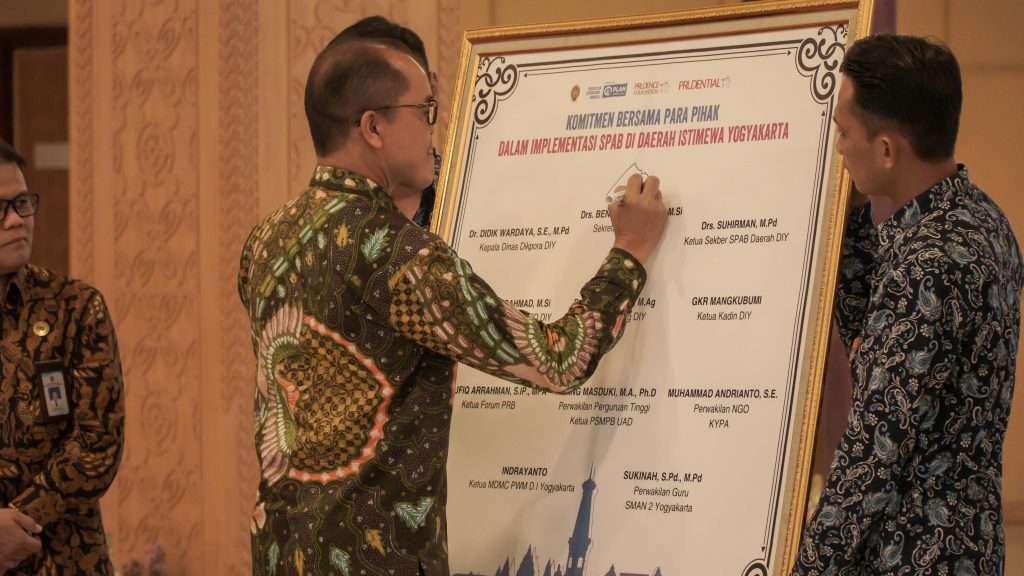
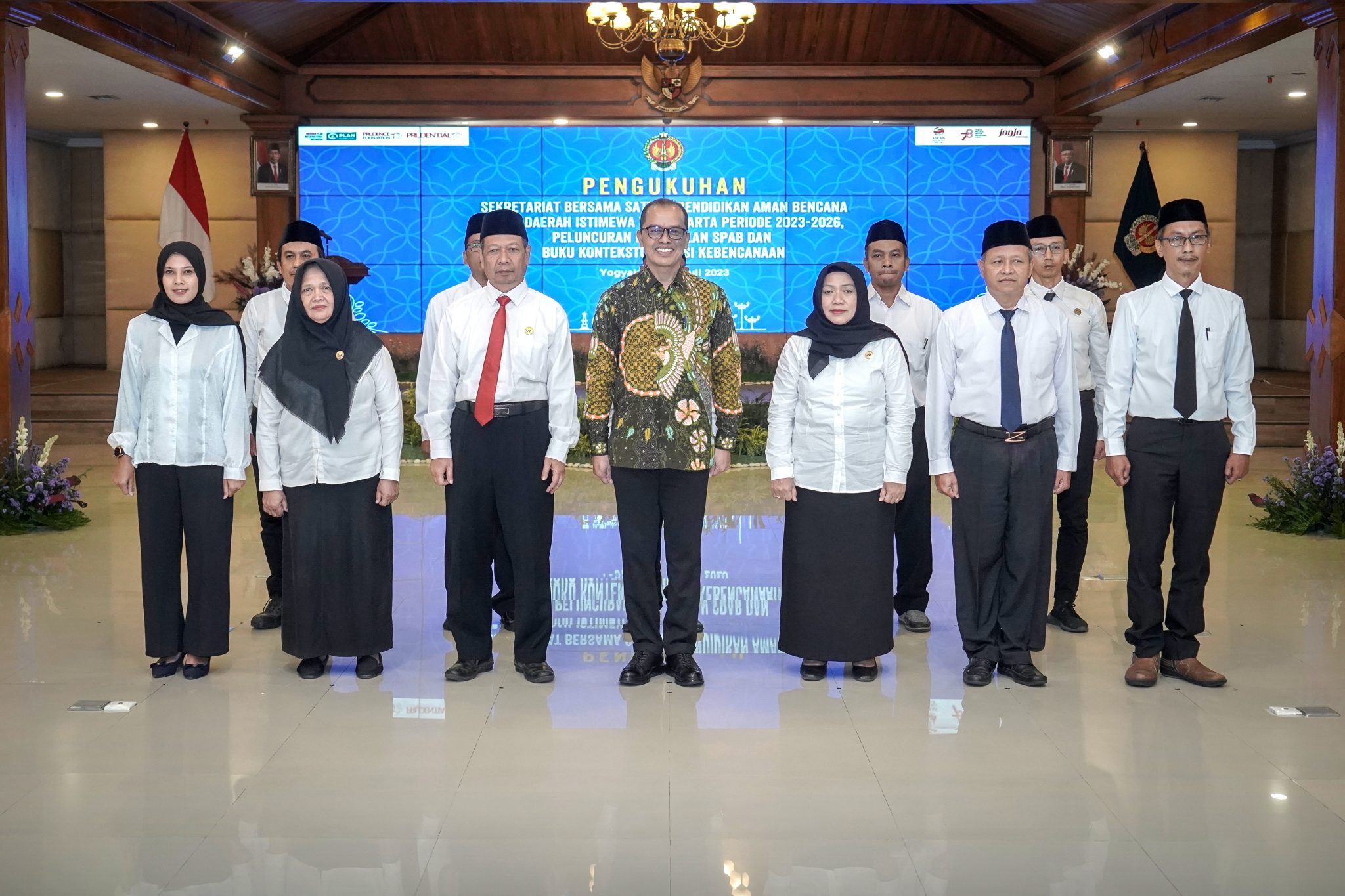
The inauguration was attended by the elected Chairman of the DIY Joint Secretariat for the period 2023 – 2026, Drs. Suhirman, M.Pd and representatives of the members of the DIY SPAB Joint Secretariat. The DIY SPAB Joint Secretariat has 120 members consisting of government representatives and related stakeholders, namely the DIY Education, Youth and Sports Office, DIY National Agency for Regional Disaster Management, Regional Apparatus Organizations in DIY, DIY Regional Planning and Development Agency (Bappeda), BMKG, BASARNAS, BPMP, Satpol PP, NGOs, community organizations, youth organizations, academics/universities and the media.
The task of the DIY SPAB Joint Secretariat will be to coordinate the implementation of SPAB programs in DIY. Primarily, it plays a role in pre-disaster situations, namely preparing schools to face disaster emergency situations through risk assessments, providing disaster mitigation training, preparing trained personnel, and mapping safe facilities in educational units.
Head of the DIY Education, Youth and Sports Agency (Dikpora), Didik Wardaya, said that realizing SPAB requires early preparation that covers many aspects. These aspects need to be handled by stakeholders who have relevant expertise including each stakeholder so that implementation becomes effective. In addition, it is necessary to establish the SPAB Joint Secretariat in each school to be able to answer specific problems in the education unit.
“As a first step, the DIY Regional Government in collaboration with the DIY Dikpora Office formed the DIY SPAB Secretariat 2023-2026 with Gub Decree No. 72 of 2023 dated March 2, 2023. The DIY SPAB Secretariat has compiled the SPAB Road Map as a guide to the development of DIY SPAB to minimize the impact of disasters both pre, post and during disasters. The SPAB Secretariat has also compiled a contextual disaster book for high school, vocational school and special school as a guide for education units,” Didik explained.

Efforts to implement SPAB in education units have long been made by the DIY provincial government. For this reason, Yayasan Plan International Indonesia (Plan Indonesia) established DIY as a SPAB model to realize a safe and child-friendly learning environment. Ida Ngurah, Humanitarian and Resilience Program Manager of Plan Indonesia revealed that Plan Indonesia learned a lot from DIY and the people of Yogyakarta about responsibility, independence, harmony and tolerance.
“We hope that the values we learned from Yogyakarta about SPAB as an embryonic place for the birth of Disaster Preparedness Schools, then became Disaster Safe Madrasah Schools, then became Disaster Safe Education Units to other Plan Indonesia work areas. The inauguration and launch of this roadmap is a pilot and model to replicate the SPAB program so that more children are safe from disasters,” he said.
Ida added that children are among the most vulnerable groups affected by disasters. Disasters cause many children to miss out on learning at school or even drop out of school.
“We believe that one child victimized by a disaster is enough, so with the collaboration of the DIY government we are able to make our children in Jogja in particular, safe from disasters,” he added.
The Disaster Safe Education Unit Program is also expected to run in harmony and be integrated with the Child Friendly School Program, as well as the Community Based Disaster Risk Reduction Program through the existence of Disaster Resilient Communities and villages that have been established throughout DIY.
In 2019, the Ministry noted that 52,902 schools were located in earthquake-prone areas, 54,080 in flood-prone areas, and 15,597 in landslide-prone areas. Thus, education units need to prepare themselves for disasters, one of which is through the implementation of the Disaster Safe Education Unit (SPAB).
Plan Indonesia has also launched the SPAB Model Province program to encourage the implementation of SPAB in Indonesia. The program, which is supported by funding from the Prudence Foundation and Prudential Indonesia through Plan International Hong Kong, took place in two provinces namely D.I Yogyakarta and Bali for 36 months, targeting 176 schools in Yogyakarta and Bali. The hope is that through this program, all provinces in Indonesia can implement SPAB by emulating the implementation carried out in these two provinces.


