

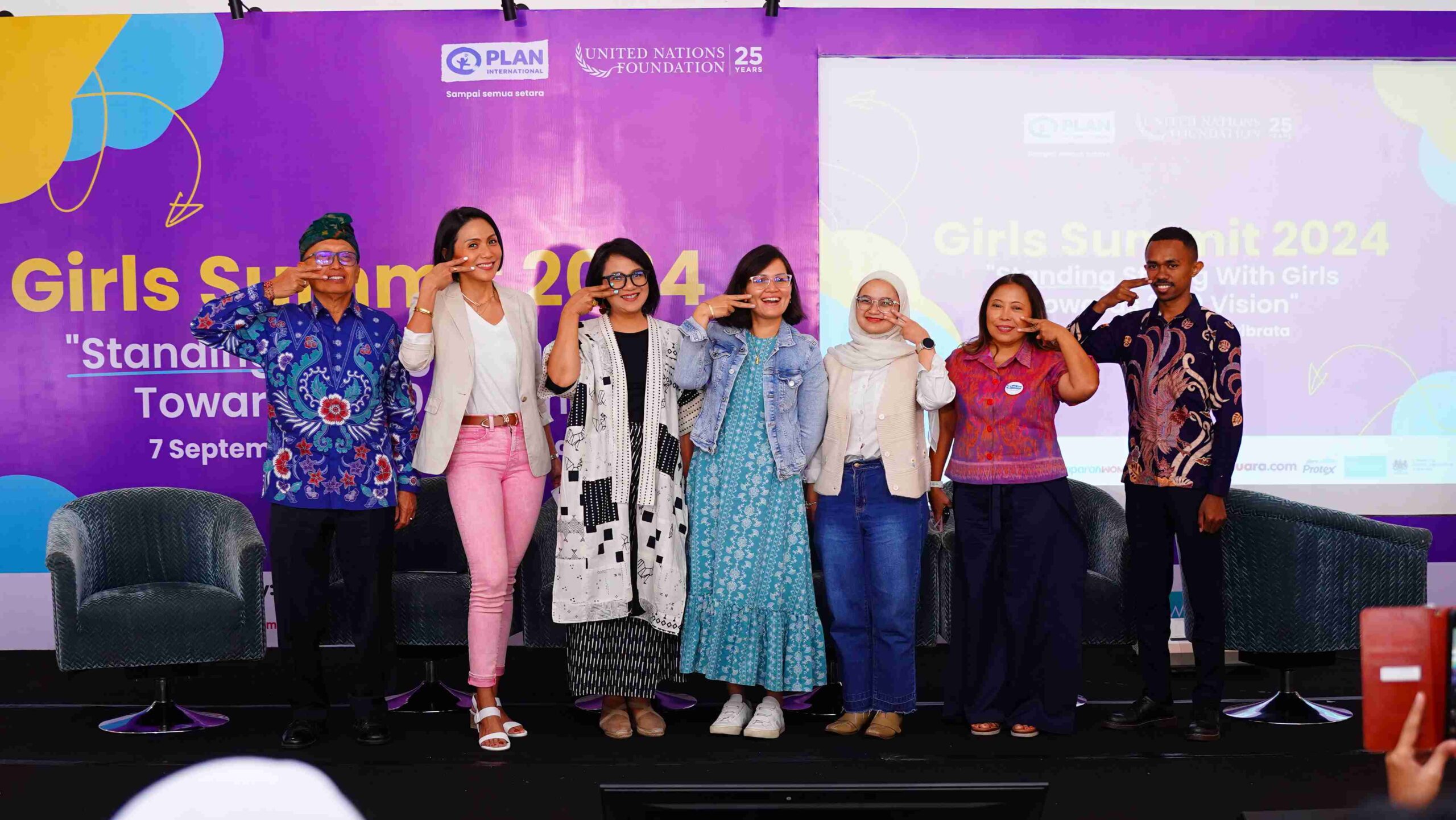
Girls Summit 2024: Development Investment in Girls for SDG 2030 and Vision 2100
07 September 2024
Jakarta, September 7, 2024 – By 2100, it is predicted that the young population will dominate up to 80 percent worldwide. Including in Asia, more than half of the population will be under the age of 30. Indonesia as one of the countries with the largest population in the world needs to understand this 2100 context, especially preparing young people to face various changes, challenges and opportunities in the next few decades.
In this context, Yayasan Plan International Indonesia (Plan Indonesia) in collaboration with the United Nations Foundation held a Girls Summit themed “Standing Strong with Girls Towards 2100 Vision”, on September 7, 2024 in Jakarta.
“As a girls and youth-centered organization, we dedicate the Girls Summit to strengthen the position of young people, especially women, as the center of development today and in the future. Supporting and investing in them is essential to ensure readiness, unlocking their potential, power and space to design their future,” said Dini Widiastuti, Executive Director of Plan Indonesia.
The Girls Summit 2024 was attended by more than 400 participants including young activists, village changemakers, women leaders, government representatives, donor agencies, companies and media, as well as representatives from civil society organizations.
The Girls Summit 2024 was preceded by a Pre-Summit on 30 July 2024 in Jakarta, which summarized the recommendations for children and young people in achieving the 2100 vision. Three young activist representatives presented their recommendations at today’s Girls Summit including on future climate risks, rapid digital technology and youth empowerment.
These recommendations have previously been submitted to the UN Foundation, to be included in the Pact for the Future, a declaration towards the 2100 Roadmap that will be discussed by world leaders at the Summit of the Future during the United Nations General Assembly (UNGA) in New York, in late September 2024.
Dwi Yuliawati Faiz, Head of Programmes at UN Women Indonesia who also attended the Girls Summit said, “Now the SDGs that should be achieved in 2030 are still quite behind. We have to do something very strong for this mission to be achieved. This vision is to look at long-term targets beyond the current generation, consider the impact if the SDGs are not achieved, and think about the next steps after 2030 until the 2100 vision.”
Towards a 2045 Golden Indonesia, the discussion of the 2100 Roadmap from the perspective of young people is relevant to the government according to the Deputy for Coordinating the Quality Improvement of Children, Women, and Youth of the Coordinating Ministry for Human Development and Culture (Kemenko PMK) of the Republic of Indonesia, Woro Srihastuti Sulistyaningrum (Lisa) in her keynote speech at the Girls Summit.
“When talking about Indonesia Emas 2045, we must ensure that young people are not only the target of development, but become agents of change who can encourage various innovations in development. Ensuring various social, economic and digital transformations can be well guarded by young people, including creative economy drivers. This means that we must ensure empowerment for young people and women and accelerate the achievement of the SDGs and the vision of a sovereign, advanced and sustainable Golden Indonesia 2045,” Lisa concluded.
Social activist and content creator, Nabila Ishma, who was also a speaker in one of the sessions at the Girls Summit 2024 entitled Girls Talk: Investing in Girls to Achieve SDGs and Beyond said young women need to be increasingly encouraged and empowered to reach their full potential. “When we talk about women, it is actually about how women can be empowered to do something and have a role that can make a change to their surroundings,” she concluded.
Recently, the UN reported that the achievement of the Sustainable Development Goals (SDGs) was only 15%, including the 5th goal, gender equality. According to the World Economic Forum, it will take another 130 years to achieve global gender equality, which reflects the slow process.
In this regard, Dini emphasized that without accelerated efforts, investment from all parties, and stronger policies and implementation, gender equality, which is one of the bases of inclusive sustainable growth, will be difficult to realize, both in 2030 and even 2100.**
—-
About Yayasan Plan International Indonesia (Plan Indonesia)
Plan International has been working in Indonesia since 1969 and officially became Yayasan Plan International Indonesia (Plan Indonesia) in 2017. We work for the fulfillment of children’s rights and equality for girls. We also work with young people, to ensure meaningful participation in decision-making about their lives.
As part of Plan International Inc, Plan Indonesia has a sponsored children program. Plan Indonesia has nurtured 36,000 girls and boys in East Nusa Tenggara, with five commitments to fulfill their basic rights: birth certificates, basic vaccines, clean water, sanitation and hygiene, and education.
Plan Indonesia works in 8 provinces through seven thematic programs, namely Prevention of Child Growth Failure, Elimination of Violence against Children and Young People, Adolescent Health, Youth Employment and Entrepreneurship, Resilient Schools, Disaster Preparedness and Gender Responsive Humanitarian Response, and Youth-led Climate Resilience.
These programs aim to increase the capacity of leadership, agencies, and social movements that engage and target 3 million girls for equal power, equal freedom, and equal representation. More information: plan-international.or.id.


