

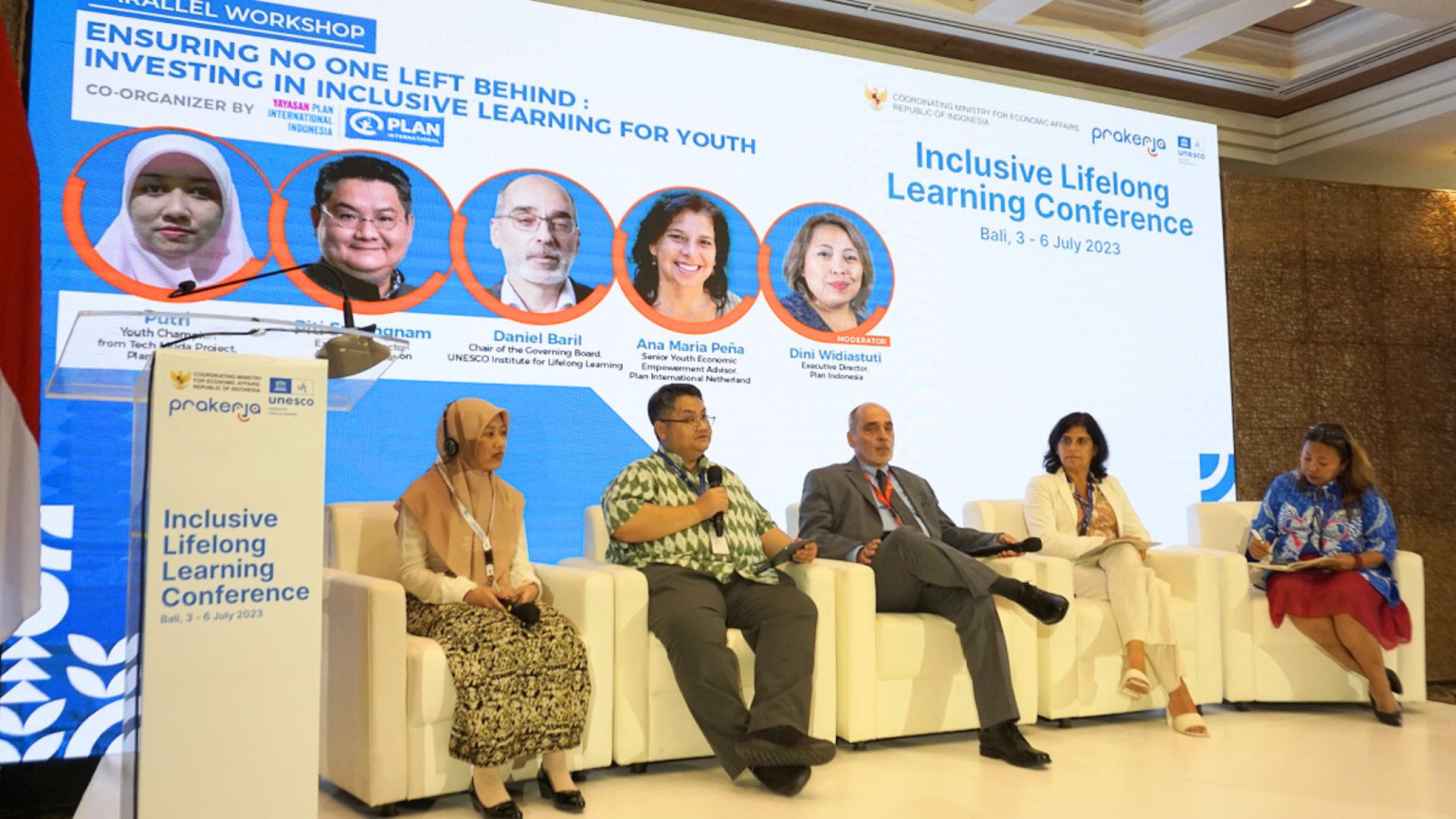
Ensuring No One Left Behind: Investing in Inclusive Learning for Youth
04 July 2023
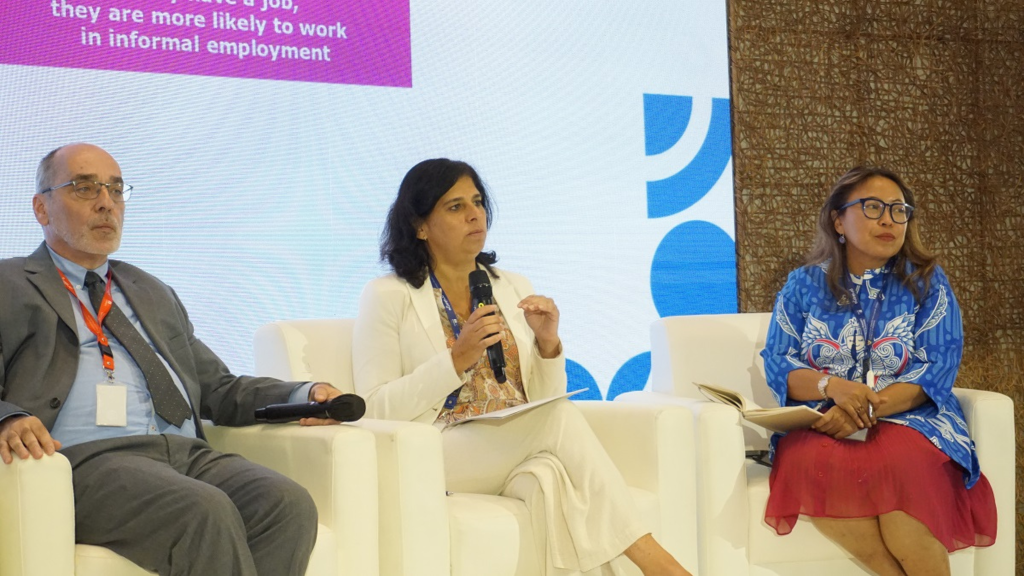
Ana Maria Peña, Youth Economic Empowerment Senior Advisor at Plan International Netherlands, who represents Plan International in the talk show, highlighted that traditional gender stereotypes remain in the labour market and a gender gap still exists in terms of access to quality education, participation, and transition to work.
“We need to invest in digital literacy and continuously develop digital solutions tailored for and co-created with vulnerable groups, including young women and people with disabilities. We also need to understand their expectations and needs in particular post the COVID-19 pandemic,” she expressed.
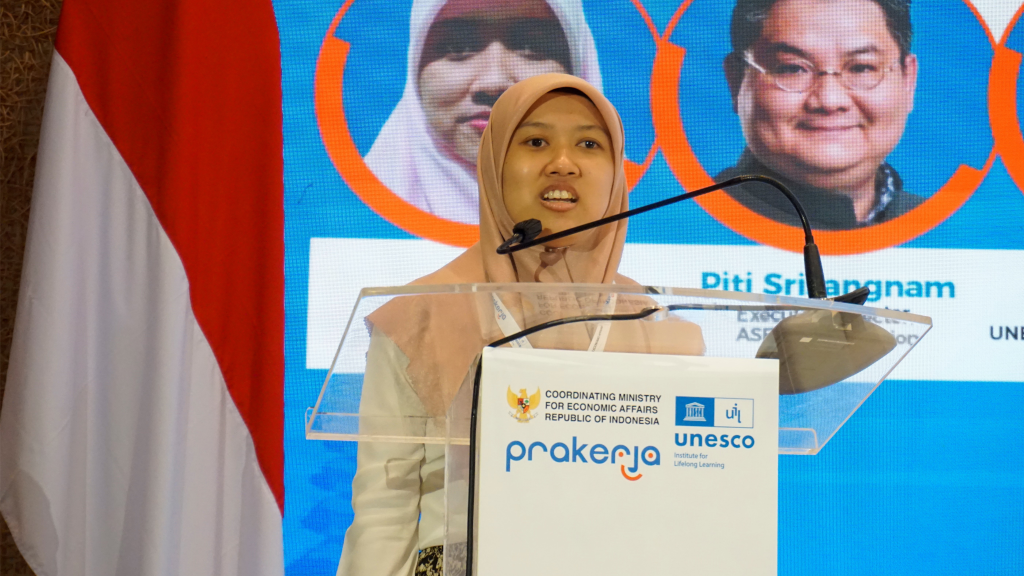
Putri, Plan Indonesia’s program participant and representative of young people with disabilities, explained her experience with a low vision disability and the investment needed to compete in the market.
“People with disabilities are often not regarded as a priority in the working sector, despite our ability to succeed and be as productive as non-disabled people. It is time for us to walk the talk and invest in young people, with or without disabilities, so that we can reach our full economic potential together,” said the young woman who currently works in a private sector company.
More substantial support in the form of inclusive training for young people is indeed deemed crucial. Despite the growing demand, Dr Piti Srisangnam, Executive Director of the ASEAN Foundation, addresses the lack of access to reskilling and upskilling for the ASEAN young people
“ASEAN young people face challenges accessing job training opportunities, including limited information, budget and time constraints, and distance barriers. This contrasts with the increasing demand for skilled workers, especially in the growing digital sector,” stated Dr Piti.
Daniel Baril, Chair of the Governing Board of the UNESCO Institute for Lifelong Learning, expressed a similar sentiment. He reiterated the importance of upskilling and reskilling for the Indonesian labour market “In light of the exponential growth of digital technology and past the pandemic, we must ensure that upskilling and reskilling efforts continue to be accessible for young people in every part of the world, including Indonesia. Only with the right method can we guarantee lifelong learning and ensure that no one is left behind,” Daniel said.
Since 2010, Plan Indonesia, part of the Plan International organisation, has worked to close the gap by implementing youth employment and entrepreneurship (YEE) initiatives that focus on providing vocational and technical skills, with special attention to young women (60 per cent of the programme participant).
The program comprised digital job readiness training, mentoring and access to employment. Until now in total, 28,341 young people in Indonesia have been trained, with 35 per cent pursuing employment or starting a business.
About Yayasan Plan International Indonesia (Plan Indonesia)
Plan International has been working in Indonesia since 1969, officially registered as a national foundation named Yayasan Plan International Indonesia (Plan Indonesia) in 2017. Our vision is to strive for children’s rights and equality for girls. We also work with youth to ensure youth meaningful participation in decision-making that has impact to their lives. Together with youth groups and networks, we work to ensure the meaningful participation of the youth in the decision making that impacts on the fulfilment of the children’s rights and equality for girls. We also mobilise resources with partners, such as private sectors, donor agencies, philanthropy foundations and individual donors, to provide a wider impact for Indonesian children.
More info: plan-international.or.id
Media Contact:
Masajeng Rahmiasri (Ajeng)
OIC Media & Communications Manager Plan Indonesia
Ph: +62 817 004 0274 | e: [email protected]


