

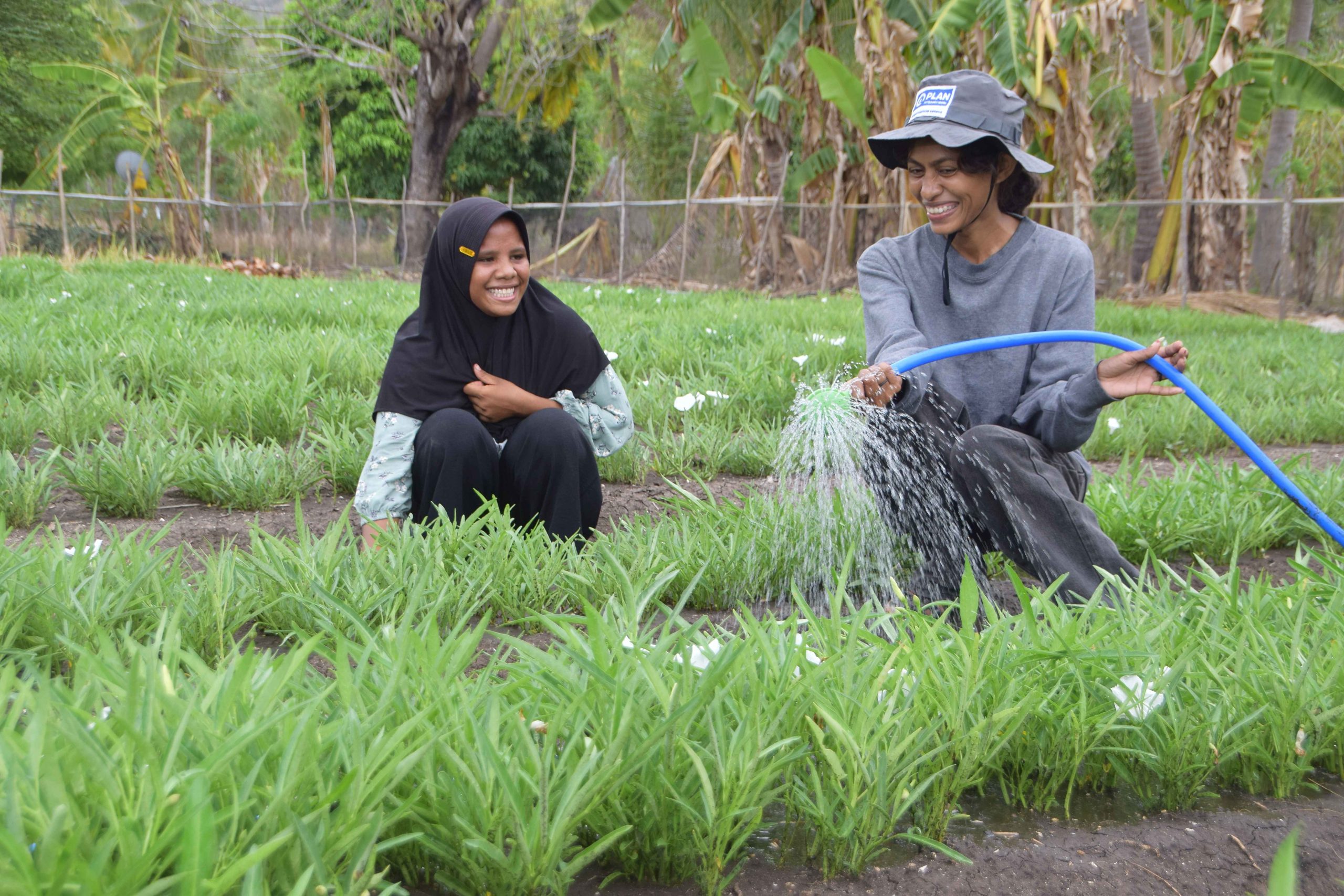
Ema’s Journey and Mama Baha’s Inspiration in Climate Smart Agriculture
06 November 2024
Before going home, I encouraged my friends to continue to work together to realize the hopes that we had poured. Go home with the hope of continuing the knowledge and spirit that Mama Baha instilled, with the determination to become a young farmer who is also able to bring change.
I am Ema, a young woman from Lembata, with a deep interest in the world of agriculture. Growing up in a family that was familiar with nature, I witnessed from a young age how farming has become an inseparable part of our lives.
This story began when I was selected as a participant in a climate-smart agriculture training program for young people. This training was attended by 15 participants from three villages, each sending five young people. The training site is about three hours away from our village, this activity offers me a valuable opportunity to live directly with the locals for three days, making this experience even more special and meaningful.
After a long and pleasant journey, we finally arrived at Wowong village. As soon as we got off the bus during the day, we immediately felt the warmth of the people who welcomed us with kindness and enthusiasm. In this warm atmosphere, the activity began with remarks from the organizing committee, followed by remarks from the Head of Wowong Village. In his remarks, he took the opportunity to share an important story about the history of this village’s agricultural land. He explained that the land that we will now see later used to be damaged by flash floods caused by the Seroja disaster in 2021. For recovery, the village government collaborates with Plan Indonesia to help affected residents through economic recovery programs. The results of this collaboration are now visible, land that was once damaged is now back to productive and has become a source of livelihood for the community. “The results of this joint effort are now visible,” he added.
Over time, people began to resume their activities, many switched from going to sea to farming. This decision is not only to improve their economy, but also to build the resilience of the village to extreme weather in the future.
“He added that in the past, most of the people of Wowong worked as fishermen. However, due to declining catches and often unpredictable weather, many residents have switched to the agricultural sector. Now, a lot of land in the village is used for horticultural cultivation, making agriculture a more stable source of livelihood for families in this village.”
To be honest, I was initially hesitant to see the sandy soil around here. It came to mind, how can agricultural practices be carried out in an environment like this? My doubts remained when we were invited to listen to introductory material on a beautiful tourist beach, making me even more curious about how agriculture would be applied in villages that had experienced flash floods.
Towards the afternoon, we were divided into three groups, mixed with participants from other villages. I was trusted to be the leader of the group, even though the members of my group were all men. At first, there was a doubt, could I collaborate with these new friends? However, thanks to the help of the facilitators who made the atmosphere more intimate, we began to work well together.
I also took the initiative to divide the roles among the group members so that every step we took was in accordance with the material. We were excitedly invited to visit the sample garden managed by local farmers, and it turned out that there are a lot of horticultural plants thriving here! That scene made me even more enthusiastic to take part in the training series until the end. We also share stories with local farmers, discussing what we find. If there is anything we miss, the farmers help to add it.
On the second day, we practiced directly in the garden, starting from installing drip irrigation, spreading plastic mulch, making bokasi fertilizer, seed playpers to planting seedlings. Learning from the field made me better understand each step needed, and I took notes on the materials and stages neatly.
While practicing in the garden, I had a chance to chat with Mama Baha, a passionate and friendly female farmer. His appearance is simple, but the way he explains always catches my eye. Every time she spoke, Mama Baha was able to liven up the atmosphere with her fresh stories full of cheerfulness, making us, the participants, feel more relaxed. Every once in a while, he would throw out spontaneous funny things, and we would laugh out loud together.
Behind her cheerfulness, Mama Baha is a housewife who is no longer young. He told about the flash flood disaster he had experienced, which submerged his house and washed away most of his livestock. Even so, the energy is still on par with us participants. He showed extraordinary tenacity in farming, which turned out to be an inspiration for his first son. His son, who is also involved in farmer groups, was present as one of the speakers at this training. Seeing how they work together in farming, I feel that I have learned a valuable lesson, being a farmer is not only about planting, but also about building a spirit with family and community. The inspiration from Mama Baha really fostered my determination to be more serious in pursuing the world of agriculture.
Her figure to me is more than just a farmer, she is a true female leader who is able to set a real example of perseverance and togetherness. Seeing him lead I felt compelled to apply the same spirit, in my experience leading a group for three days. Every morning, I wake up early, prepare notes, and think about the best way to divide tasks with friends. At first, there was a feeling of nervousness, fear that my friends would disagree or that I would not be able to direct them properly. But apparently, every time I divided roles, my friends were very supportive and enthusiastic about helping. The doubts that originally existed began to disappear when we worked together, and it turned out that they were actually happy if there was a clear direction. Day by day, I am more confident in leading.
On the last day, I realized that the responsibility of a leader is not only about giving direction, but also listening. I make sure every idea from the group members is recorded in the form of pictures, and then we work together to plan the steps we want to achieve in the next few months. Seeing the spirit of my friends, I feel proud to have
This training also awakened my dream of becoming a young farmer. Seeing firsthand how the farmers in this coastal village take care of their crops, hearing stories of their struggles against extreme weather, and learning climate-smart farming techniques made me even more determined.
I will also ask for permission to use my grandfather’s land that used to grow vegetables. I imagined how the land would be green again with kale, mustard greens, and chili plants, eggplants exactly like Mama Baha did in her garden. Hopefully my family will support my dream of becoming a young farmer who can be useful for our village.
Ending this experience, I felt that Mama Baha had left a deep mark in the opportunity to meet her, even if it was only for 3 days. The opportunity to collaborate across ages, between young people, parents, and farmers from different backgrounds has opened up new insights for me.


