

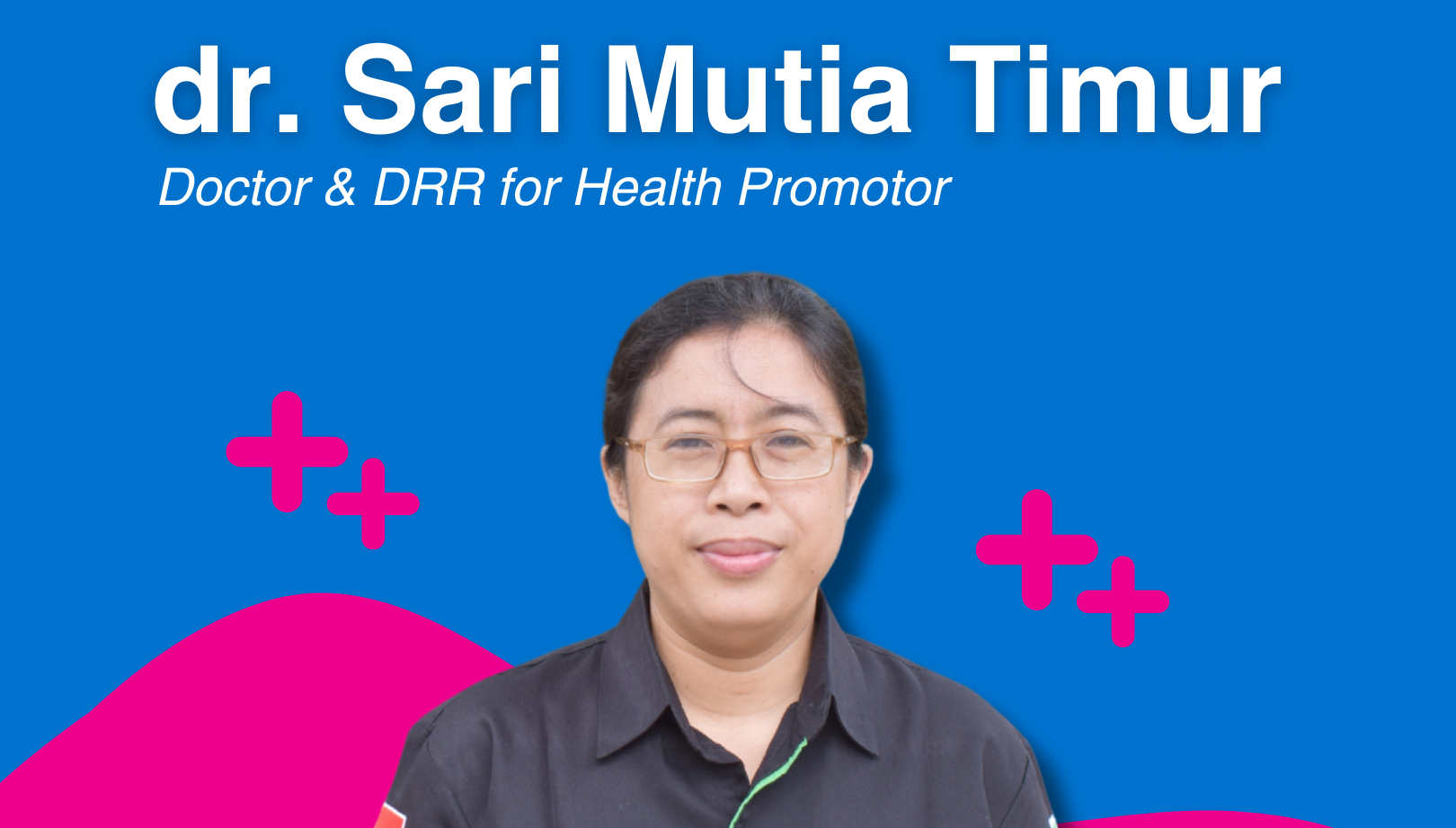
dr. Sari, Promoting Disaster Risk Reduction for Health through Women’s Leadership
29 July 2023
“Women today are more advanced, resilient, open-minded, detailed, and highly committed. Unfortunately, women’s opinions and input are sometimes invisible. I encourage them not to be afraid to speak up, to convey their needs and be the solution in disaster risk reduction efforts.”
dr. Sari Mutia Timur – Doctor & DRR Promoter for Health.
For more than 20 years, Dr. Sari Mutia Timur, or Doctor Sari (48 years old), has been working in DRR for health, especially healthcare. As a doctor, Sari encourages preparedness in healthcare, both in terms of infrastructure, facilities, access, and health workers. As a doctor, Sari encourages preparedness in healthcare, both in terms of infrastructure, facilities, access, and health workers.
“If hospitals or health institutions are unprepared, how can they provide public health?” Not only major hospitals, but lower levels such as community health centers and clinics must have preparedness,” said Sari.
Health workers are also her concern. She trained health workers with disaster preparedness training and made contingency plans. Hopefully, health workers can identify potential disasters and respond to the contingency plans.
“At the beginning of a disaster, health workers are needed but not being noticed. Most of the time, health workers are not fully prepared because they also have to evacuate their family members,” said Sari, who currently serves as Deputy Director of YAKKUM Emergency Unit (YEU).
Her efforts in disaster risk reduction in Indonesia are also shared at global forums. In 2019, she flew to New York, United States, to speak at the UN Headquarters regarding the elderly, a vulnerable group left behind in disaster situations.
During the Covid-19 pandemic, she spoke out loudly to various international forums about the importance of involving religious leaders in tackling doubts about using the Covid-19 vaccine in the community.
“Religious leaders play a significant role in the use of the covid vaccine. They can counter the negative assumptions related to the use of vaccines,” She said.
Champion of Inclusion in Disaster Risk Reduction and Emergency Response
that older people and PWDs are often left behind and neglected in disaster response. Dr. Sari Mutia Timur (48), a dedicated doctor and advocate for Disaster Risk Reduction (DRR) in the healthcare sector, has been making waves with her inclusive approach to involving the older people and people with disabilities (PWDs) in disaster risk reduction and emergency response efforts.
Dr. Sari has long observed that older people and PWDs are often left behind and neglected in disaster response. One of the main issues is the lack of attention to accessibility for these groups during disasters. Many evacuation locations and shelters do not consider their specific needs, making it difficult for them to reach evacuation points and receive dignified assistance.
“For example, during the Merapi eruption in 2010, evacuations were conducted using trucks, which posed significant challenges for older people, as they had to be carried and pushed. It was an inhumane situation. Moreover, in the shelters, the needs of older people and PWDs were often overlooked, despite their different requirements compared to other evacuees,” she stated.
Therefore, dr. Sari advocates involving older people and PWDs in disaster risk reduction and emergency response efforts. Along with the YAKKUM Emergency Unit (YEU), she has empowered older people and PWDs with knowledge about disaster risk reduction and provided training to help them voice their needs more effectively.
They are given opportunities to provide safe and comfortable feedback, ensuring the assistance is accurate and effective. “We train them to voice their needs so that they can provide valuable input for a more inclusive disaster response,” she added.
In addition, dr. Sari ensures that older people and PWDs are involved into the monitoring and evaluation process. They are given opportunities to provide safe and comfortable feedback, ensuring the assistance is accurate and effective.
In various disaster risk reduction and emergency response efforts, Yayasan Plan International Indonesia (Plan Indonesia) collaborates with dr. Sari involves older people and PWDs, especially women, to ensure that their needs, including those of older people and disabled, are considered to promote a more gender-responsive approach. Plan Indonesia ensures that the needs of older people and PWDs, especially women, are considered to promote a more gender-responsive approach.
Dr. Sari emphasizes that older people and disabled women face double challenges. They are often not included in crucial meetings and decisions.
“During meetings, such as the MUSREMBANG, older people and disabled women are either not invited or not given the opportunity to speak. Consequently, many of their needs are not communicated, such as the difficulties they face in accessing toilets, far and dark which are often poorly lit and riskier for them,” dr. Sari said.
In practice, dr. Sari has illustrated several successful examples involving older people and PWDs. They are included in the emergency response team and empowered older people individuals are made peers to motivate others. Moreover, the application of inclusive rapid need assessments helps identify the needs and challenges faced by older people and PWDs
At the global level, this issue is gaining more significant attention. During a speech at a United Nations meeting in the UN Headquarters in New York, USA, in 2019, dr. Sari boldly stated that involving older people and PWDs is not only to prevent them from becoming most at risk groups but also because their experiences and capacities can provide valuable contributions to enhancing disaster response.
“Involving older people and PWDs in disaster risk reduction and emergency response brings great benefits for everyone. With inclusive program designs, improved accessibility, and active participation from all groups, disaster response can become more comprehensive and benefitted for all groups,” she added.
Dr. Sari has shown extraordinary dedication to promoting the inclusion of older people and PWDs in disaster risk reduction. Her role as a doctor and DRR advocate opens the door for positive change and better disaster response for all groups, without exception. Through her initiatives, disaster response becomes more inclusive and accessible for everyone, helping to create a safer world ready to face disaster risks.
—
Support Sari in The Women’s International Network for Disaster Risk Reduction (WIN DRR) Leadership Awards 2023. This Award recognizes women’s achievements in disaster risk reduction across the Asia-Pacific region. The awards are part of UNDRR’s flagship women’s leadership initiative the Women’s International Network for Disaster Risk Reduction (WIN DRR), supported by Australian Aid.
Nominate Dr Sari via: forms.office.com/r/zSMxHigYCw
The WIN DRR Leadership Awards recognize women’s achievements in disaster risk reduction across the Asia-Pacific region and will be presented on 13 October 2023 – the International Day for Disaster Risk Reduction – in Manila, the Philippines.


