

Clean Water for Mama Reta and Eci
25 February 2025
“On one morning, Eci left early to the river to wash and fetch water, but she came home right away. I asked, why? She said she’s scared because there was no one at the river,” told Mama Reta (49).
When she saw her daughter came back home with pale face and shortness of breath, Mama Reta’s heart shrinked. Her mind was filled with bad images. Was there something there? A venomous snake slithering through the undergrowth? Or worse, something invisible that could only be felt but not explained?
In this village, the myth of the spring’s inhabitants goes back a long way. The story has been passed down from generation to generation. People believe that if someone goes there alone, they could be misled, detained, or even taken away by the supernatural inhabitants of the spring. In addition, the road to the river is lined with dense undergrowth, where scorpions and venomous snakes hide. And most dreaded of all, rumors of the ata dora-a mysterious figure said to kidnap those who walk alone.
But there was no choice. They had to fight the fear of myths and rumors. Every morning and evening they must still go to the river. Because, returning home with a clean body and enough water is a simple happiness that they strive for every day. This routine has become part of the life they have lived all this time. There is fear, there is struggle, but there is also joy.
Surviving with Spring Water “Pela”
For a long time, the people of this village have depended on clean water from “Pela”, a spring hidden among the trees on the banks of the river that surrounds this small village. Every morning, when the sky is a little lighter, the children have to rush to bathe in the river before school. By 05.00 to 05.30 am, they have already left for the river. Meanwhile, at home, mothers are busy preparing breakfast for their children.
“Later, after they go to school, it’s our turn, the mothers, who go to the river to wash clothes, bathe, and take the water home. The men have to go to the garden and feed the cattle,” said Mama Reta.
The path is narrow, only enough for one adult. The route goes around a ridge with a steep slope. At some points, the ground is slippery and rocky, making every step to be measured carefully. The slightest misstep, the risk of slipping is huge.
“When we go downhill, we go back uphill while carrying water and washed clothes. If the rainy season floods the river, we can collect rainwater for use. It’s been like this since I was a child,” Mama Reta recalls.
For children like Eci (14), searching for water is an inevitable routine. They happily endure this grueling struggle. Armed with detergent and empty jerry cans, every morning she and her friends go down to the river to bathe and wash their clothes. When they were done, they had to return with their washed clothes and jerry cans of clean water.
“We came back from hiking. If we are tired, we rest first, then walk again. We get home, get ready, and then go to school. Sometimes we were late. If we are late, we are punished by being told to kneel down,” said Eci with a laugh.
At school, access to water is limited. The water they bring is the only source for washing hands, washing faces, and even flushing toilets. Each student brings their own water, pouring it into a container in the school toilet. If the supply runs out, teachers and some students have to work together to go to the river.
Although it sounds loud, Eci and her friends still do it with cheerful faces. They were used to it. For them, carrying a jerry can of water to school is not suffering, just another part of life’s challenges that must be faced. Together with the teachers at school, they work together to provide enough water to make their activities in the school area more comfortable. Underneath it all, they are just children who want to stay in school, play, learn and grow.
Father, Field, and Clean Water
In patriarchal agrarian cultures, clean water is often considered a domestic task that women are responsible for in addition to cooking, washing and cleaning the house. But here, this burden also rests on the shoulders of men, although it is rarely discussed.
Sevrin (32) is the head of one of the hamlets in this village. Since morning, he has been in the fields, feeding the cattle, hoeing, planting, tending the garden that is the source of his family’s livelihood. However, he can’t work until dusk like other farmers. At 2pm, he has to leave the field, return home, and prepare to go to the river with his wife.
“If only one person goes, it’s not enough. There are three of us at home, father, mother and child. It has to be the father and mother who go to the river, so that there is enough water for drinking, cooking, and toilet needs at night. If the wife goes alone, she will get tired and sick.”
To carry water from the river optimally, Sevrin and his wife usually use Bolakoli, a traditional water carrier woven from palm leaves. Two five-liter jerry cans of water would be strapped to their backs, while their hands would each carry another jerry can. With the help of this tool, climbing is honed easier, with a maximum load of water.
“One trip to the river and back takes at most an hour, if we don’t carry it that way, we are tired if we have to go down to the river twice,” he said.
The condition of clean water has long received special attention from the local community. When Sevrin was a child, his father and other parents had tried to build pipelines and reservoirs independently. They worked together to build clean water pipelines, hoping to bring water closer to the village. However, the effort did not last long due to a lack of planning and maintenance capacity.
“At that time around 2002, it was also our own people who installed the pipes, so the turn was far away. The water also dried up quickly. Finally, this water was also finished, in less than three months,” he recalls.
Plan Indonesia’s Efforts and Many Challenges
Plan Indonesia’s efforts through the Program Implementation Area (PIA) Nagekeo to bring clean water to this village were not easy. Careful planning involving technical consultants and water experts is still hampered by various technical and social obstacles.
“Of all the efforts, the most difficult is when we need a very large amount of electricity to raise water to the village. The existing meters are not able to support the pump because we use the antigravity method. After engineering and testing, it turned out that we needed 10,600-watts of power for the pump to lift water to the reservoir,” said Kosmin (48), Plan Indonesia staff in Nagekeo who is responsible for fulfilling children’s rights to access clean water.
After the electricity meter was upgraded as needed, the river overflowed due to the rainy season which coincided with the installation of the pump. As a result, materials such as gravel and sand were carried away by the current, entered the pump, and caused the pump to catch fire.
This seemingly never-ending technical obstacle triggered social turmoil. People who still believed in mystical things began to doubt the success of this project. Community participation began to decline. Some became apathetic and reluctant to engage in community service. Plan Indonesia officers even experienced rejection and expulsion from some residents.
Faced with this situation, Philip and John, two Plan Indonesia field staff, immediately took strategic advocacy steps to revive the community’s spirit of gotong royong. The right momentum came when the replacement hydrant pump arrived at the location. Plan Indonesia’s hard work with the local community finally succeeded in raising the water from Pela to the village.
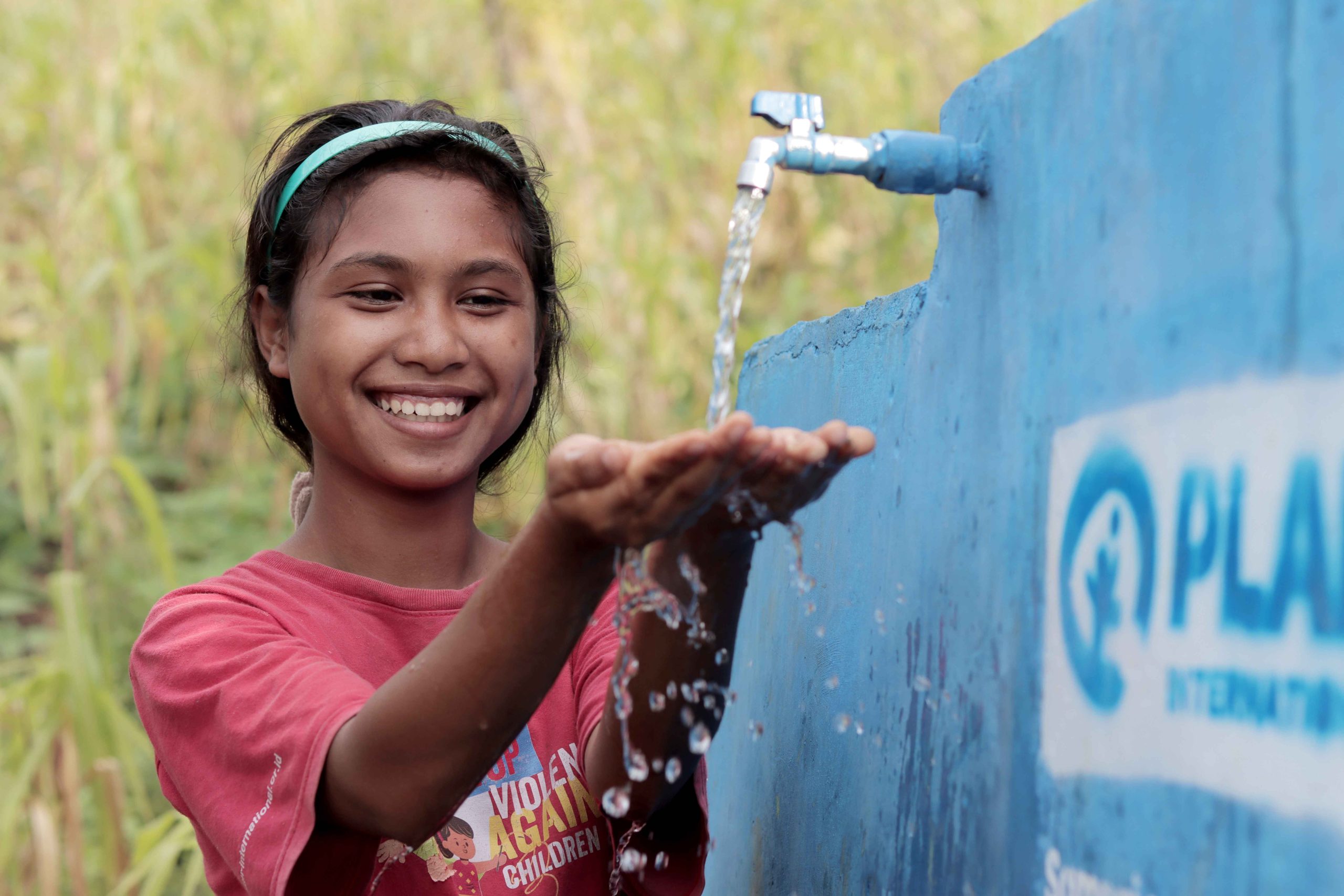
Since then, this small village in Nagekeo has recorded a new history. Public hydrants scattered throughout the village began to function, distributing clean water to all residents. The distance from the house to the nearest public hydrant is only 5 to 20 meters. In addition, the local community also formed a Village Drinking Water Management Agency that is still receiving assistance from Plan Indonesia. Gradually, this group will be increased in capacity related to the management, maintenance, and development of this existing clean water infrastructure.
Eci, Mama Reta, and Clean Water Facilities at Hand
Mama Reta, holding her youngest child, two years old, recalls that day with tears in her eyes. The day her prayers and dreams came true in the form of a broncaptering, a 10,600-watt electricity meter, a pair of storage and distribution reservoirs, pipelines, and 14 public hydrants.
“Now, water is near the house. The children don’t have to bathe in the river anymore, thank you, we thought we would never be able to do this, but now we have,” said Mama Reta.
Eci, who was standing next to her mother, smiled, “We don’t go to the river anymore, so in the morning I like to help my mom cook first, then I take a shower and get ready for school. I’m not late anymore, and the teacher doesn’t tell us to bring water to school anymore.”
Author: Alfred Ike Wurin | Editor: Moudy Alfiana | Photo: Plan Indonesia/Alfred Ike Wurin


