

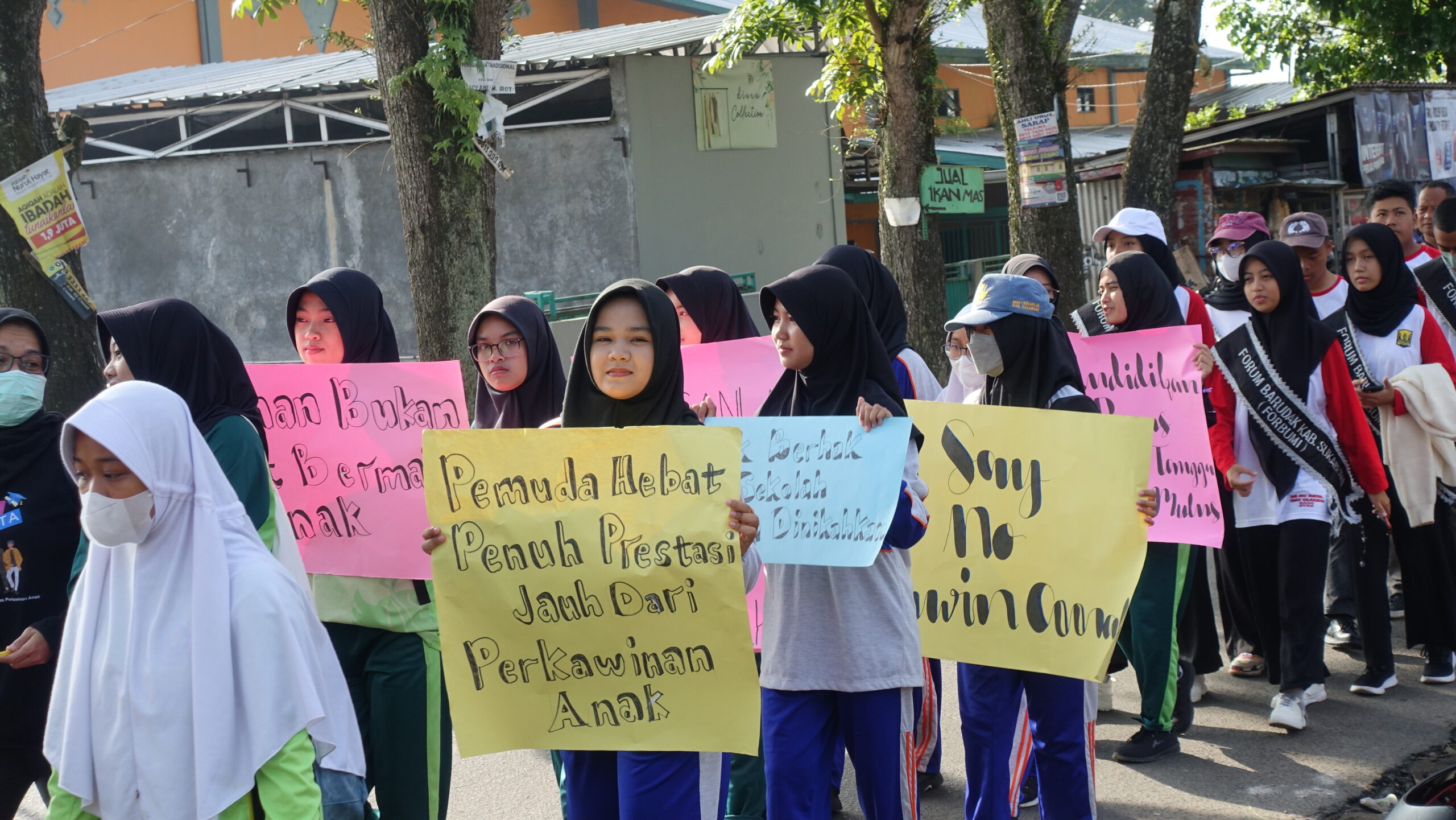
Child Marriage Dispensation, Supporting or Hindering?
01 June 2023
Unfortunately, the Religious Courts recorded that in 2022, there were 55,000 dispensation requests submitted by the community. Although this figure is lower than in 2021, which reached 66 thousand applications, it shows that there is still a high tendency for people to practice child marriage in Indonesia. Child Marriage Dispensation Becomes a Gap Child Marriage Increases
The enactment of Law (UU) Number 16 of 2019 concerning Amendments to Law Number 1 of 1974 concerning Marriage has pushed the minimum age of marriage to 19 years for men and women, which was previously only 16 years old. However, in article 7 paragraph 2, the government seems inconsistent in rejecting child marriage, because it provides a loophole by presenting a child marriage dispensation policy. The loophole is contained in Supreme Court Regulation (Perma) No. 5 of 2019 concerning Guidelines for Adjudicating Marriage Dispensation. Article 1 paragraph 6 of this Perma explains, Marriage Dispensation is the granting of marriage permission by the court to prospective husband and wife who are not yet 19 years old to enter into marriage.
In West Lombok District, West Nusa Tenggara (NTB) and Sukabumi District, West Java, it was found that child marriage dispensation decisions were based on urgent reasons due to pregnancy or siri marriage. Another factor is the strong public misunderstanding of the “Merarik” culture, which is one of the Sasak traditions in Lombok that allegedly allows men to take away women to marry. Thus, this Merarik culture is often used as a mode of “allowing child marriage” and can be a cause that influences the decisions of religious judges. This fact shows that marriage dispensation decisions have not considered the best interests of the child. Judges are still caught up in the bias between certain cultural values and do not pay attention to how children’s rights are deprived after the dispensation is granted.
In fact, Merarik aims to protect, respect and uphold the rights of women, because women are given full authority in determining when and with whom they will marry. In principle, Merarik Customary Law in the Sasak tradition has provisions including: “Customary Law must not conflict with higher laws, namely religious and state laws;” and “There must be no disagreement between the two parties. If one of the bride and groom does not want to get married then he/she has the right to be protected by Customary Law.” (Raden M. Rais-Majelis Adat Sasak Paer Bat; 2018). Counteracting community misconceptions, in 2021, the Regent of West Lombok in collaboration with DP2KBP3A West Lombok and several Non-Governmental Organizations (NGOs) including Yayasan Plan International Indonesia (Plan Indonesia) has created the Gerakan Anti Merarik Kodeq (GAMAK) Program as an effort to prevent child marriage and stunting.
Through the Stunting Prevention, Adolescent Health, End of Violence Against Children and Youth (SPACE) program, Plan Indonesia also presents the Gema Cita initiative in preventing child marriage, teenage pregnancy, and violence against children. Specifically, in two assisted areas, namely West Lombok District and Sukabumi District, through a peer educator approach. Not stopping there, Plan Indonesia through Gema Cita also seeks to create a supportive environment for children and young people. The goal is for them to participate positively, meaningfully, and for their voices to be heard and considered by adults. The way to do this is by optimizing the function by providing assistance to Child Friendly Schools (SRA) and PATBM through various trainings and regular mentoring. Currently, SRHR’s discussion activities in Sukabumi and West Lombok districts have trained approximately 4,200 children and young people, 310 of whom are peer educators, to increase their agency regarding the rejection of child marriage.
These good practices need to be carried out by local and central governments for sustainable impact. In addition, it is also necessary to optimize the involvement of meaningful participation of adolescents and young people. This means that the presence of children and young people is not only to fulfill quantity requirements, but their ideas and ideas also need to be heard and considered to become a decision related to their problems. Child marriage is a clear violation of children’s rights and includes violence against children. They are victims of the will of people in their environment or the lack of knowledge, understanding of themselves, boundaries and accountability, to the risks and impacts of child marriage. So, let’s join hands, work together, work together with more integrated collaboration, assume a stronger and more responsible role. Together, let’s eliminate child marriage in Indonesia!


