

Breaking the Chains of Child Marriage
06 November 2024
In Indonesia, the climate crisis means more girls are being married off before the age of 18 as their families face increasing financial pressures. This has devastating consequences, leaving girls vulnerable to violence, reducing their access to education and economic opportunities, and increasing the risk of complications during pregnancy and childbirth.
“Whenever a family has money problems, the first thing they think of in my village is to marry off their daughter, which stops her education,” says 16-year-old Astriyati, who lives in a small village in rural Nagekeo regency.
Indonesia is highly vulnerable to the effects of climate change. As temperatures rise, more moisture evaporates, exacerbating extreme rainfall and flooding and leading to more destructive storms. Some of the most vulnerable parts of the country are also some of the most densely populated, and it is often the poorest people in society who bear the brunt.
Extreme weather events exacerbate poverty, and child marriage is seen as a way of reducing the economic burden on households. But Astriyati knows that when girls are married early, they are usually expected to abandon their education and dreams. “As a girl, I know that girls have as much potential as boys, but in our culture, people see and put boys first.”
Through our work with multiple partners, Plan International Indonesia is committed to preventing child marriage in Astriyati’s community. We are focusing on promoting the rights of children and adolescents to delay marriage and strengthening service systems, including adolescent health and education.
By working with young people to give them the support they need to become today’s leaders, Astriyati says she is using the skills she has learned to encourage other girls and young women in her community to set goals, plan the steps needed to achieve them, and take control of their own futures.
“Child marriage has been common in our community and culture, but now we need to stop it because it is a burden on women and girls,” Astriyati explains. “I have a dream to prevent all child marriages in my community. I want girls to have big dreams, not to have their dreams stopped by marriage.
By raising awareness of issues such as menstrual health and hygiene, reproductive health and the negative consequences of child marriage, Astriyati is empowering other girls to make good decisions about their future – including not marrying before they have completed their education.
She realises that without creating a platform for adolescent especially girls to acknowledge their own challenges, to build their capacity and identify their own solutions, it will be difficult to address the challenges. She believes that children and youth have the capacity to protect themselves and to achieve set goals however they require constant support. This support, however, often dries up once they move to tertiary factors where they are presented with opportunities to make wider choices for themselves.
To support the capacity of adolescent to respond to reproductive health and ending child marriage-related challenges, through increased knowledge and skills, she and her friends identify and collaborates with Plan staffs and local stakeholders who have demonstrated capacity in the various targeted areas. She prides herself as a being a learner and enhances her own capacity to provide cutting edge reproductive service through networking with Plan in Nagekeo.
Due to her increased capacity in reproductive health and ending child marriage-related issues, Astriyati also participates in podcasts on adolescent reproductive health and ending child marriage, which helps her reach her target audience of girls and young people and encourages them to make their own life choices.
“Through awareness sessions in our village, parents and children are made aware of the importance of ending child marriage and managing reproductive health,” says Astriyati. “This has given them hope because there are solutions for a better future for the children.”
Leading the example for adolescents, Astriyati’s initiative is increasingly gaining people recognition due to her ability to impact on adolescents by changing their mind-sets. She has thus far made considerable progress in addressing adolescents-specific reproductive health and child marriage issues through adopting The GALS (Gender Action Learning System) approach.
The GALS (Gender Action Learning System) approach integrates gender strengthening activities into Plan’s programmes and projects to support and guide girls and boys, especially sponsored children, to become youth leaders. This self-leadership starts with setting goals and planning, followed by identifying opportunities and challenges to achieve these goals.
The method provides a pathway for projects to mainstream gender equality by addressing the power relations at the root of inequality in order to achieve our ambitions for gender equality and women’s empowerment. An important feature of GALS is that it motivates behavioural change in households, which in turn drives wider change through peer education by young people.
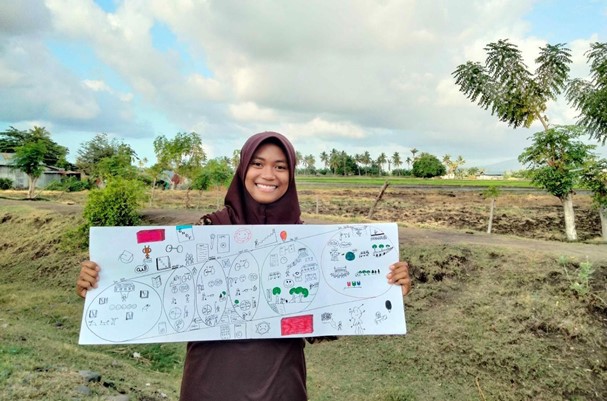
Using GALS approach, Astriyati mapping her personal relations and emotional-economic aspects to identify social network when her GALS message can be delivered voluntarily to share her planning of ending child marriage, analyse which relation that can support and challenge her dream, determine which ways to be changed in that relations to achieve her dream and emphasize her actions to support her journey to achieve her dream and build her leadership strategy to gender equality and girls empowerment.
She believes every person is a leader of change which GALS approach shows by showing interest and feeling of individual ownership of having dream and participative. This meaningful approach encourages change lead to gender transformative to connect change at individual level, household level and the community level where the sponsored children live like Astriyati and other adolescents.
“To reduce the rate of child marriage, the key is to ensure that all girls have access to and can finish their education. It is also improving the capacity of girls to voice their rights mainly related to gender equity and they are able to be leaders to encourage gender equity at family and community” says Astriyati.
Astriyati’s plan of action be her tool to monitor her progress in campaign of ending child marriage in her community and encourage other adolescents to follow her lead to achieve their dreams.


